A free, ready-to-run toolbox talk for construction crews. Read it aloud at your morning huddle; it takes about ten minutes. Leer en español →
OSHA standard: 29 CFR 1926 Subpart P (1926.650–652)
At a glance
- A cubic yard of soil weighs as much as a pickup truck
- 5 feet deep = protective system, no exceptions
- Ladder within 25 feet of every worker
- Competent person inspects daily — and after every rain
Introduction
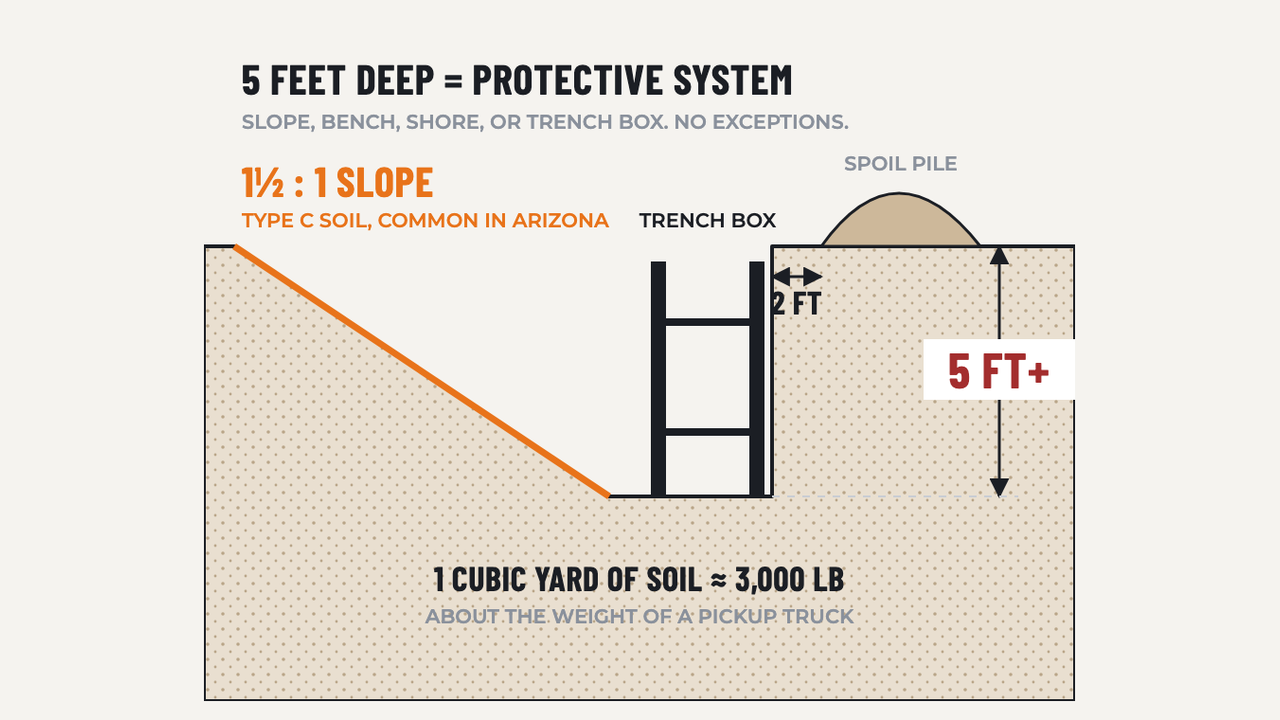
A collapsing trench wall gives no warning and no second chance: one cubic yard of soil weighs around 3,000 pounds, and a worker buried to the chest usually can't be pulled free without equipment. Trench deaths are rising nationally, and almost every one was preventable with a protective system that was sitting on site. Today's talk covers when protection is required, what counts as protection, and the daily checks that keep a trench legal and safe.
The Rules That Save Lives
- 5 feet or deeper: sloping, benching, shoring, or a trench box — always
- Under 5 feet still needs protection if the competent person sees any sign of instability
- Ladder, ramp, or steps within 25 feet of every worker in trenches 4 feet or deeper
- Spoil piles, tools, and equipment stay at least 2 feet back from the edge
Protective Systems
- Slope or bench to the angle the soil type requires — Arizona's dry, granular soil is often Type C, the least stable
- Trench boxes protect only the space inside them — stay inside the box
- Shoring goes in from outside the trench, top down; comes out bottom up
- Water in the trench, or soil that's been wet, changes everything — stop and reassess
The Competent Person
- Inspects the trench daily before entry, after rain, and after anything changes
- Has the authority to stop work and pull the crew — use it
- Classifies the soil and picks the protective system
- If you don't know who the competent person is today, ask before you enter
Other Trench Killers
- Call 811 before digging — struck utilities mean electrocution, explosion, or flooding
- Atmosphere: deep trenches near sewers, landfills, or tanks may need air testing
- Equipment working the edge can trigger collapse — keep it back
- Never enter an unprotected trench to "grab something real quick" — that's the sentence people die saying
Key takeaways
- 5 feet = protection, period
- A trench box only protects inside it
- Ladder within 25 feet, spoils 2 feet back
- Daily competent-person inspection, plus after rain
- 811 before you dig
- Never enter unprotected — not even for a second
Questions for your crew
- Trenches 5 feet or deeper require sloping, benching, shoring, or a trench box — one cubic yard of soil weighs as much as a pickup truck.
- Keep a ladder, ramp, or steps within 25 feet of every worker, and keep spoils and equipment at least 2 feet back from the edge.
- A trench box protects only the space inside it — stay inside the box.
- The competent person inspects daily, after rain, and after anything changes; know who it is before you enter.
- Call 811 before digging — struck utilities mean electrocution, explosion, or flooding.
- Never enter an unprotected trench, not even to grab something real quick.
Run this talk with crew sign-offs
This talk is part of the Safirst ONE toolbox talk library, in English and Spanish. Your foreman picks the talk in the app, the crew signs from their own phones by scanning a QR code, and the signed record files itself in your Docs Locker. Talk to Safirst to get it for your crews.