A free, ready-to-run toolbox talk for construction crews. Read it aloud at your morning huddle; it takes about ten minutes. Leer en español →
OSHA standard: 29 CFR 1910.147 · 1926.417
At a glance
- Machines that start unexpectedly kill and maim
- De-energize, lock, tag, and VERIFY before any service work
- One worker, one lock, one key
- Only the person who hung the lock removes it
Introduction
Lock-out/tag-out exists because machines don't know you're inside them. A breaker gets flipped, a valve gets opened, stored pressure lets go — and the worker clearing a jam or changing a blade takes the full force. LOTO is the procedure that guarantees equipment stays dead while you work on it. Today's talk covers the steps, and the one rule that makes the whole system work: your lock, your key, your life.
What Counts as Energy
- Electrical is the obvious one — but hydraulic pressure, air pressure, spring tension, gravity (raised parts), and heat all count
- "Off" is not "safe": a switched-off machine can still be re-energized by someone who doesn't know you're there
- Stored energy stays after the power is cut — capacitors, accumulators, compressed springs, elevated components
The Steps
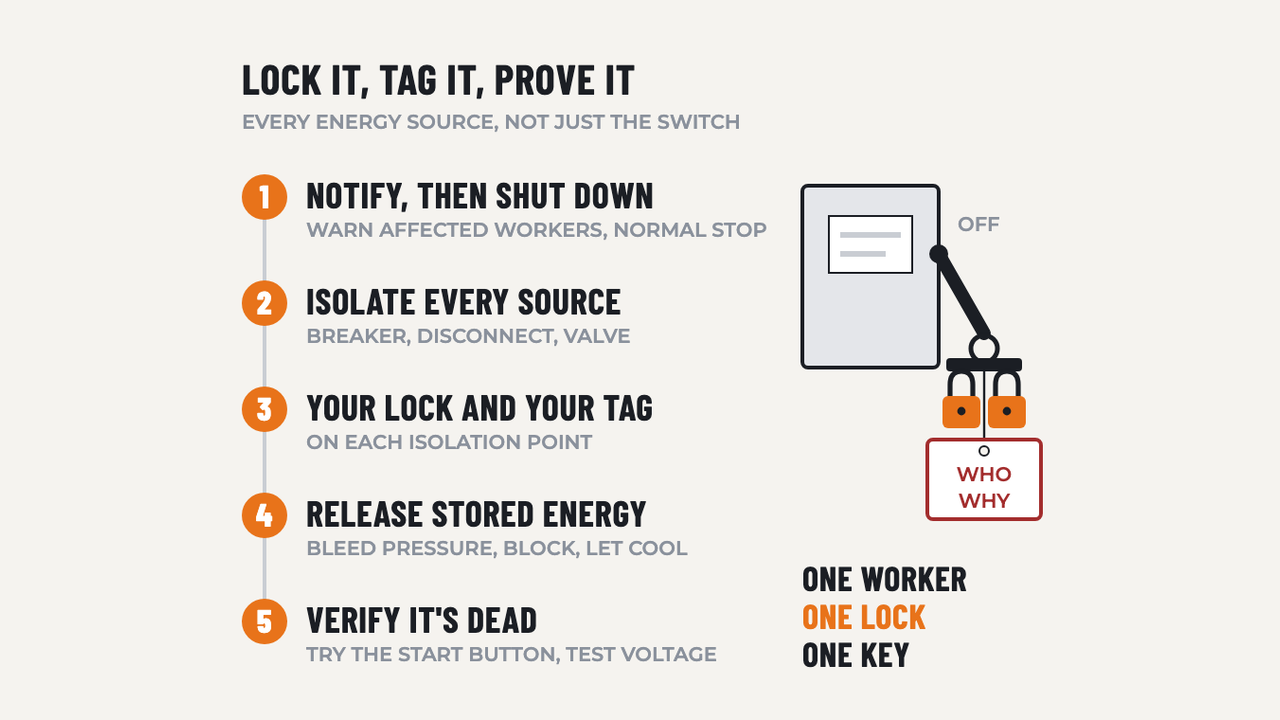
- Notify affected workers, then shut down by normal procedure
- Isolate every energy source: breaker, disconnect, valve — not just the start button
- Hang YOUR lock and tag on each isolation point; the tag says who and why
- Release or restrain stored energy: bleed pressure, block raised parts, let things cool
- VERIFY: try the start button, test for voltage — prove it's dead before hands go in
The Rules That Keep It Working
- One worker, one lock, one key — everyone working on the equipment hangs their own
- Only the person who hung a lock removes it; a supervisor override is a formal, documented last resort, never a favor
- A tag without a lock is a request, not protection — lock whenever the equipment accepts one
- Shift change? Locks transfer person-to-person, never an empty gap
When It Applies to You
- Clearing jams, changing blades or bits, greasing, repairs, anything past a guard
- If your task removes a guard or puts any part of you in the danger zone — that's LOTO, even for "a two-minute job"
- Not trained or not authorized? You don't service it — get the person who is
Key takeaways
- Every energy source, not just the switch
- Lock it, tag it, then PROVE it's dead
- Your lock, your key — nobody else's hands on it
- Stored energy counts: bleed, block, restrain
- Two-minute jobs get full LOTO too
- Locks transfer at shift change, never lapse
Questions for your crew
- Machines don't know you're inside them — isolate every energy source before service work: electrical, hydraulic, air, spring, and gravity.
- Hang your lock and tag on each isolation point, then VERIFY zero energy — try the start button, test for voltage — before hands go in.
- One worker, one lock, one key — everyone working on the equipment hangs their own, and only the person who hung a lock removes it.
- Bleed pressure and block raised parts — stored energy remains after the power is cut.
- Two-minute jobs get full LOTO too: jams, blade changes, anything past a guard.
- At shift change, locks transfer person-to-person — never an unprotected gap.
Run this talk with crew sign-offs
This talk is part of the Safirst ONE toolbox talk library, in English and Spanish. Your foreman picks the talk in the app, the crew signs from their own phones by scanning a QR code, and the signed record files itself in your Docs Locker. Talk to Safirst to get it for your crews.