A free, ready-to-run toolbox talk for construction crews. Read it aloud at your morning huddle; it takes about ten minutes. Leer en español →
OSHA standard: 29 CFR 1926.1153
At a glance
- Cutting, grinding, or drilling concrete and stone makes dust that scars lungs permanently
- Silicosis is incurable — prevention is the only treatment
- Wet methods and vacuum attachments first; respirators where required
- Never dry-sweep or blow silica dust
Introduction
Every time we cut block, grind concrete, drill anchors, or sweep up after, we can put respirable crystalline silica in the air — particles a hundred times smaller than sand, invisible at the size that matters, that scar lung tissue permanently. Silicosis doesn't announce itself; it builds over years and it doesn't reverse. The good news: this hazard is almost entirely controllable with water, vacuums, and habits. Today's talk covers which tasks make silica dust and how we knock it down.
Where It Comes From
- Concrete, block, brick, mortar, stone, tile — cutting, grinding, coring, drilling, chipping, jackhammering
- Abrasive blasting, demolition of masonry, and yes, cleanup of the dust everyone else made
- The dangerous fraction is the dust you CAN'T see hanging in the air — a visible cloud means it's already bad
- Arizona bonus: our native dust adds to the load — don't stack hazards
Controls That Work
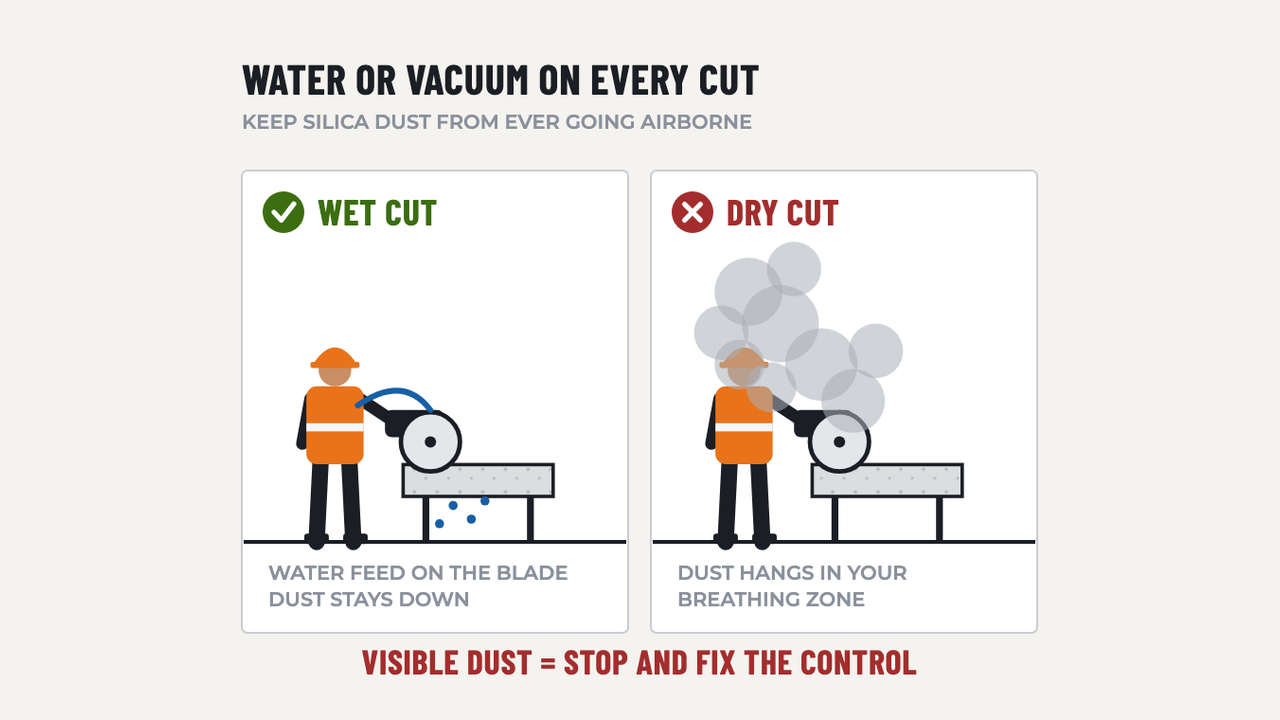
- Wet methods first: integrated water feed on saws and drills keeps dust from ever going airborne
- Vacuum dust collection (with HEPA) on grinders and drills where water doesn't fit — emptied per the manufacturer, not when overflowing
- Follow the task card (OSHA Table 1) for your tool: it names the control and whether a respirator is needed for your hours of use
- Position yourself upwind; enclose or barricade dusty work away from other trades
Respirators
- Where Table 1 or the plan requires one, it's typically at least an N95 — fit-tested, clean-shaven at the seal, worn the whole task
- A dust mask hanging under your chin filters nothing
- Respirators are the LAST layer — water and vacuums do the heavy lifting
Cleanup & Habits
- Never dry-sweep, never blow down with compressed air — that re-launches everything into your breathing zone
- HEPA vacuum or wet-sweep instead
- Wash hands and face before eating or drinking; don't carry the dust home on your clothes if a change is practical
- If your task suddenly makes visible dust, stop and fix the control — water off? bag full?
Key takeaways
- Silica scars lungs permanently — no cure, only prevention
- Water or vacuum on every cut, grind, and drill
- Follow the task card for your tool and hours
- Respirator fit-tested and sealed, where required
- Never dry-sweep or air-blast dust
- Visible dust = stop and fix the control
Questions for your crew
- Cutting, grinding, or drilling concrete, block, and stone releases silica dust that scars lungs permanently — silicosis has no cure, only prevention.
- The dangerous dust is the fraction you can't see — a visible cloud means it's already bad.
- Use wet methods or HEPA vacuum attachments on every cut, grind, and drill, and follow the task card for your tool and hours.
- Where a respirator is required, it's fit-tested and sealed — a dust mask under your chin filters nothing.
- Never dry-sweep or blow down silica dust — HEPA vacuum or wet-sweep instead.
- If your task suddenly makes visible dust, stop and fix the control — water off, bag full, something failed.
Run this talk with crew sign-offs
This talk is part of the Safirst ONE toolbox talk library, in English and Spanish. Your foreman picks the talk in the app, the crew signs from their own phones by scanning a QR code, and the signed record files itself in your Docs Locker. Talk to Safirst to get it for your crews.