Toolbox Talks
Caught-In / Between Hazards Toolbox Talk
Published · 3 min read
A free, ready-to-run toolbox talk for construction crews. Read it aloud at your morning huddle; it takes about ten minutes. Leer en español →
OSHA standard: Focus Four · 29 CFR 1926 Subparts O, P & Q
At a glance
- A Focus Four killer: machinery, loads, vehicles, and pinch points
- Never put your body between something moving and something fixed
- Guards stay on; lock out before reaching in
- Nothing overhead held only by hydraulics
Introduction
Caught-in and caught-between incidents are one of construction's Focus Four killers: workers pulled into rotating equipment, pinned between a backing truck and a wall, crushed under equipment that dropped when a hydraulic line failed. These incidents are fast and violent, and the common thread is body position — the victim was somewhere a moving object could reach them. Today's talk is about seeing pinch points and crush zones before you're in one.
Where It Happens
- Rotating equipment: augers, mixers, drills, saws — loose clothing, gloves, and hair get pulled in faster than you can react
- Between vehicles or equipment and fixed objects: walls, columns, stacked material, other machines
- Under raised equipment, beds, or loads that were never blocked
- Trench and excavation collapses — the same hazard family (covered in its own talk)
Machine Guards & Moving Parts
- Guards over belts, gears, chains, and blades stay on — a missing guard is a stop-work condition
- If a guard comes off for maintenance, the machine is locked out first
- No loose clothing, jewelry, or drawstrings near rotating parts; tie back long hair
- Never reach into a running machine to clear a jam — shut it down, lock it out, then clear it
Equipment & Vehicles
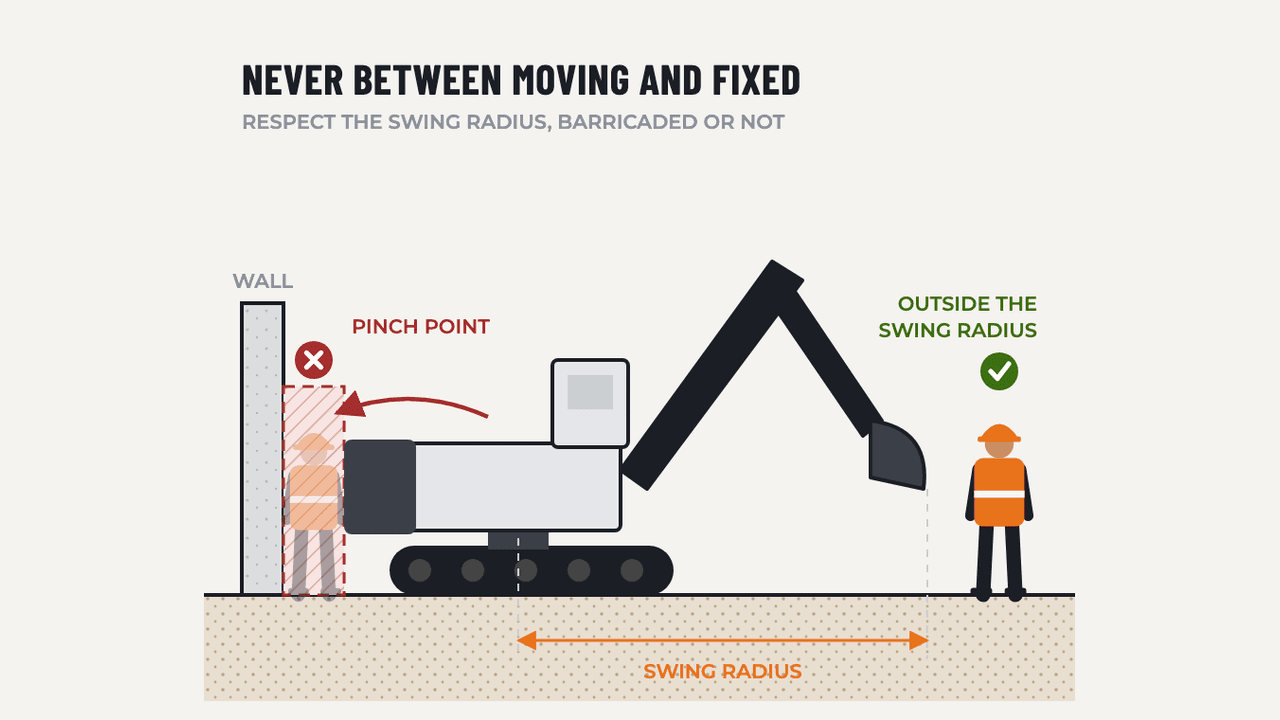
- Know the swing radius of excavators and crane counterweights — it should be barricaded; stay out either way
- Never position yourself between a backing vehicle and anything fixed
- Make eye contact with the operator before entering their zone; assume they can't see you until they show you they can
- Before approaching parked equipment: bucket down, blade down, wheels chocked
Blocking & Stored Energy
- Never work under a raised bed, boom, or bucket supported only by hydraulics — lines fail without warning
- Jacks lift; rated cribbing and stands hold — never trust a jack alone
- Release stored energy (springs, pressure, gravity) before putting hands into equipment
Key takeaways
- Position first: never between moving and fixed
- Guards on; lockout before reaching in
- Respect the swing radius, barricaded or not
- Blocked, chocked, and grounded before you approach
- Dress for rotating equipment
- Most caught-betweens are shortcuts — slow down
Questions for your crew
- Never put your body between something moving and something fixed — position is what decides these incidents.
- Machine guards stay on; if a guard comes off for maintenance, the machine is locked out first.
- No loose clothing, jewelry, or drawstrings near rotating equipment, and tie back long hair.
- Never reach into a running machine to clear a jam — shut down, lock out, then clear.
- Stay out of swing radii, and never stand between a backing vehicle and a fixed object.
- Never work under equipment held only by hydraulics — use rated blocking or cribbing, and release stored energy first.
Run this talk with crew sign-offs
This talk is part of the Safirst ONE toolbox talk library, in English and Spanish. Your foreman picks the talk in the app, the crew signs from their own phones by scanning a QR code, and the signed record files itself in your Docs Locker. Talk to Safirst to get it for your crews.