Toolbox Talks
Roofing Safety Toolbox Talk
Published · 3 min read
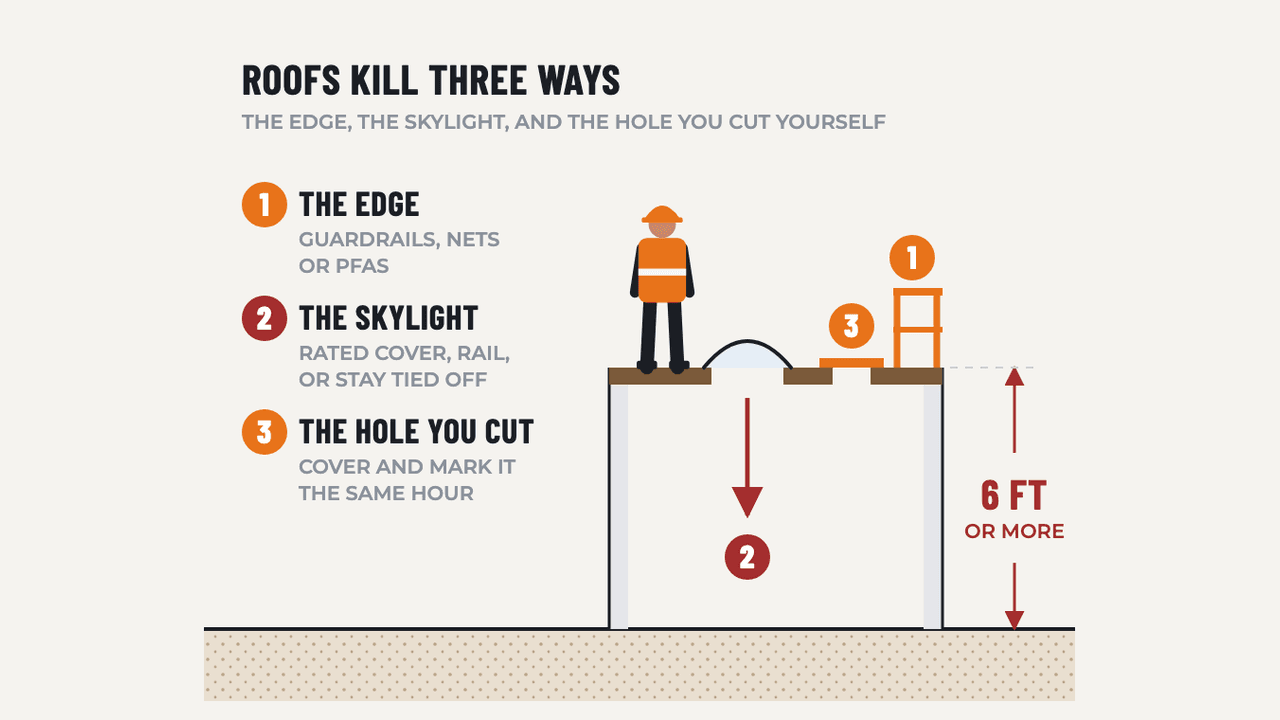
A free, ready-to-run toolbox talk for construction crews. Read it aloud at your morning huddle; it takes about ten minutes. Leer en español →
OSHA standard: 29 CFR 1926.501(b)(10)–(13) · Subpart M
At a glance
- The edge, the skylight, and the hole you cut yourself — roofs kill three ways
- Fall protection from the first step on the roof, not the first step near the edge
- Skylights are holes with a lid that won't hold you
- Arizona roofs add heat, glare, and monsoon wind to everything
Introduction
Roof work concentrates every fall hazard in one place: unprotected edges on all four sides, skylights and openings scattered mid-field, material sliding on pitch, and — in Arizona — a surface hot enough to soften shoe soles under a sun that erases depth perception. Roofers fall from edges, but they also fall THROUGH: skylights and unsecured decking take workers who never went near the edge. Today's talk covers protection on the roof plane, not just at its rim.
Getting Protected
- 6 feet or more: guardrails, nets, or PFAS — chosen and rigged before work starts, per the plan for THIS roof type and pitch
- Low-slope roofs may combine warning lines with monitors per the standard — but a "safety monitor" is a trained, dedicated role, not the nearest guy
- Steep roofs: PFAS with roof anchors installed to manufacturer spec — into structure, not just sheathing
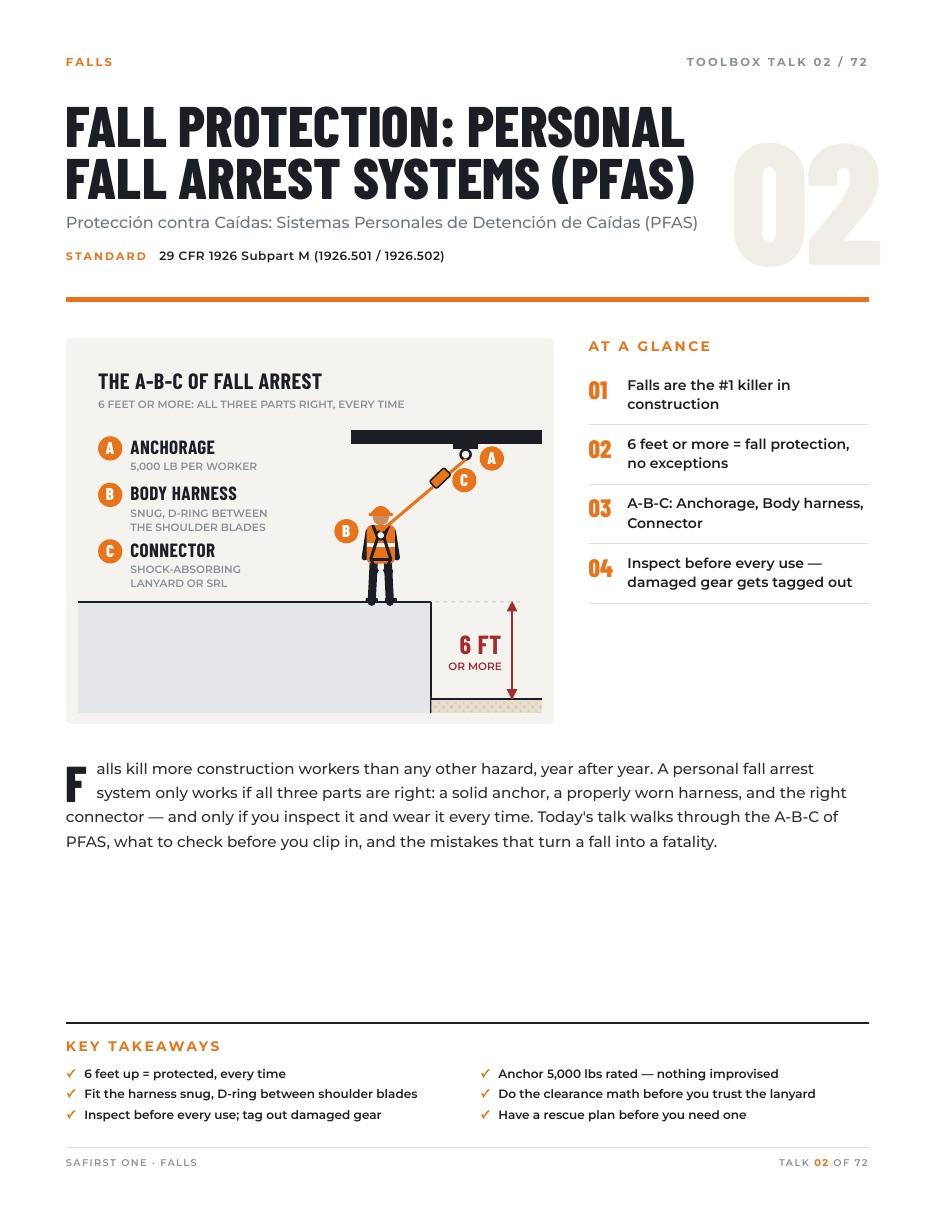
- Anchor and clearance math from the PFAS talk applies — a short roof with a long lanyard is a ground strike
Falling THROUGH
- Skylights: every one gets a rated cover, a rail, or you stay tied off near them — a plastic dome holds rain, not a person
- Openings you cut get covered and marked the same hour — an open curb hole at quitting time is a trap for the morning crew
- Check decking before trusting it: rotted OSB, rusted pans, and unsecured sheets all let go without warning — walk structure lines on suspect decks
The Roof Environment
- Material staged flat and secured — monsoon outflow turns foam boards and metal panels into aircraft (weather talk applies in full)
- Hot work on roofs (torch-down, hot air welding) follows the fire watch rules — including the 30 minutes after
- AZ heat: rotate, hydrate, and remember the surface itself burns — kneepads and gloves are heat PPE up here
- Ladders and access per the ladder talk: 3 feet above the eave, tied off
Key takeaways
- Protected from the first step on the roof
- Skylights are holes — cover, rail, or tie off
- Cut a hole, cover and mark it the same hour
- Test suspect decking before it tests you
- Stage flat and secured — monsoon wind shops early
- Heat, glare, and hot surfaces are roof PPE items
Run this talk with crew sign-offs
This talk is part of the Safirst ONE toolbox talk library, in English and Spanish. Your foreman picks the talk in the app, the crew signs from their own phones by scanning a QR code, and the signed record files itself in your Docs Locker. Talk to Safirst to get it for your crews.