Toolbox Talks
Respiratory Protection Toolbox Talk
Published · 3 min read
A free, ready-to-run toolbox talk for construction crews. Read it aloud at your morning huddle; it takes about ten minutes. Leer en español →
OSHA standard: 29 CFR 1910.134 (via 1926.103)
At a glance
- Respirators are the LAST control — water, vacuums, and ventilation come first
- The right filter for the right hazard; dust masks don't stop vapors
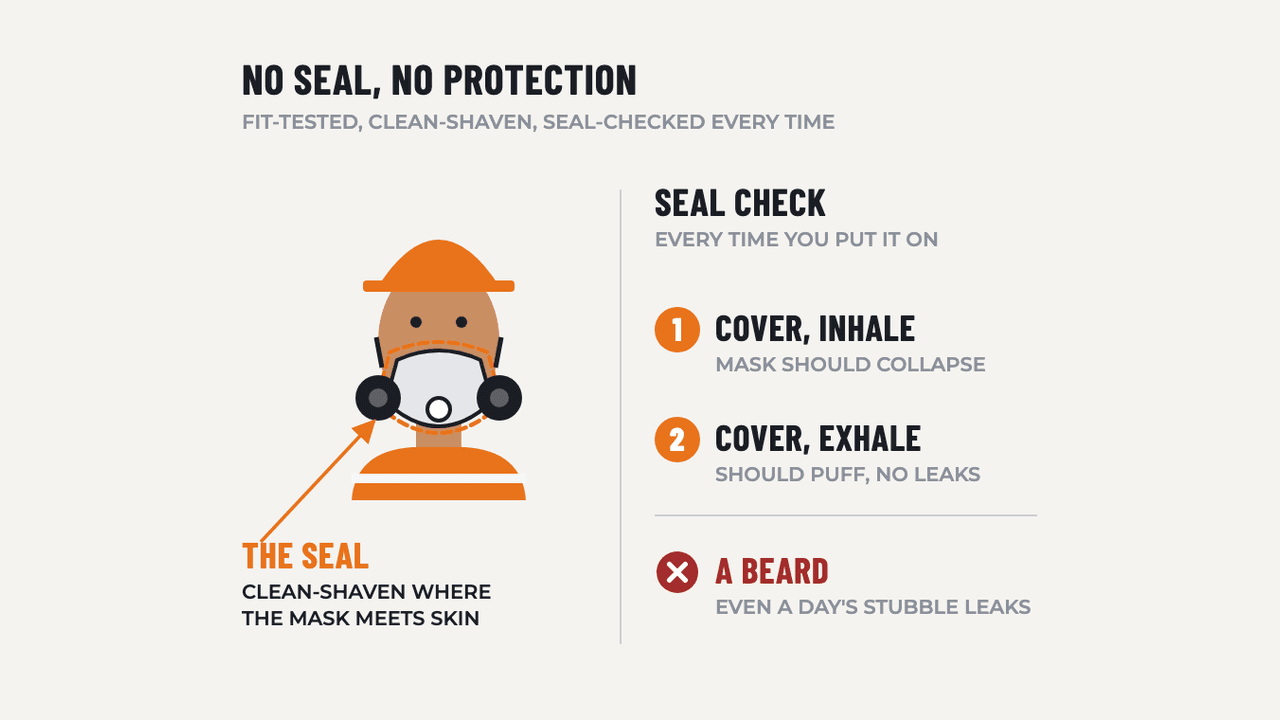
- No seal, no protection: fit-tested and clean-shaven at the sealing surface
- A respirator hanging around your neck is filtering your chest
Introduction
Some of the worst injuries on a jobsite have no impact, no blood, and a twenty-year delay: silicosis, asbestosis, welding-fume damage, solvent effects. Respirators are the last line against all of them — last because engineering controls (water, vacuums, ventilation) do the real work, and the respirator catches what's left. But a respirator only works as a sealed system. Today's talk covers picking the right one, wearing it so it seals, and knowing when its protection has quietly expired.
Match the Respirator
- Dust, silica, general particulates: N95 or better filtering facepiece, or a half-face with P100 cartridges for heavier or longer exposure
- Solvents, adhesives, coatings, fuels: half-face with the CORRECT chemical cartridge — a particulate filter does nothing against vapor
- Welding fume: at minimum a properly fitted N95 under the hood for most work; some materials (galvanized, stainless) demand more
- Oxygen-deficient or unknown atmospheres: no cartridge helps — that's supplied air and a confined-space program, not a trip to the gang box
The Seal Is Everything
- Fit-tested to the specific make, model, and size you wear — respirators are not one-size
- Clean-shaven where the mask meets skin; even a day's stubble leaks — a beard turns a respirator into a costume
- User seal check EVERY donning: cover and inhale (should collapse), cover and exhale (should puff, no leaks)
- Glasses, hood straps, and hard-hat suspensions that cross the seal break it
Care & Change-Out
- Particulate filters: change when breathing resistance rises or per the plan — clogged filters push air around the seal
- Chemical cartridges expire by exposure time, not appearance: smell or taste of the chemical inside means it expired a while ago — follow the change schedule
- Store clean and sealed, not loose in the truck bed collecting the dust it's supposed to stop
- Voluntary N95 use is fine where allowed — but the seal rules still decide whether it's doing anything
Key takeaways
- Controls first; the respirator catches the remainder
- Particulates vs vapors: different filters, no substitutions
- Fit-tested, clean-shaven, seal-checked every time
- Smell inside a cartridge = changed too late
- Unknown atmosphere = supplied air, period
- Around the neck is not a wearing position
Questions for your crew
- Respirators are the LAST control — water, vacuums, and ventilation come first; the respirator catches the remainder.
- Match the filter to the hazard: particulate filters don't stop vapors, and there are no substitutions.
- No seal, no protection — fit-tested, clean-shaven at the sealing surface, seal-checked every time you put it on.
- Smelling the contaminant inside a cartridge means it was changed too late.
- Unknown or oxygen-deficient atmosphere means supplied air, period.
- A respirator hanging around your neck is filtering your chest.
Run this talk with crew sign-offs
This talk is part of the Safirst ONE toolbox talk library, in English and Spanish. Your foreman picks the talk in the app, the crew signs from their own phones by scanning a QR code, and the signed record files itself in your Docs Locker. Talk to Safirst to get it for your crews.