Toolbox Talks
Rebar & Impalement Protection Toolbox Talk
Published · 3 min read

A free, ready-to-run toolbox talk for construction crews. Read it aloud at your morning huddle; it takes about ten minutes. Leer en español →
OSHA standard: 29 CFR 1926.701(b)
At a glance
- Exposed rebar is a bed of spears — a trip becomes an impalement
- Cap or bend every dowel a person could fall onto — with RATED caps
- The little mushroom caps mark rebar; they do NOT stop a falling body
- Working at height above dowels raises the stakes — guard the fall first
Introduction
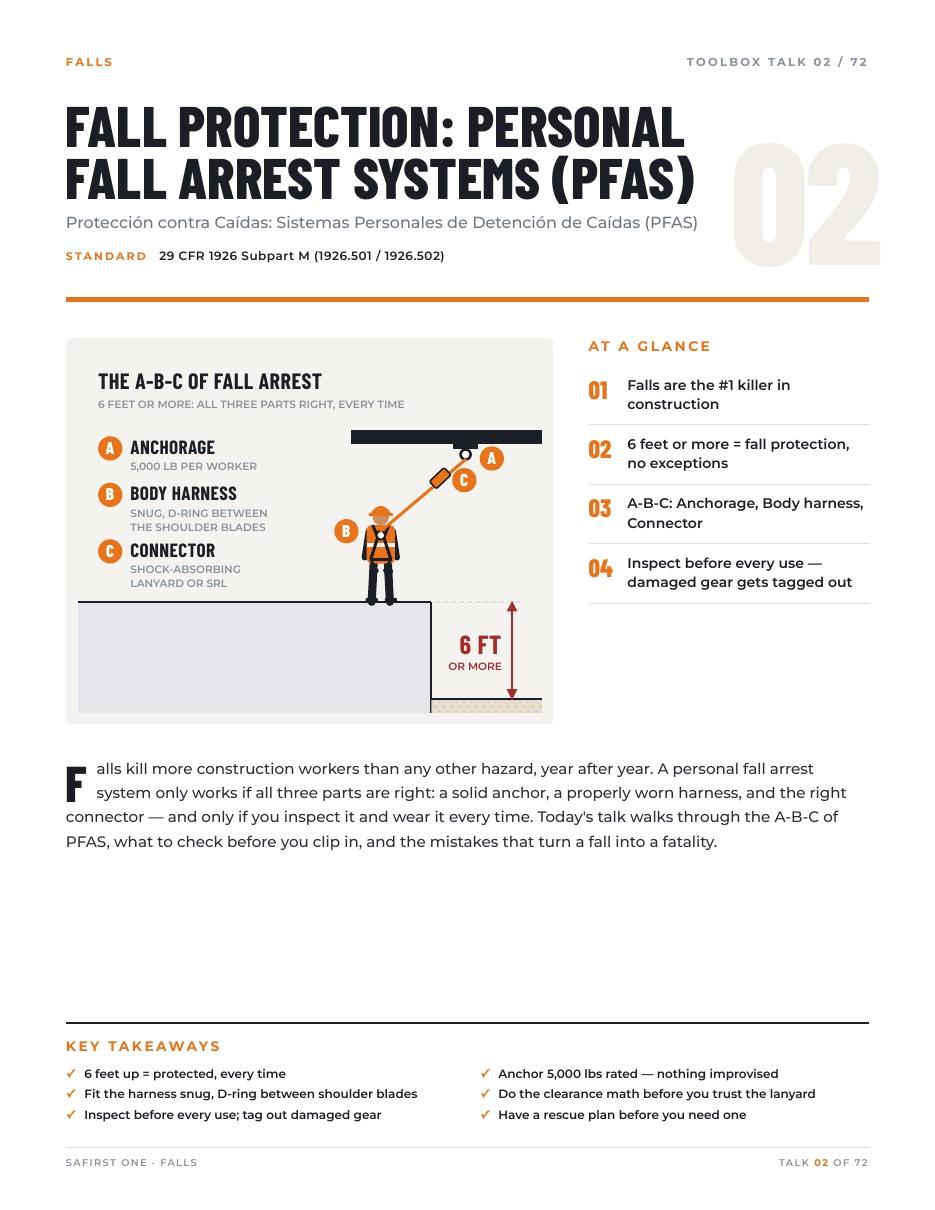
Every slab and wall pour starts as a field of vertical steel — and every dowel is a spear pointed at anyone working above it or walking through it. Impalement injuries are as bad as jobsite trauma gets, and the defense is cheap and specific: protect every exposed end a person could fall onto. The catch most crews miss: the common yellow mushroom caps are visibility markers, not protection. Today's talk sorts the real protection from the decoration.
What Counts as Protection
- Rated impalement-protective caps (steel-reinforced, marked as meeting the standard) — the square steel-plate style — stop a falling body; plain plastic mushrooms do not
- Bending the steel over to horizontal removes the spear entirely — the best fix where the design allows
- Troughs or lumber over dowel rows protect runs of steel at once
- If a person could fall ONTO it from any height — walking grade included — it gets real protection, not just marking
Where It Bites
- Footing and slab dowels along walkways and access paths — the trip-and-fall-forward case at ground level
- Wall and column steel below leading edges, ladders, and formwork platforms — anyone above dowels needs BOTH fall protection and capped steel below
- Form stakes, anchor bolts, and cut pipe count too — impalement doesn't care what the steel was for
- Caps knocked off by traffic and pours: assign a daily walk to re-cap — caps migrate, steel doesn't
Working the Steel
- Tying rebar: position to avoid working directly over unprotected verticals; cap before you climb the mat, not after
- Carrying rebar: long steel on shoulders takes corners wide — the person on the other end of the stick can't see what you see
- Cut ends are razor-edged: gloves per the hand-protection basics, and cut steel stacked points-down or capped
Key takeaways
- Every exposed end a body could meet gets protected
- Rated caps or bent steel — mushrooms are markers, not armor
- Above dowels: fall protection AND capped steel
- Stakes, bolts, and pipe count as spears too
- Walk the caps daily — they wander
- A trip in a dowel field must land on plastic-and-steel, not steel
Run this talk with crew sign-offs
This talk is part of the Safirst ONE toolbox talk library, in English and Spanish. Your foreman picks the talk in the app, the crew signs from their own phones by scanning a QR code, and the signed record files itself in your Docs Locker. Talk to Safirst to get it for your crews.