Toolbox Talks
Road Work Zones Toolbox Talk
Published · 2 min read
A free, ready-to-run toolbox talk for construction crews. Read it aloud at your morning huddle; it takes about ten minutes. Leer en español →
OSHA standard: 29 CFR 1926 Subpart G · MUTCD Part 6
At a glance
- Two threats: public traffic outside, our own equipment inside
- Class 2 hi-vis minimum; Class 3 at night and on high-speed roads
- Work inside the protected area — cones are a boundary, not armor
- Face traffic when you can; never trust a driver to see you
Introduction
In a road work zone you're working feet from drivers doing 45-plus who are texting, tired, or drunk — and simultaneously sharing your protected strip with our own trucks and machines. Workers on foot get hit from both directions. Today's talk covers the zone setup that keeps the public out, the habits that keep you inside the protection, and the internal traffic plan that keeps our own iron off our own people.
The Setup
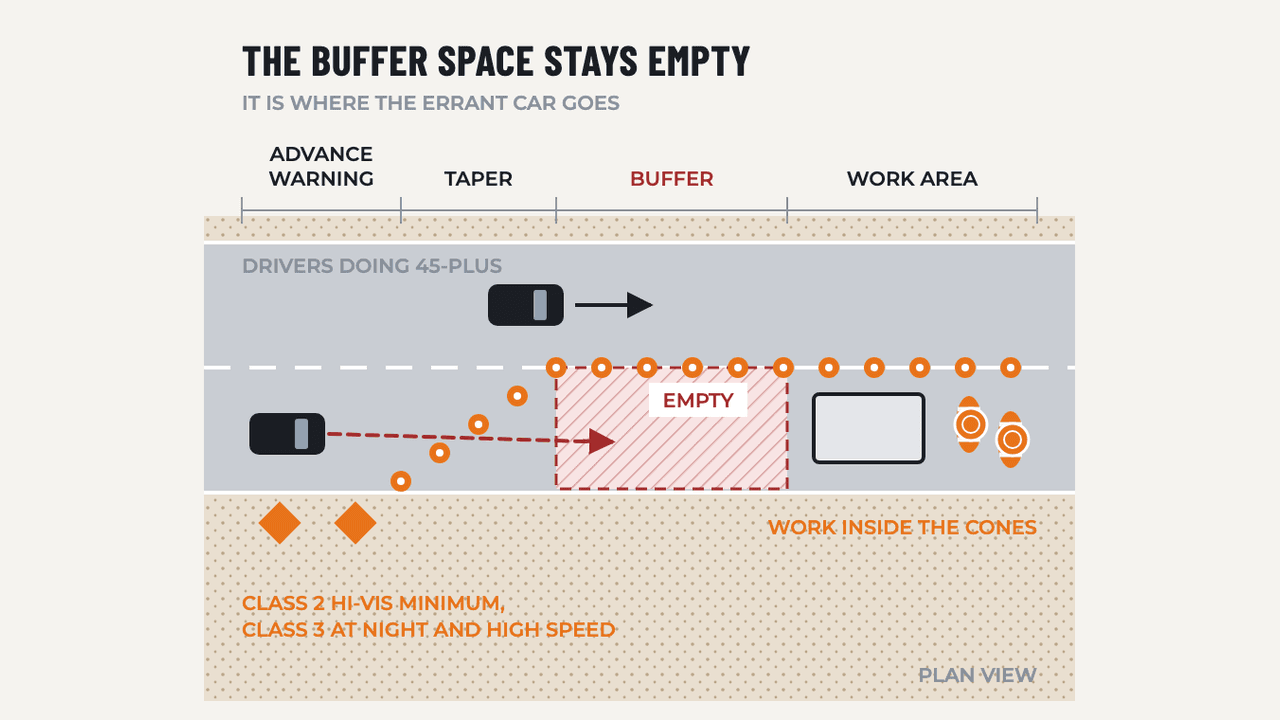
- Zones follow the traffic control plan: advance warning, taper, buffer, work area — set up and torn down in the safe order (with traffic, first cone last cone rules per the plan)
- The buffer space is empty for a reason: it's where the errant car goes — never stage equipment, trucks, or break areas in it
- Flaggers are trained, paddle-equipped (STOP/SLOW, never just a hand), positioned with an escape path, and lit at night
- Check the zone each morning: overnight hits scatter cones, and a gapped taper aims traffic at the crew
Working Inside
- Class 2 hi-vis minimum, Class 3 for night and high-speed — clean and worn closed, because faded gray-vis is camouflage
- Work facing traffic where the task allows; when you can't, a spotter with an air horn watches for intrusions
- Stay inside the protected area — stepping over the cones for a tool is stepping into a live lane
- Night work: lit vests or wearable lights, and never stand in the glare-blind spots between light towers
Our Own Iron
- An internal traffic control plan separates people on foot from equipment paths inside the zone — marked lanes, marked crossings
- Backing rules apply in full (spotter talk): the dump truck inside the zone is as lethal as the sedan outside it
- Getting in and out of the zone — parking, deliveries, crew changes — follows the plan, not convenience
Key takeaways
- Right zone setup, checked every morning
- Buffer space stays EMPTY — it's the crash zone
- Class 2 minimum, Class 3 nights/high-speed
- Face traffic or post a watch
- Inside the cones is the only place you work
- Internal traffic plan: our trucks hit hardest
Run this talk with crew sign-offs
This talk is part of the Safirst ONE toolbox talk library, in English and Spanish. Your foreman picks the talk in the app, the crew signs from their own phones by scanning a QR code, and the signed record files itself in your Docs Locker. Talk to Safirst to get it for your crews.