A free, ready-to-run toolbox talk for construction crews. Read it aloud at your morning huddle; it takes about ten minutes. Leer en español →
OSHA standard: 29 CFR 1926.52 · 1926.101
At a glance
- Noise damage is painless, gradual, and permanent
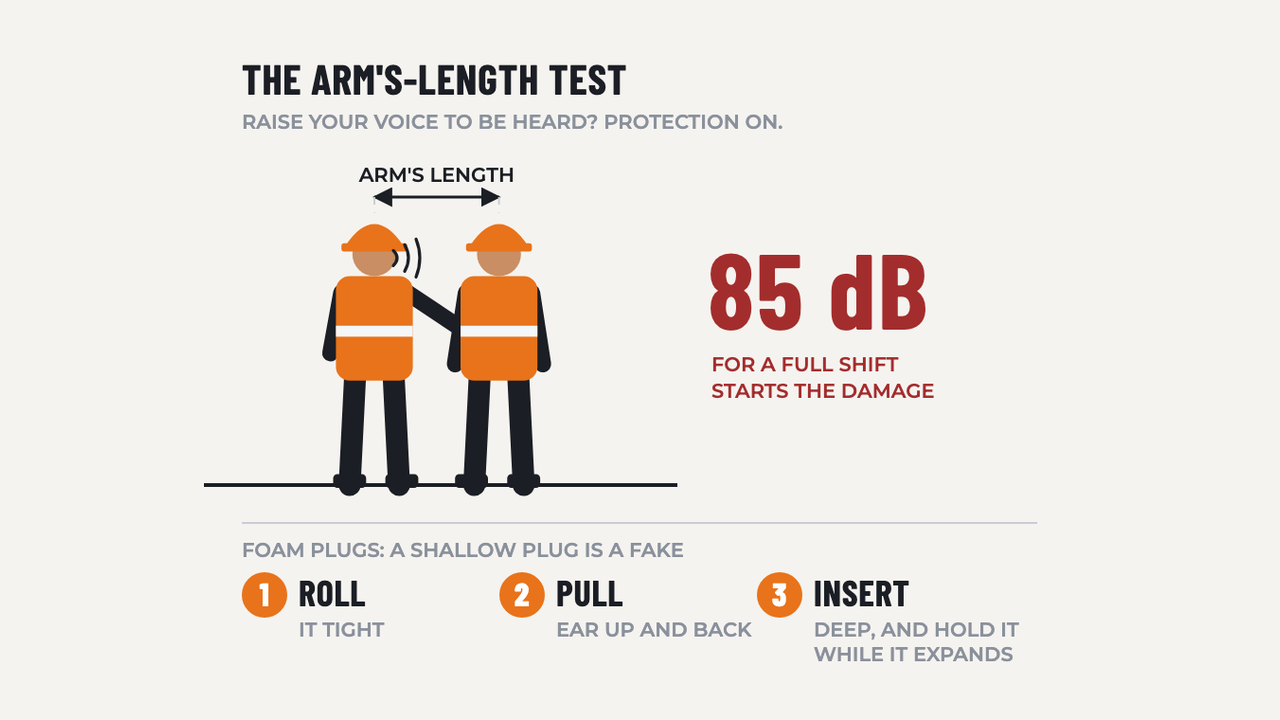
- Raise your voice at arm's length? Loud enough to need protection
- Plugs and muffs only work worn correctly — a half-inserted plug is decoration
- Ringing ears after work means the damage already started
Introduction
Hearing loss is construction's quietest injury: it doesn't bleed, it doesn't hurt, and by the time you notice it, it's permanent. Saws, grinders, jackhammers, compressors, and heavy equipment all run past 85 decibels — the level where damage begins with a full shift of exposure. The fix costs a few cents a day and takes ten seconds. Today's talk covers when protection is required, how to wear it so it actually works, and the warning sign everyone ignores.
Know When It's Loud
- The field test: if you have to raise your voice to be heard at arm's length, you're in damaging noise
- The usual suspects: cut-off saws, grinders, chop saws, jackhammers, powder-actuated tools, compressors, equipment cabs with the windows open
- Damage stacks by dose: louder noise damages in less time — a chop saw can do in minutes what a loader takes hours to do
- Impulse noise (nail guns, PAT shots) spikes past safe levels instantly
Wear It Right
- Foam plugs: roll it tight, pull the top of your ear up and back, insert deep, hold while it expands — a plug sitting in the bowl of your ear blocks almost nothing
- Muffs: full seal against the head; safety-glasses temples and beanies break the seal — thin-temple glasses or plugs solve it
- Double up (plugs + muffs) for the loudest work: jackhammering, cutting in enclosed spaces
- Keep plugs clean; dirty plugs trade hearing loss for ear infections
The Warning Everyone Ignores
- Ringing, buzzing, or muffled hearing after shift is not "getting used to it" — it's the sound of hair cells dying
- Those cells never grow back; hearing aids amplify what's left, they don't restore what's gone
- Tinnitus — permanent ringing — is often worse than the loss itself; it never turns off
- Protect the hearing you have left: damage is cumulative, and stopping now stops the slide
Key takeaways
- 85 decibels for a shift starts the damage
- Arm's-length voice test: raised voice = protection on
- Roll, pull, insert — a shallow plug is a fake
- Glasses temples break muff seals; plan for both
- Double protection for the loudest tools
- Ringing ears = damage done; don't collect more
Questions for your crew
- Noise damage is painless, gradual, and permanent — 85 decibels across a shift is enough to start it.
- The arm's-length test: if you have to raise your voice to be heard at arm's length, it's loud enough to need protection.
- Foam plugs only work inserted right: roll, pull the ear, insert — a half-inserted plug is decoration.
- Glasses temples break muff seals — plan plugs, muffs, or both around your other PPE.
- Double up with plugs plus muffs for the loudest work: powder-actuated tools, demolition saws, jackhammering.
- Ringing ears after work means the damage already started — don't collect more.
Run this talk with crew sign-offs
This talk is part of the Safirst ONE toolbox talk library, in English and Spanish. Your foreman picks the talk in the app, the crew signs from their own phones by scanning a QR code, and the signed record files itself in your Docs Locker. Talk to Safirst to get it for your crews.