In 2018, one of the largest general contractors and developers in the world was building a multifamily apartment complex in Arizona. Early in the project, we spotted a problem: there was no plan for temporary fire protection.
We asked the team a simple question. Did they have someone contracted to handle fire extinguishers, or was the superintendent team going to take it on? The project manager turned it back to me and asked if Safirst would do it.
I’ve been a firefighter paramedic my entire adult life, so I knew the NFPA requirements cold. I also saw how much value Safirst could deliver by owning temporary fire protection end to end. That’s the day fire extinguisher service became part of our deliverable packages, and it’s been there ever since.
Why temporary fire protection matters on an active jobsite
Getting temporary fire extinguishers dispersed throughout a project is one of the most powerful things you can do to prevent a catastrophe. A building under construction is full of fuel: framing lumber, packaging, solvents and debris. It doesn’t have working sprinklers or finished fire separations yet.
Extinguishers work alongside the basics every site should already have:
- A hot work permitting process for welding, cutting and grinding
- Proper housekeeping every day
- No smoking inside the buildings
- No cooktops, burners or furnaces inside the structure
Those controls lower the odds of a fire. Extinguishers in the right places are what keep a small fire from becoming a total loss.
What our fire extinguisher service includes
Safirst handles temporary fire protection from the first delivery to the last day on site, so your superintendents can stay focused on building:
- Purchasing the right extinguishers for the hazards on your project
- Delivery to the jobsite
- Installation throughout the project, moving and adding units as the building goes up
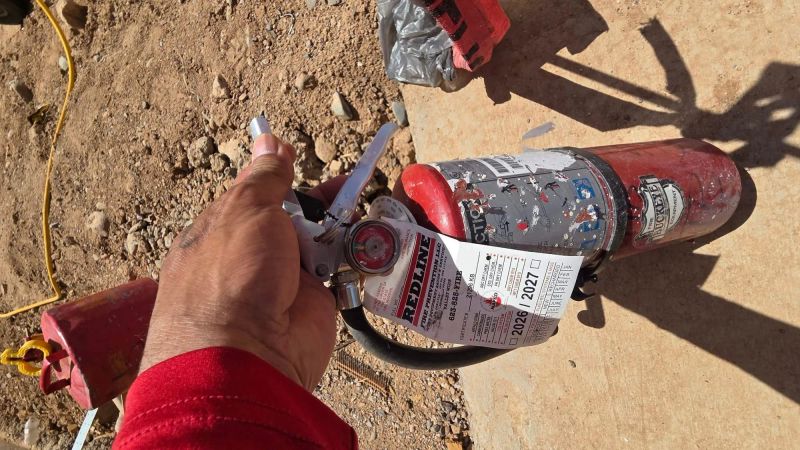
- Monthly inspections with documented tags
- Recharging after any use or when pressure drops
- Servicing and maintenance to keep every unit ready
One team owns it, so nothing falls between the GC, the subs and the safety program. See our fire safety services for the full scope.
What OSHA requires for fire extinguishers on a construction site
The federal construction standard, 29 CFR 1926.150, sets the baseline. In Arizona, ADOSH enforces the same construction rules.
| Requirement | What it means on your site |
|---|---|
| Coverage | At least one 2A-rated extinguisher for every 3,000 sq ft of building area |
| Travel distance | No more than 100 ft from any point to the nearest extinguisher |
| Every floor | One or more 2A extinguishers per floor, with one next to a stairway in multistory buildings |
| Flammables | A 10B-rated extinguisher within 50 ft of more than 5 gallons of flammable liquid or 5 lbs of flammable gas |
| Access | Extinguishers kept conspicuous and accessible at all times |
| Inspection and maintenance | Inspected periodically and maintained to NFPA standards; defective units replaced immediately |
The catch: those numbers change every week as the building grows. A floor that didn’t exist on Monday needs coverage by Friday. That’s why temporary fire protection has to be managed, not just dropped off.
What’s at stake when temporary fire protection is overlooked
The real risk is catastrophic. When extinguishers are missing, empty or buried behind material, a fire that should have been knocked down in seconds gets time to grow. Lives can be lost.
The business fallout stacks up fast:
- Builder’s risk coverage at risk. A fire on a site with poor fire protection can put your builder’s risk policy in jeopardy, including cancellation.
- OSHA and ADOSH citations. Missing, uninspected or inaccessible extinguishers are straightforward violations to document.
- Schedule and reputation. A fire stops work, triggers investigations and follows your company to the next bid.
This is preventable, and we’re ready to help any contractor who needs fire safety support.
How Safirst ONE keeps it on track between visits
Fire protection doesn’t fail on the day the extinguishers show up. It fails three months later, when a monthly check gets skipped or a new floor goes up without coverage.
That’s why we built Safirst ONE, our construction safety operating system. It tracks the whole fire prevention picture in one place:
- Fire protection: extinguisher inspections logged with photos and GPS, filed automatically
- Hot work permitting: permits and fire watch tracked instead of lost on a clipboard
- Housekeeping: daily conditions documented as part of routine inspections
- Reminders: prompts when inspections and follow-ups are due, so nothing lapses
Every record files itself into the Safety Docs Locker, ready when an inspector, insurer or owner asks.
Get temporary fire protection handled
Safirst has managed jobsite fire extinguisher service in Arizona since 2018, led by a career firefighter paramedic. We purchase, deliver, install, inspect and recharge, and Safirst ONE keeps every record and reminder in one place.
Contact Safirst to set up fire extinguisher service for your next project, or see how Safirst ONE tracks fire protection, hot work and housekeeping on every site.
Frequently asked questions
OSHA requires at least one 2A-rated extinguisher per 3,000 sq ft, no more than 100 ft of travel to reach one, and at least one on every floor. Areas with more than 5 gallons of flammable liquid or 5 lbs of flammable gas need a 10B-rated unit within 50 ft.
NFPA 10 calls for a visual inspection every month and full maintenance every year. On an active jobsite, units get used, moved and damaged, so monthly checks matter even more.
It needs to be recharged or replaced right away. A partially discharged extinguisher is not ready for the next fire.
Under OSHA 1926.150, the employer is responsible for a fire protection program through every phase of the work. Many GCs hand day-to-day management to a qualified service provider so it’s done consistently.