Fire extinguishers are one of the most overlooked pieces of safety equipment on a construction site, right up until someone needs one. At Safirst, we inspect and maintain extinguishers on jobsites across Arizona, and we see the same patterns again and again.
Here’s what a fire extinguisher inspection looks like, what we find, and why the monthly check and the annual maintenance are two different jobs.
The monthly fire extinguisher inspection checklist
On a temporary construction site, the first thing we look at is location.
A jobsite isn’t a finished building where extinguishers sit in fixed cabinets. Walls go up, material gets staged, and crews move around. The extinguisher that was by the stairs last month may now be behind a pallet of drywall, on another floor, or gone. So the first question every month is the one that matters most in an emergency: is there a charged extinguisher where one needs to be, and can a worker get to it quickly?
After that, the rest of the check is quick:
- The pin and tamper seal are intact.
- The gauge reads in the green.
- The unit feels full when you lift it.
- There’s no visible damage.
- The instructions can be read.
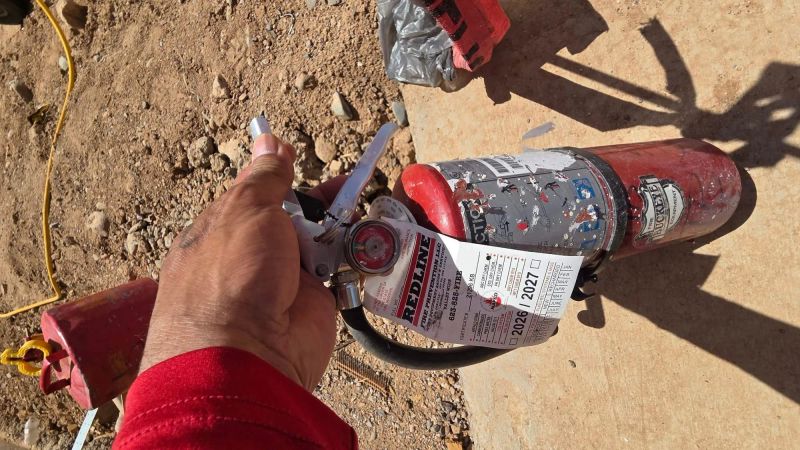
- The tag is initialed and dated.
Each unit takes a couple of minutes, and anyone on site can be trained to do it.
The most common failures we find on construction sites
On construction sites, temporary extinguishers almost always fail in one of four ways:
- Missing. The unit was borrowed, moved or never replaced.
- Blocked. Material, equipment or debris is stacked in front of it.
- Damaged. It was knocked over, run into or left lying in the dirt.
- Discharged. Someone bumped the handle or squeezed it to test it, then set it back looking fine, but it has no pressure left.
All four come from the same thing: a busy site that changes every week. The monthly check is how you catch them before a fire does.
Monthly inspection vs. annual maintenance
The monthly inspection asks whether the extinguisher is there and looks ready. It’s a fast visual check, and its value comes from being done often.
The annual maintenance asks whether it will actually work. A certified technician does it hands-on, examining the mechanical parts, the agent and the discharge system. This is also when units are pulled for their 6-year maintenance or 12-year hydrostatic test, and when each one gets a new annual service tag.
| Monthly inspection | Annual maintenance | |
|---|---|---|
| Question it answers | Is it there and does it look ready? | Will it actually work? |
| Who does it | Anyone trained on site | A certified technician |
| How | Quick visual check | Hands-on exam of parts, agent and discharge system |
| Time per unit | A couple of minutes | Longer; some units pulled for 6-year or 12-year service |
| Record | Initialed and dated tag | New annual service tag |
A unit can pass every monthly check and still fail its annual. You need both.
A real example: what one annual visit turned up
You don’t need a dramatic fire story to see why this matters. A normal annual visit makes the point.
On a recent annual inspection at an industrial facility, we went through 41 extinguishers. Twenty-nine were in good working order and got a new annual Fire Marshal service tag. Eleven had to be taken out of service entirely. Some had lost pressure, some had reached their 6-year maintenance requirement, and some were simply too old to keep, close to 20 years of age. Every one of those was replaced with a brand-new ABC extinguisher. We also found an electrical room with no extinguisher at all, so we added one to bring it up to code.
That means that on a site that looked fully covered, more than a quarter of the fire protection either couldn’t be relied on or wasn’t where the code required it. From the floor, everything looked fine. The gaps only showed up because someone inspected every unit.
That one visit is the whole case for regular inspections. Fire protection that looks ready and fire protection that is ready are two very different things, and the only way to know which one you have is to check. For what OSHA requires on an active jobsite, see our guide to fire extinguisher service for construction sites.
Keep monthly inspections from slipping
The hard part of monthly inspections isn’t doing them. It’s remembering to do them every month, on every floor, on every site, and being able to prove it.
Safirst ONE handles that:
- Mobile inspections with photos and GPS, done from a phone in minutes
- Reminders when monthly checks come due, so nothing lapses
- Findings tracked to closure, from a blocked unit to a missing one
- Automatic filing in the Safety Docs Locker, ready when a fire marshal, insurer or GC asks
Know your fire protection is ready
Safirst inspects, maintains and replaces fire extinguishers on jobsites and facilities across Arizona, and Safirst ONE keeps every monthly check on schedule and on record.
Schedule a fire extinguisher inspection with Safirst, or see how Safirst ONE tracks inspections across every site.
Frequently asked questions
A visual inspection every month and hands-on maintenance by a certified technician every year. Some units also need 6-year maintenance and a 12-year hydrostatic test.
Location and access, pin and tamper seal, gauge in the green, a full feel when lifted, no visible damage, readable instructions, and an initialed and dated tag.
Anyone on site who has been trained. Annual maintenance must be done by a certified technician.
Yes. The monthly check is visual. Only annual maintenance confirms the unit will actually discharge.
Extinguishers that are missing, blocked, damaged or discharged, usually because the site changes every week.