A free, ready-to-run toolbox talk for construction crews. Read it aloud at your morning huddle; it takes about ten minutes. Leer en español →
OSHA standard: 29 CFR 1926 Subpart K (1926.404 / 1926.405 / 1926.416)
At a glance
- Electrocution is a Focus Four killer — and 120 volts is enough
- GFCI protection on every circuit you plug into, no exceptions
- Inspect every cord and tool before use — damaged gear gets tagged out
- Water and electricity share every jobsite; respect both
Introduction
Most electrical deaths in construction don't come from high-voltage lines. They come from ordinary 120-volt tools and extension cords — damaged, ungrounded, or used without GFCI protection. The current it takes to stop a human heart is a fraction of what runs a drill. Today's talk covers GFCI protection, cord care, and the habits that keep temporary power from becoming a fatality.
Why Ordinary Power Kills
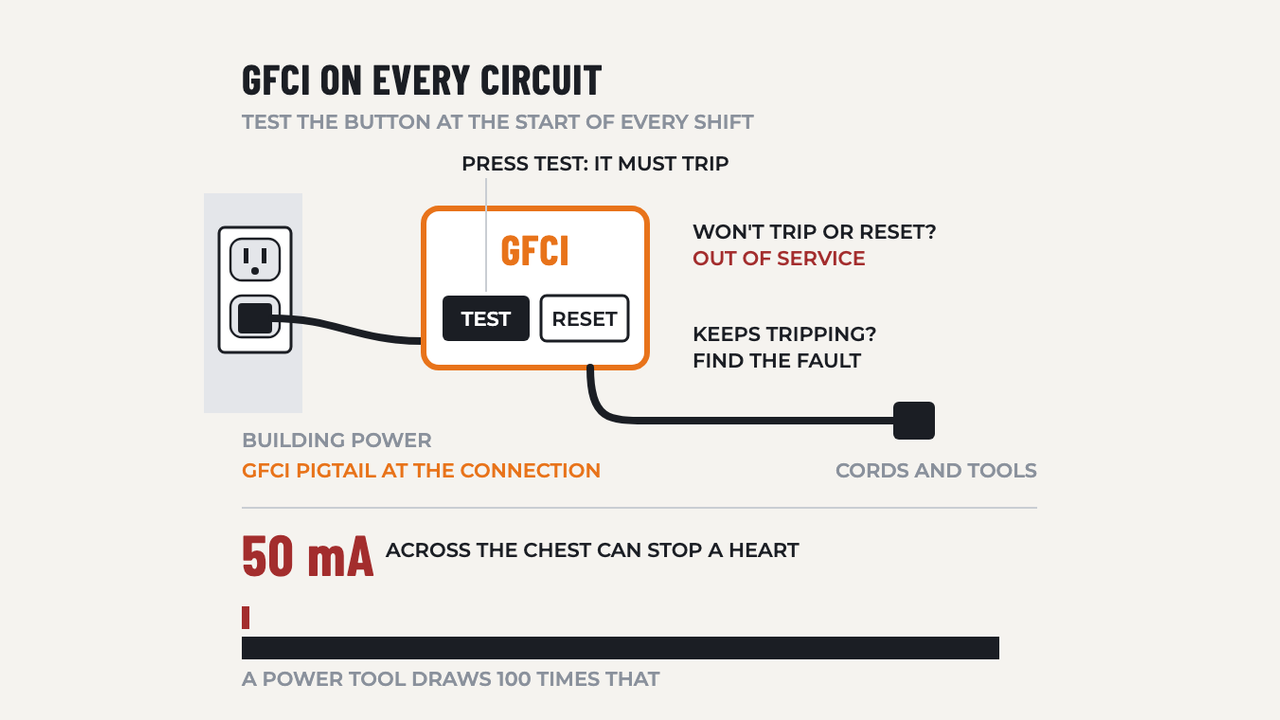
- As little as 50 milliamps across the chest can stop a heart — a power tool draws a hundred times that
- Sweat, wet gloves, standing water, and metal surfaces all lower your body's resistance
- Jobsites destroy cords: doorways, vehicle traffic, weather, sharp edges, constant dragging
- Fatal shocks are usually stacked failures: a damaged cord PLUS a missing ground PLUS no GFCI
GFCI Protection
- Every receptacle you use on site must be GFCI-protected — including power from the house or an existing building
- A GFCI trips in milliseconds, before current reaches a lethal level — it is the difference between a jolt and a funeral
- Not sure the source is protected? Use a GFCI pigtail at the connection
- Test the button at the start of shift — a GFCI that won't trip or won't reset is out of service
- A GFCI that keeps tripping is telling you something is wrong — find the fault, don't hunt for an unprotected outlet
Cords & Tools
- Inspect before use: cuts, exposed conductors, cracked casings, crushed spots, missing ground prongs
- A missing ground prong = out of service, period — and never snap one off to fit an outlet
- Electrical tape over a gouge is not a repair; damaged cords get replaced or professionally repaired
- Route cords overhead or along edges — out of doorways, water, and traffic
- Unplug by the plug, not by yanking the cord
Around Water & Weather
- Treat every circuit as live until verified otherwise
- Tools and cords that got soaked dry out and get inspected before returning to service
- Rain moving in? Wrap up exterior electrical work before it arrives, not during
- Fiberglass ladders around any electrical work — never aluminum
Key takeaways
- 120 volts kills — no such thing as "just house power"
- GFCI on everything, tested at shift start
- Inspect cords and tools daily; tag out damage
- No missing ground prongs, no tape repairs
- Keep cords elevated, dry, and out of traffic
- A tripping GFCI is a warning, not a nuisance
Questions for your crew
- Ordinary 120-volt power kills — the current that stops a heart is a fraction of what runs a drill; treat every circuit as live until verified.
- Every receptacle you use on site must be GFCI-protected, including power from the house — test the button at the start of shift.
- Inspect cords and tools daily for cuts, exposed conductors, cracked casings, and missing ground prongs; tag out damage.
- Never remove a ground prong, and never call electrical tape over a gouge a repair.
- Route cords overhead or along edges — out of doorways, water, and traffic — and unplug by the plug, not the cord.
- A GFCI that keeps tripping is a warning: find the fault, don't hunt for an unprotected outlet.
Run this talk with crew sign-offs
This talk is part of the Safirst ONE toolbox talk library, in English and Spanish. Your foreman picks the talk in the app, the crew signs from their own phones by scanning a QR code, and the signed record files itself in your Docs Locker. Talk to Safirst to get it for your crews.