A free, ready-to-run toolbox talk for construction crews. Read it aloud at your morning huddle; it takes about ten minutes. Leer en español →
OSHA standard: 29 CFR 1926 Subpart M (1926.501 / 1926.502)
At a glance
- Falls are the #1 killer in construction
- 6 feet or more = fall protection, no exceptions
- A-B-C: Anchorage, Body harness, Connector
- Inspect before every use — damaged gear gets tagged out
Introduction
Falls kill more construction workers than any other hazard, year after year. A personal fall arrest system only works if all three parts are right: a solid anchor, a properly worn harness, and the right connector — and only if you inspect it and wear it every time. Today's talk walks through the A-B-C of PFAS, what to check before you clip in, and the mistakes that turn a fall into a fatality.
When You Need It
- Working at 6 feet or more above a lower level: guardrails, safety nets, or PFAS
- Near unprotected edges, floor openings, roof edges, or leading edges
- On scaffolds and lifts per their specific rules — aerial lift = tied off, always
- If you're not sure the height triggers protection, treat it like it does
The A-B-C of PFAS
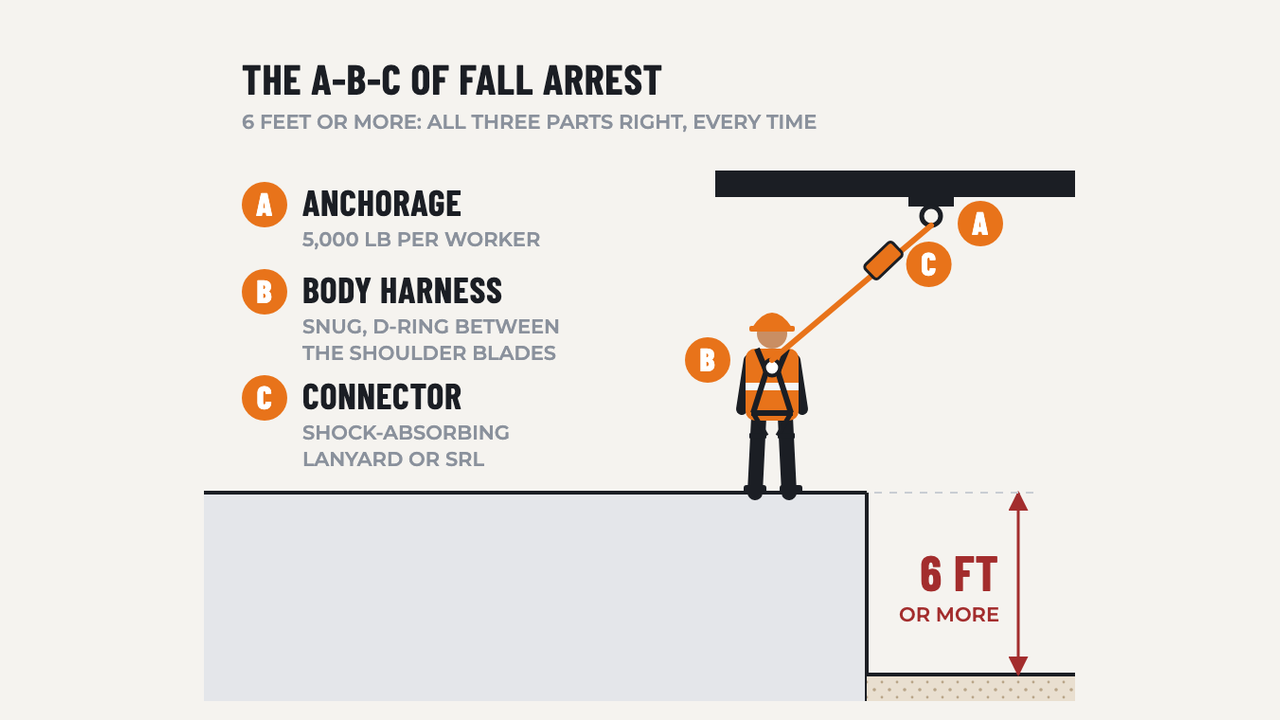
- Anchorage — rated for 5,000 lbs per worker, or engineered by a qualified person. Guardrails, rebar, and conduit are NOT anchors
- Body harness — snug fit, D-ring centered between shoulder blades, leg straps tightened, chest strap mid-chest
- Connector — shock-absorbing lanyard or SRL; keep the fall distance math in mind: a 6-ft lanyard plus deceleration needs roughly 18 ft of clearance below
Inspect Before Every Use
- Webbing: cuts, frays, burns, chemical damage, UV fading
- Hardware: cracks, corrosion, bent D-rings, gates that don't close and lock
- Stitching and labels: broken stitches or a missing/illegible label = out of service
- Any gear that has arrested a fall is done — tag it out, turn it in
Common Fatal Mistakes
- Harness worn loose — you can slide out or take the shock on the wrong body parts
- Anchoring at foot level with a lanyard that needs more clearance than you have
- Tying off to whatever is handy instead of a rated anchor
- Unhooking "just for a second" to move — 100% tie-off means transitions too
Rescue
- A worker hanging in a harness has minutes before suspension trauma sets in
- Know the site rescue plan before you clip in — who, how, with what equipment
- Calling 911 is not a rescue plan by itself
Key takeaways
- 6 feet up = protected, every time
- Anchor 5,000 lbs rated — nothing improvised
- Fit the harness snug, D-ring between shoulder blades
- Do the clearance math before you trust the lanyard
- Inspect before every use; tag out damaged gear
- Have a rescue plan before you need one
Questions for your crew
- At 6 feet or more above a lower level, use guardrails, safety nets, or a personal fall arrest system — no exceptions.
- Anchor only to points rated for 5,000 pounds per worker or engineered by a qualified person — never guardrails, rebar, or conduit.
- Wear the harness snug, with the D-ring centered between the shoulder blades and leg straps tightened.
- Do the clearance math before trusting a lanyard: a 6-foot shock-absorbing lanyard needs roughly 18 feet of clearance below.
- Inspect webbing, stitching, and hardware before every use; tag out damaged gear and anything that has arrested a fall.
- Know the rescue plan before you clip in — a worker hanging in a harness has minutes before suspension trauma sets in.
Run this talk with crew sign-offs
This talk is part of the Safirst ONE toolbox talk library, in English and Spanish. Your foreman picks the talk in the app, the crew signs from their own phones by scanning a QR code, and the signed record files itself in your Docs Locker. Talk to Safirst to get it for your crews.