Toolbox Talks
Scissor & Aerial Lifts (MEWPs) Toolbox Talk
Published · 3 min read
A free, ready-to-run toolbox talk for construction crews. Read it aloud at your morning huddle; it takes about ten minutes. Leer en español →
OSHA standard: 29 CFR 1926.453 · ANSI A92 series
At a glance
- Trained and authorized operators only — per lift type
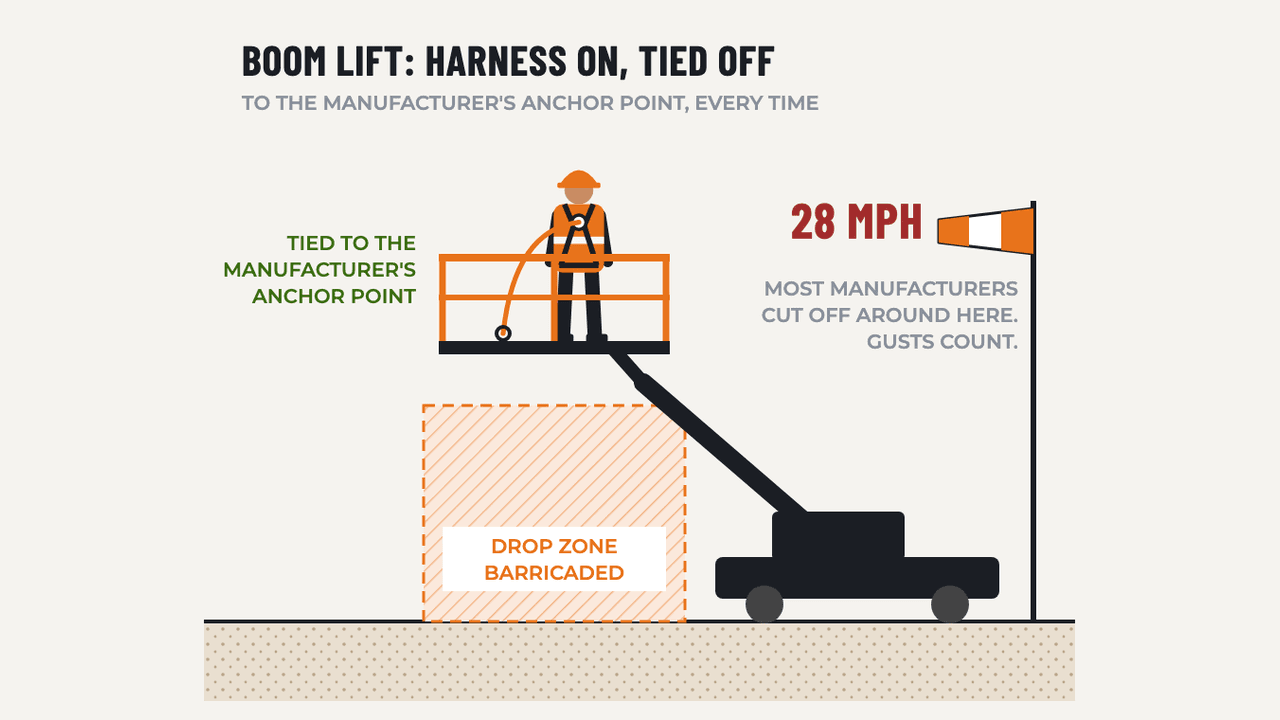
- Boom lift = harness tied to the manufacturer's anchor, every time
- Inspect the lift AND the ground before going up
- Never climb the rails; never exit at height unplanned
Introduction
Scissor and aerial lifts put you 20 to 60 feet up on a platform that moves, tips, and can be ejected from — and most lift fatalities trace to the same few causes: untrained operators, no harness in a boom lift, driving into holes or drop-offs, and power line contact. Today's talk covers the pre-use routine and the in-air rules that keep a lift from becoming a fall.
Before Operating
- You must be trained and authorized for that class of lift — a scissor card doesn't cover a boom
- Pre-use inspection: platform and ground controls, brakes, tires, hydraulics, horn, anchor points, guardrails and gate
- Walk the route and work area: holes, drop-offs, slopes, soft ground, debris, overhead obstructions
- Keep 10 feet minimum from power lines — more as voltage goes up
- Check the wind: most manufacturers cut off around 28 mph, and gusts count
In the Air
- Boom lifts: full-body harness with lanyard tied to the manufacturer's anchor point — a boom whips when it's struck or drops a wheel, and it throws you like a catapult
- Scissor lifts: gate closed and latched, both feet on the platform floor
- Never climb on the midrail or top rail, and never plank between the rails for extra height
- Never exit an elevated platform unless it was specifically planned, approved, and tied off for
- Keep the drop zone below clear — barricade before you go up
Moving the Lift
- Travel with the platform lowered unless the lift is designed to drive elevated
- Use a spotter around blind corners, other trades, and overhead steel
- Never use the lift as a crane, a bridge, or a prop for materials
Key takeaways
- Trained on that lift, not just any lift
- Inspect the machine and walk the ground first
- Harness + anchor in every boom lift, no exceptions
- Feet on the floor — never on the rails
- 10 feet from power lines; respect the wind limit
- Lowered to travel, barricaded below
Questions for your crew
- Operate only lifts you are trained and authorized for — a scissor lift card does not cover a boom lift.
- Do the pre-use inspection and walk the route first: holes, drop-offs, slopes, soft ground, and overhead obstructions.
- In a boom lift, wear a full-body harness tied to the manufacturer's anchor point every time — a struck boom throws you like a catapult.
- Keep both feet on the platform floor — never climb the rails, and never exit at height unless it was specifically planned and approved.
- Keep at least 10 feet from power lines and respect the wind limit, gusts included.
- Travel with the platform lowered unless the lift is designed otherwise, and barricade the ground below.
Run this talk with crew sign-offs
This talk is part of the Safirst ONE toolbox talk library, in English and Spanish. Your foreman picks the talk in the app, the crew signs from their own phones by scanning a QR code, and the signed record files itself in your Docs Locker. Talk to Safirst to get it for your crews.