Toolbox Talks
Focus 4 OSHA Toolbox Talk
Published · 3 min read
A free, ready-to-run toolbox talk for construction crews. Read it aloud at your morning huddle; it takes about ten minutes. Leer en español →
OSHA standard: OSHA Focus Four · 29 CFR 1926 Subparts M, O, K & P
At a glance
- Four hazard types cause roughly 60% of construction deaths
- Falls, Struck-By, Caught-In/Between, Electrocution — every site has all four
- Each one has a handful of habits that defeat it
- Today is the map; the dedicated talks are the territory
Introduction
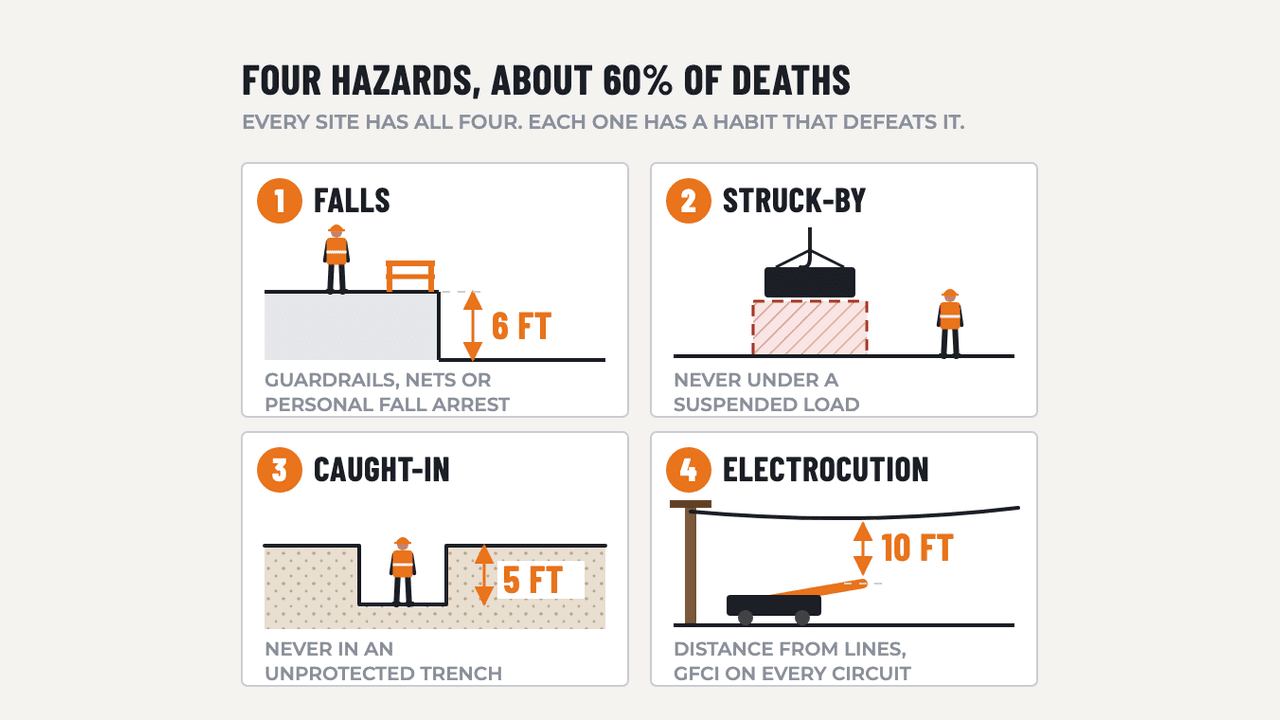
OSHA calls them the Focus Four because year after year, the same four hazard types kill about six of every ten construction workers who die on the job: falls, struck-by, caught-in/between, and electrocution. None of them are exotic. They're the ladder, the backing truck, the trench, the extension cord — ordinary things on an ordinary day. Today's talk is the overview: what the four are, where they live on our sites, and the one or two habits that defeat each.
Falls — the Biggest Killer
- Over a third of construction deaths; the killers are roofs, ladders, and unprotected edges — not just high steel
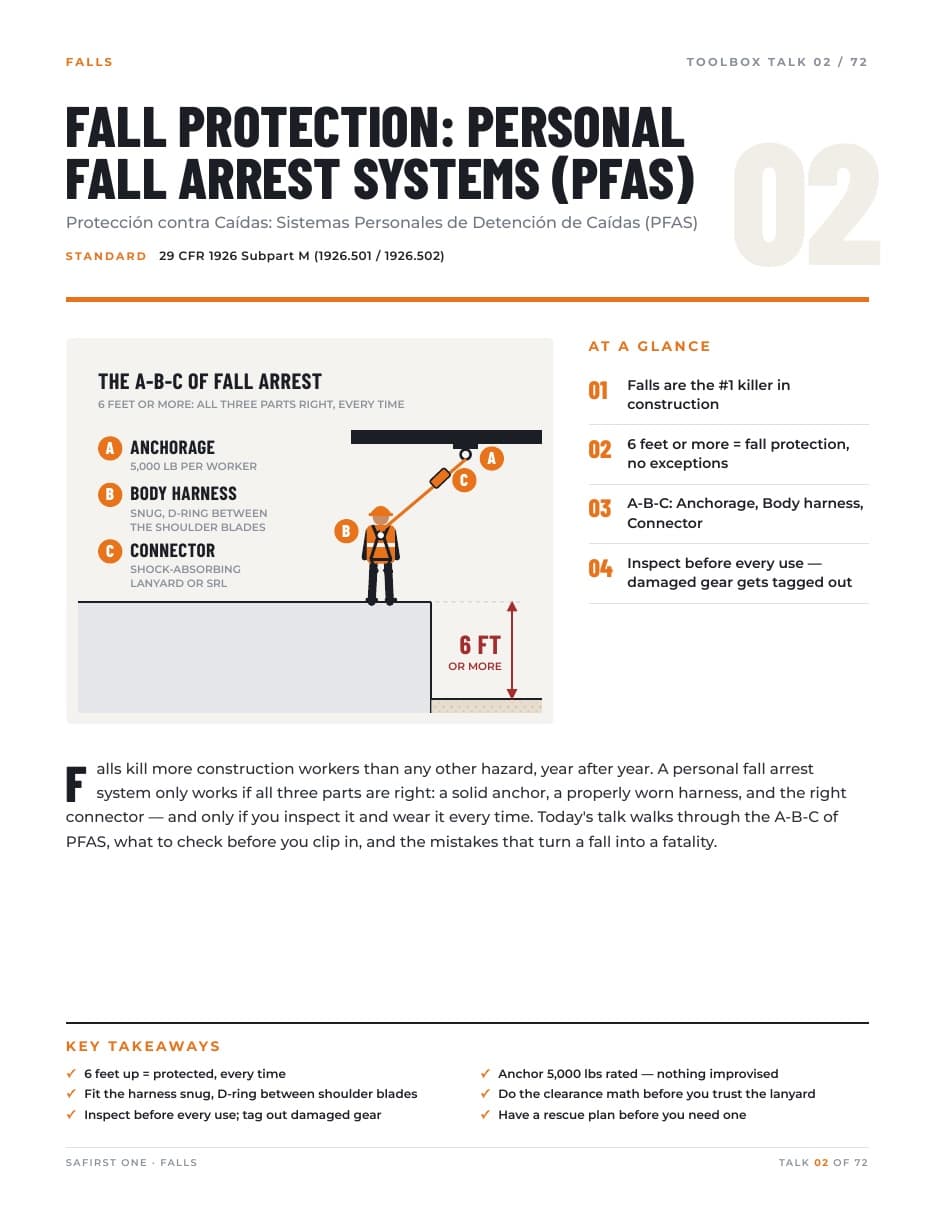
- The 6-foot rule: guardrails, nets, or a personal fall arrest system at 6 feet and above
- Ladders set at 4-to-1, three points of contact, never the top rungs
- Openings covered and marked, or guarded — a covered hole that isn't secured and labeled is a trap
Struck-By
- Vehicles and equipment, falling loads, flying debris — being hit is the second-biggest killer
- High-visibility gear around equipment, eye contact with operators, never under a suspended load
- Barricaded swing radii and drop zones mean it — walk around
Caught-In / Between
- Trench collapses, rotating parts, pinch points between machines and fixed objects
- Never in an unprotected trench past 5 feet; never between a backing machine and a wall
- Guards stay on, lockout before reaching in, nothing overhead held only by hydraulics
Electrocution
- 120 volts kills; damaged cords and missing GFCIs do it more often than power lines
- GFCI on every circuit, cords inspected daily, 10 feet from overhead lines
- Treat every wire as live until verified
Key takeaways
- Four hazards, ~60% of construction deaths
- Falls: protection at 6 feet, every time
- Struck-by: visibility, eye contact, never under loads
- Caught-in: trench protection, guards, lockout
- Electrocution: GFCI, cord checks, distance
- Every dedicated talk in this library deepens one of these
Questions for your crew
- The Focus Four — falls, struck-by, caught-in/between, and electrocution — cause roughly 60% of construction deaths, and every site has all four.
- Falls are the biggest killer: guardrails, nets, or a personal fall arrest system at 6 feet, every time.
- Struck-by: hi-vis around equipment, eye contact with operators, and never under a suspended load.
- Caught-in/between: never in an unprotected trench past 5 feet, guards stay on, lock out before reaching in, and nothing overhead held only by hydraulics.
- Electrocution: 120 volts kills — GFCI on every circuit, cords inspected daily, 10 feet from overhead lines, every wire live until verified.
- None of the four are exotic — they're the ladder, the backing truck, the trench, and the extension cord; each has a handful of habits that defeat it.
Run this talk with crew sign-offs
This talk is part of the Safirst ONE toolbox talk library, in English and Spanish. Your foreman picks the talk in the app, the crew signs from their own phones by scanning a QR code, and the signed record files itself in your Docs Locker. Talk to Safirst to get it for your crews.