Toolbox Talks
Confined Spaces Toolbox Talk
Published · 3 min read
A free, ready-to-run toolbox talk for construction crews. Read it aloud at your morning huddle; it takes about ten minutes. Leer en español →
OSHA standard: 29 CFR 1926 Subpart AA (1926.1201–1213)
At a glance
- The air inside can kill in minutes — and you can't see or smell most of it
- Permit-required spaces need testing, a permit, and an attendant
- Never enter to rescue — most confined-space victims are would-be rescuers
- No permit, no entry, no exceptions
Introduction
A confined space is anywhere big enough to enter, with limited ways in and out, that isn't designed for people to work in continuously: manholes, vaults, tanks, pits, crawl spaces, deep trenches near sewers. What makes them deadly is the atmosphere — oxygen displaced by other gases, toxic buildup, flammable vapor — none of which you can reliably see or smell. Today's talk covers how entries are controlled, and the instinct you must override: going in after a downed coworker.
Know the Space
- Confined space = big enough to enter + limited entry/exit + not designed for continuous occupancy
- Permit-required means it has (or could have) a hazardous atmosphere, engulfment risk, converging walls, or any other serious hazard
- On our sites: manholes, utility vaults, lift stations, tanks, deep pits, crawl spaces — when in doubt, treat it as permit-required until the competent person says otherwise
The Atmosphere
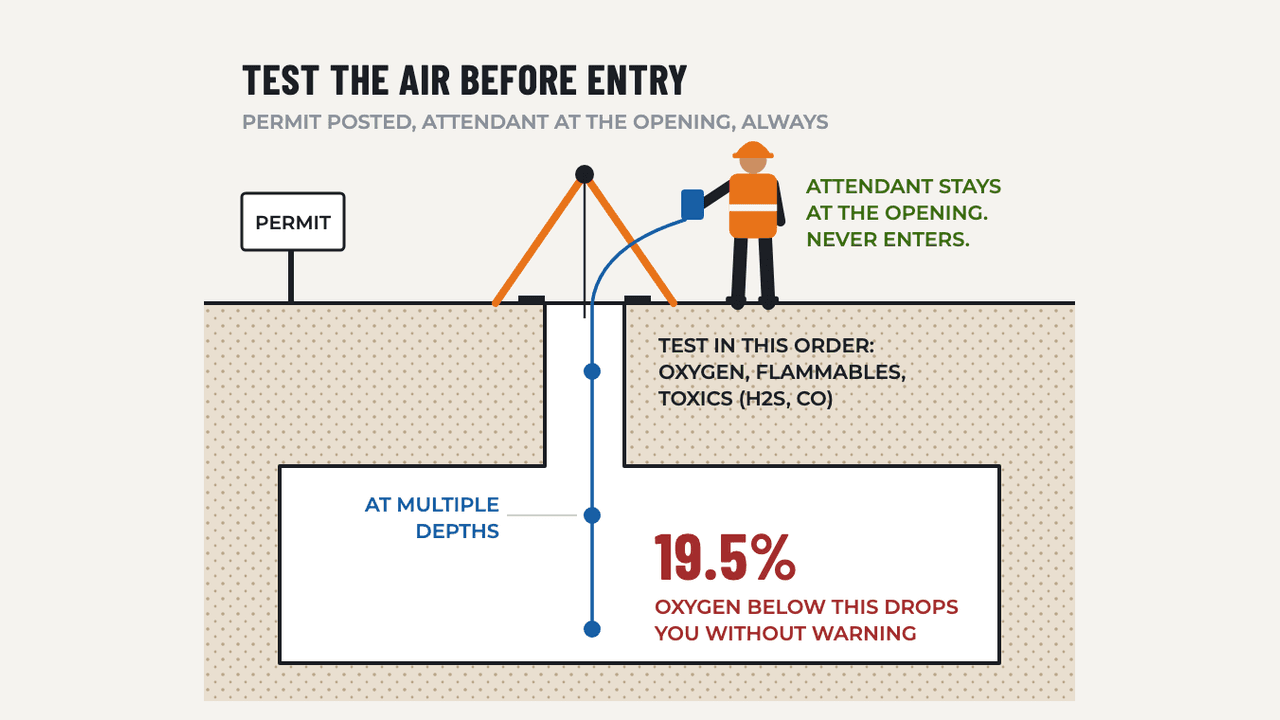
- Air is tested BEFORE entry and monitored during: oxygen, flammables, toxics like H2S and CO — in that order, at multiple depths
- Oxygen below 19.5% will drop you without warning; one breath of H2S at high concentration is enough
- Ventilation runs before and during entry; a clean test at 8 AM doesn't cover 1 PM
- Conditions change: nearby sewer work, engine exhaust, curing coatings, disturbed sludge
The Entry System
- A permit lists the hazards, controls, test results, and who's authorized — posted at the space
- The attendant stays at the opening the entire entry: counts entrants, keeps contact, controls access, calls rescue
- The attendant does NOT enter — that is the whole point of the attendant
- Retrieval gear (harness and tripod) where feasible, so rescue happens from outside
The Rescue Rule
- Most confined-space fatalities are rescuers — the air that dropped your coworker will drop you faster
- Attendant calls the rescue team; non-entry retrieval if rigged; otherwise you WAIT
- Going in bare-faced after a downed worker doesn't save them — it doubles the body count
Key takeaways
- When in doubt, it's permit-required
- Test the air first, monitor the whole time
- Permit posted, attendant at the hole, always
- The attendant never enters
- Never enter to rescue — call it in and wait
- Changing conditions mean re-test, re-permit
Questions for your crew
- Manholes, vaults, tanks, pits, deep trenches near sewers — when in doubt, treat it as permit-required until the competent person says otherwise.
- The air inside can kill in minutes and you can't see or smell most of it — test before entry and monitor continuously.
- Enter only under a posted permit, with an attendant at the opening the entire time.
- The attendant never enters — that is the whole point of the attendant.
- Never enter to rescue a downed worker — most confined-space fatalities are would-be rescuers; call the rescue team and wait.
- Conditions change: nearby sewer work, engine exhaust, curing coatings — re-test and re-permit when they do.
Run this talk with crew sign-offs
This talk is part of the Safirst ONE toolbox talk library, in English and Spanish. Your foreman picks the talk in the app, the crew signs from their own phones by scanning a QR code, and the signed record files itself in your Docs Locker. Talk to Safirst to get it for your crews.