Toolbox Talks
Hand Protection (Gloves) Toolbox Talk
Published · 3 min read
A free, ready-to-run toolbox talk for construction crews. Read it aloud at your morning huddle; it takes about ten minutes. Leer en español →
OSHA standard: 29 CFR 1926.95
At a glance
- Hands are the most injured body part in construction
- Match the glove to the task — one pair does not do everything
- NO gloves near rotating equipment — they pull hands in
- Wet cement burns skin hours before you feel it
Introduction
Look at any experienced crew and count the scarred knuckles and missing fingertips. Hands take more construction injuries than any other body part — cuts, punctures, crush injuries, burns, and chemical damage — because hands are where the work happens. Most of those injuries happen bare-handed or in the wrong glove. Today's talk covers matching the glove to the task, and the two situations where the rules reverse.
Match the Glove
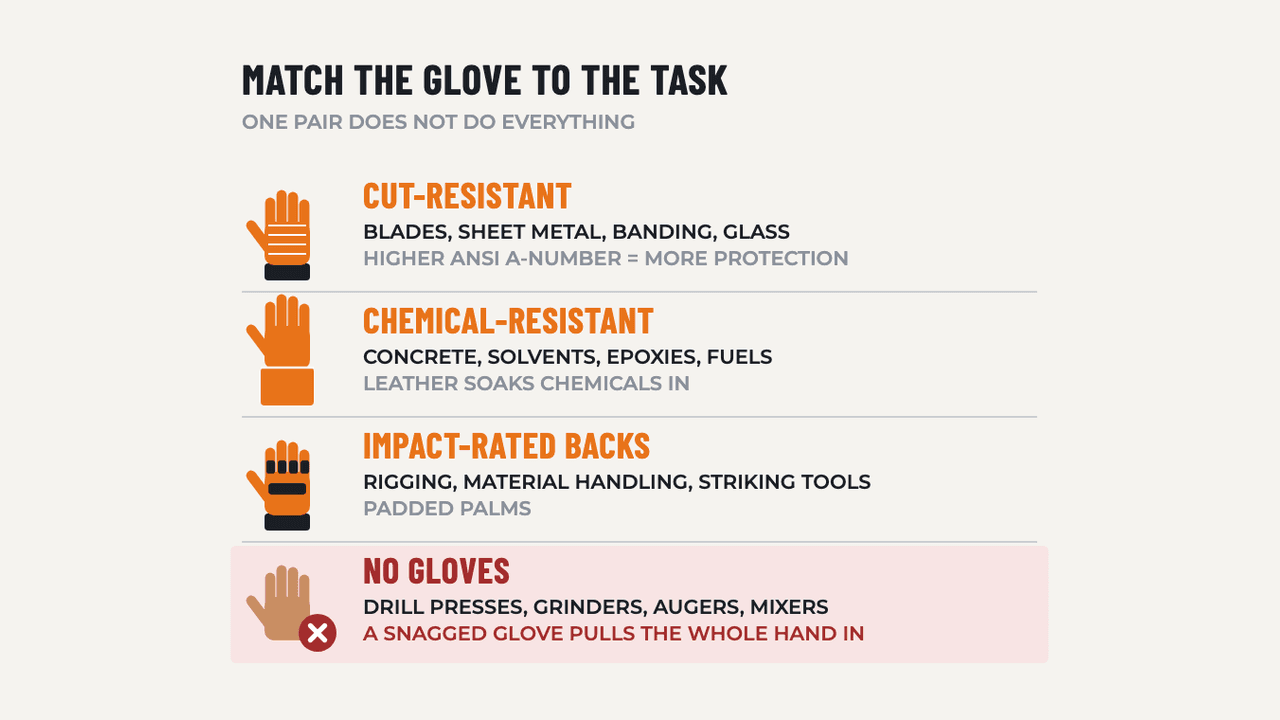
- Cut hazards — blades, sheet metal, banding, glass: cut-resistant gloves rated for the exposure (higher ANSI A-number = more protection)
- Concrete, solvents, epoxies, fuels: chemical-resistant gloves — leather soaks chemicals in and holds them against your skin
- Impact and pinch work — rigging, material handling, striking tools: impact-rated backs and padded palms
- Grip work in heat: breathable palms; sweat-slick leather drops loads
- A shredded, soaked, or worn-through glove is done — replace it, don't finish the week with it
The Reversals
- Rotating equipment — drill presses, grinders, augers, mixers: NO gloves; a snagged glove pulls the whole hand into the machine faster than you can react
- Same logic: no rings, no loose sleeves, no dangling wristbands around anything that spins — degloving injuries take the finger with the ring
Cement & Chemical Burns
- Wet concrete is caustic: it burns slowly and painlessly, and the damage shows up hours later as deep chemical burns
- Waterproof gloves and boots for concrete work; kneeling in wet mud with cloth pants soaks it against your skin
- Concrete or chemicals inside a glove is worse than no glove — rinse skin immediately, swap for a dry pair
Habits That Save Fingers
- Keep hands out of pinch points: use taglines, push blocks, and pry bars instead of fingers
- Never cut toward your hand; never hold small work against your palm to drill it
- See where your hand is BEFORE the load swings, the door closes, or the material shifts
Key takeaways
- Most injured body part — glove up accordingly
- Cut work gets cut-rated; chemicals get chemical-rated
- Never gloves, rings, or loose cuffs near rotating parts
- Wet cement burns late — waterproof and rinse fast
- Wrecked gloves get replaced, not rationed
- The best glove is a hand that isn't in the pinch point
Questions for your crew
- Hands are the most injured body part in construction — glove up accordingly.
- Match the glove to the task: cut-rated for blades and sheet metal, chemical-rated for concrete and solvents — one pair does not do everything.
- NO gloves, rings, or loose cuffs near rotating equipment — they pull hands in.
- Wet cement burns hours before you feel it — waterproof gloves, and rinse skin contact fast.
- Wrecked gloves get replaced, not rationed.
- The best glove is a hand that isn't in the pinch point — position first, PPE second.
Run this talk with crew sign-offs
This talk is part of the Safirst ONE toolbox talk library, in English and Spanish. Your foreman picks the talk in the app, the crew signs from their own phones by scanning a QR code, and the signed record files itself in your Docs Locker. Talk to Safirst to get it for your crews.