Toolbox Talks
Flash Flooding (Arizona) Toolbox Talk
Published · 4 min read
A free, ready-to-run toolbox talk for construction crews. Read it aloud at your morning huddle; it takes about ten minutes. Leer en español →
OSHA standard: General Duty Clause 5(a)(1) · 29 CFR 1926.651(h)
At a glance
- The storm that floods your wash can be 20 miles away, under blue sky here
- Six inches of moving water knocks you down; a foot floats a truck
- Trenches, washes, and low crossings are the site's flood traps — know yours
- Turn around, don't drown — and Arizona will bill you for the rescue
Introduction
Flash floods are Arizona's sucker punch: the sky above you is blue, the wash has been dry for eight months, and a storm you never saw — twenty miles upstream — sends a wall of water, mud, and debris down the channel you're working in. Flash flooding kills more people in Arizona than lightning, and a disproportionate share die in vehicles. Sites with washes, retention basins, deep excavations, or low crossings carry the risk all monsoon season. Today's talk covers reading the risk, the water math, and the vehicle rule that ends most of these stories.
The Upstream Problem
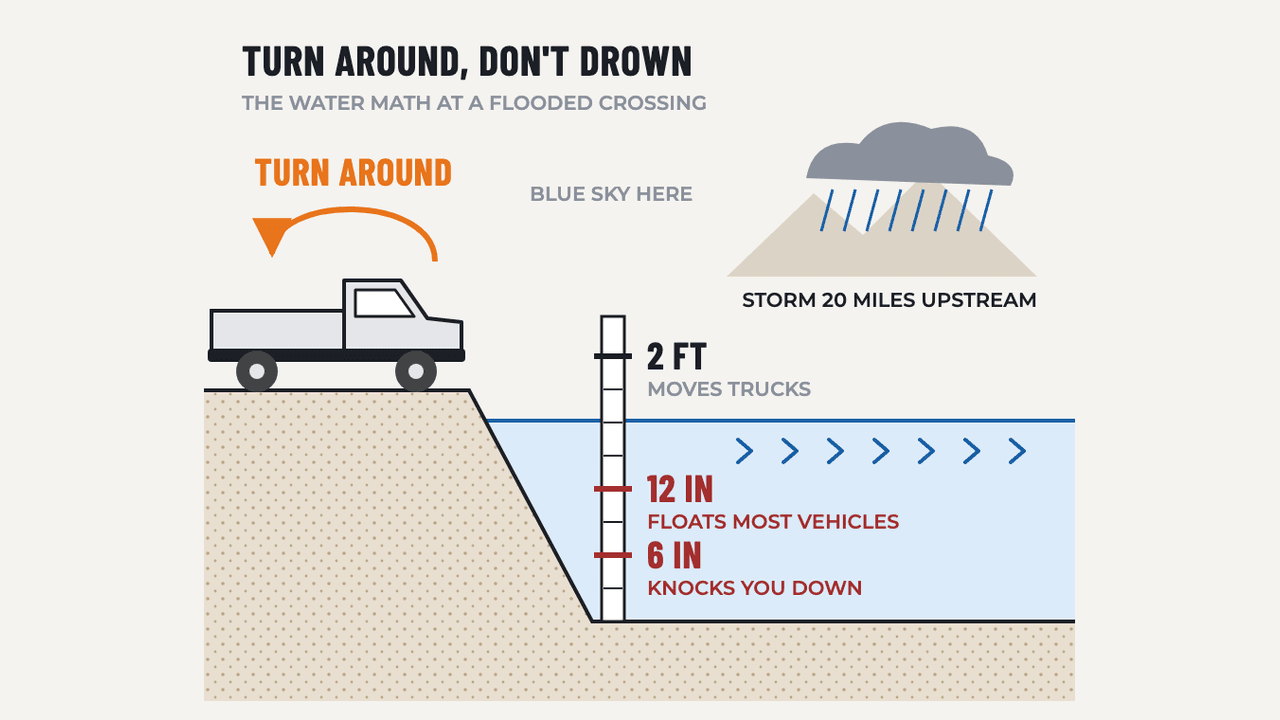
- A wash floods from ITS watershed, not your weather — blue sky overhead means nothing if it's black over the mountains
- Know before work starts: does this site touch a wash, channel, retention basin, or low crossing? That's your flood map
- Monsoon season, any wash work gets a weather check on the WATERSHED, not just the site — and an exit plan agreed before anyone goes down in
- First signs: distant thunder, a sudden debris smell, water turning muddy or rising AT ALL — get out of the channel immediately, not after confirming
The Water Math
- Six inches of moving water sweeps an adult off their feet — it doesn't look like much until it's around your boots
- Twelve inches floats most vehicles; two feet moves trucks — buoyancy doesn't care about four-wheel drive
- Flood water is a debris slurry: rocks, rebar, fence posts, half a mesquite tree — the water is the soft part of what hits you
- You cannot judge depth over a washed-out or silted road surface — the crossing may not be there anymore
Site Exposure
- Excavations and trenches ARE flash flood channels when storms hit — rain anywhere near means everyone out, and re-entry only after the competent person re-inspects (soaked walls collapse)
- Equipment, spoils, and materials staged in or beside washes move to high ground during monsoon season — the wash owns its channel
- Dewatering a flooded excavation is planned work, not a wet-vac improvisation — undermined walls and buried voids wait in there
The Vehicle Rule
- NEVER drive into water on a flooded crossing — not the work truck, not the loader, not "it's just a few inches" — turn around, take the long way
- Arizona's Stupid Motorist Law bills you for your own rescue, and the rescue is the good outcome
- Vehicle stalls in rising water: get out and get to high ground immediately — vehicles that float, roll; don't stay with it, and never let anyone go back for it
Key takeaways
- Watch the watershed, not just your sky
- Six inches takes you; twelve takes the truck
- Rising or muddying water = out of the channel NOW
- Storm anywhere near = everyone out of the trench
- Wet excavation reopens only after re-inspection
- Flooded crossing: turn around, every time
Questions for your crew
- The storm that floods your wash can be 20 miles away under blue sky here — watch the watershed, not just your sky.
- Six inches of moving water knocks you down; a foot floats a truck.
- Know the site's flood traps: trenches, washes, and low crossings.
- Water rising or turning muddy means out of the channel NOW.
- A storm anywhere near the watershed empties the trench, and a wet excavation reopens only after the competent person re-inspects.
- Flooded crossing: turn around, every time — Arizona's stupid-motorist law will bill you for the rescue.
Run this talk with crew sign-offs
This talk is part of the Safirst ONE toolbox talk library, in English and Spanish. Your foreman picks the talk in the app, the crew signs from their own phones by scanning a QR code, and the signed record files itself in your Docs Locker. Talk to Safirst to get it for your crews.