Toolbox Talks
Hazard Communication (HazCom) Toolbox Talk
Published · 3 min read
A free, ready-to-run toolbox talk for construction crews. Read it aloud at your morning huddle; it takes about ten minutes. Leer en español →
OSHA standard: 29 CFR 1910.1200 (via 1926.59)
At a glance
- You have the right to know what you're working with
- Labels and pictograms are the first warning — read them
- The SDS tells you exposure, first aid, and cleanup — know where they are
- Never put a chemical in an unlabeled or drink container
Introduction
Construction runs on chemicals: fuels, solvents, adhesives, epoxies, form oils, concrete admixtures. HazCom is the rule that says you have the right to know what's in them, what they can do to you, and how to protect yourself — through labels, Safety Data Sheets, and training. Today's talk covers how to read the warnings and the one habit that poisons more workers than any spill: unlabeled containers.
Labels & Pictograms
- Every container gets a label: product name, hazard warnings, manufacturer
- Learn the pictograms: flame (flammable), skull (acute toxicity), exclamation mark (irritant), health hazard silhouette (long-term damage), corrosion (burns skin and eyes)
- "Danger" is more severe than "Warning" — both mean read before you open
- A faded or missing label gets replaced before the product gets used
Safety Data Sheets (SDS)
- Every product on site has an SDS, and you have a right to see it — know where the binder or app is on this job
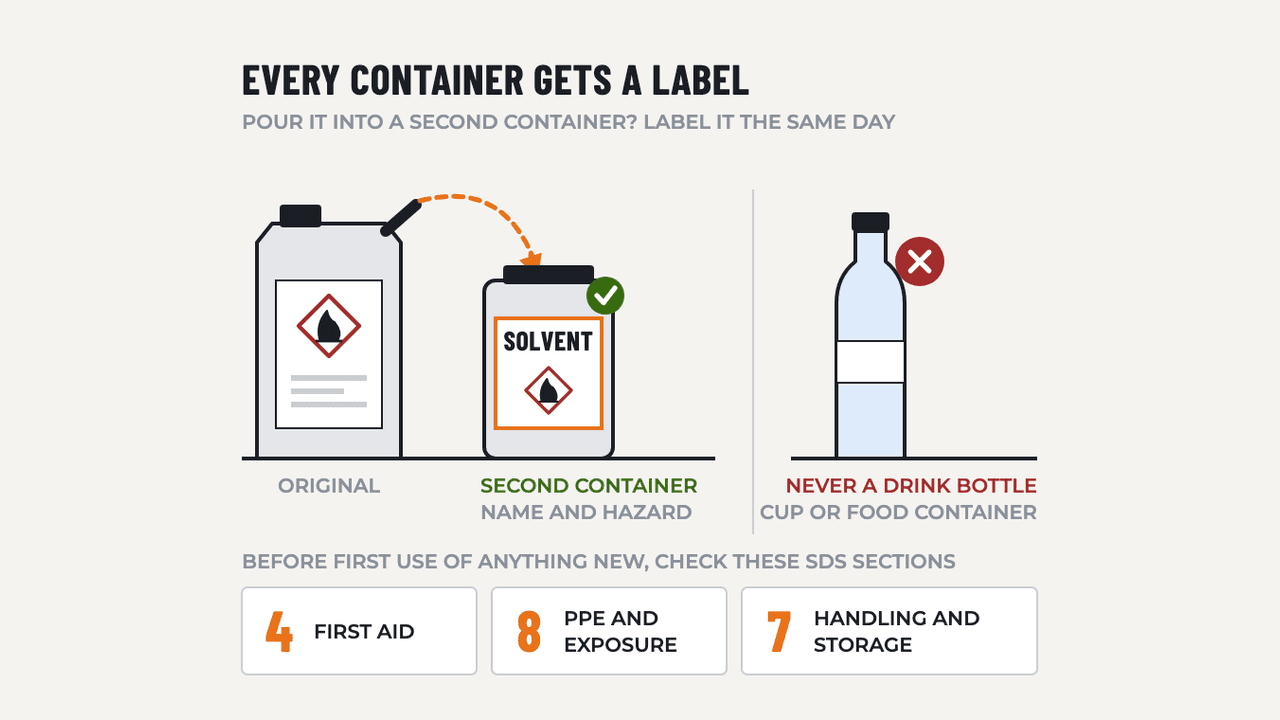
- Before first use of anything new: check Section 4 (first aid), Section 8 (PPE and exposure), and Section 7 (handling and storage)
- An SDS answers the emergency-room question — what was he exposed to? — so knowing where they are IS the emergency plan
Secondary Containers
- Pour a chemical into a second container, and that container needs a label — name and hazard, same day
- NEVER use drink bottles, coffee cups, or food containers for chemicals — workers have been poisoned drinking from a water bottle full of solvent
- Keep chemicals in their original containers whenever possible; keep lids on
Exposure & First Aid Basics
- Routes in: breathing it, skin contact, splashes to the eyes, swallowing it
- Ventilate enclosed areas when using solvents and adhesives; smell is not a reliable meter
- Know the nearest eyewash or clean-water source before you open the container
- Any exposure or reaction gets reported and checked — some effects show up hours later
Key takeaways
- Read the label before you open anything
- Know where the SDS collection lives on this site
- Label every secondary container the moment you pour
- Never chemicals in drink containers — ever
- Check first aid steps BEFORE using something new
- When in doubt, ask before you use it
Questions for your crew
- Read the label and pictograms before opening any product — a faded or missing label gets replaced before the product gets used.
- Know where the Safety Data Sheets live on this site, and check first aid and PPE sections before first use of anything new.
- Label every secondary container the moment you pour — name and hazard, same day.
- Never put chemicals in drink bottles, cups, or food containers — workers have been poisoned this way.
- Ventilate enclosed areas when using solvents and adhesives — smell is not a reliable meter.
- Report any exposure or reaction and get it checked — some effects show up hours later.
Run this talk with crew sign-offs
This talk is part of the Safirst ONE toolbox talk library, in English and Spanish. Your foreman picks the talk in the app, the crew signs from their own phones by scanning a QR code, and the signed record files itself in your Docs Locker. Talk to Safirst to get it for your crews.