Toolbox Talks
Hand Tools (Non-Powered) Toolbox Talk
Published · 3 min read
A free, ready-to-run toolbox talk for construction crews. Read it aloud at your morning huddle; it takes about ten minutes. Leer en español →
OSHA standard: 29 CFR 1926.301
At a glance
- "Just a hand tool" injuries fill more incident logs than any machine
- Mushroomed heads, loose handles, sprung jaws — out of service
- Right tool, right size: a wrench is not a hammer, a screwdriver is not a chisel
- Cut away from your body, and know where the tool goes when it slips
Introduction
Nobody holds a toolbox talk about hammers until someone loses an eye to a chip off a mushroomed chisel head or opens a forearm with a slipped utility knife. Hand tools cause a huge share of jobsite injuries precisely because nobody respects them — they're familiar, they're quiet, and they fail small until they fail into someone's hand or eye. Today's talk is the five-minute discipline that keeps hand tools boring.
Condition
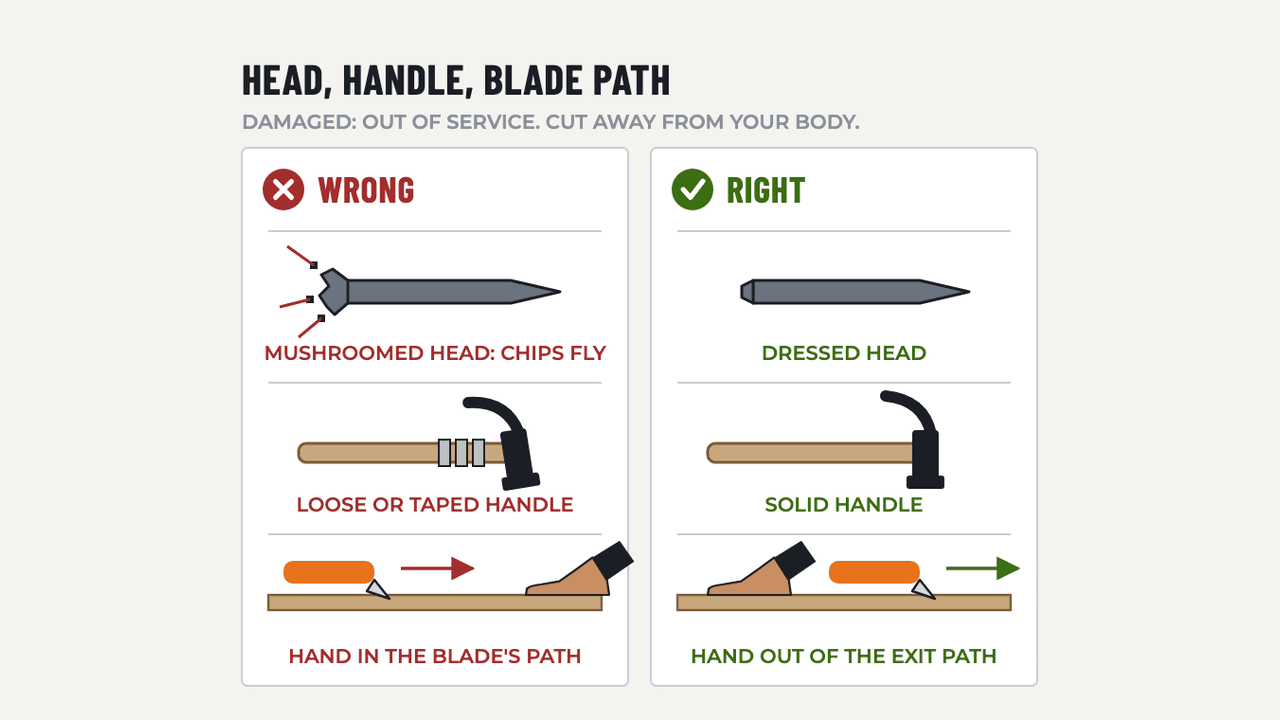
- Mushroomed striking heads on chisels, punches, and wedges chip off as shrapnel — dress or retire them
- Loose, cracked, or splintered handles on hammers and axes let heads fly — re-handle or replace, never tape and hope
- Sprung wrenches, worn pliers jaws, dull blades: each one is a slip waiting for load
- A dull blade is more dangerous than a sharp one — it needs more force, and force is what slips
Right Tool, Right Way
- Wrenches aren't hammers, screwdrivers aren't pry bars or chisels, pliers aren't wrenches — misuse is where tools break and hands land
- Size the tool to the fastener; a sloppy fit rounds the fastener and throws your knuckles
- Pull wrenches toward you rather than pushing — and brace for the give
- No cheater pipes on wrench handles; get a bigger wrench or break torque properly
Blades
- Cut AWAY from your body, your holding hand out of the exit path — ask where the blade goes when the material gives
- Retractable knives retracted the moment the cut ends; fixed blades sheathed
- Fresh blades for tough material — see dull-blade rule above
- Never a blade in a pocket, waistband, or tossed to a coworker — hand tools pass handle-first
Carrying & Storage
- Tools at height get tethered or contained — a dropped 16-oz hammer from one story hits like a brick
- Climb with hands free: belt, pouch, or hand line, never tools in hand on a ladder
- Sharp and pointed tools stored so the reach-in hand doesn't find the business end
Key takeaways
- Dress or retire mushroomed heads
- Solid handles, tight jaws, sharp blades
- Right tool, right size — no improvising
- Cut away; know the slip path
- Pass handle-first, tether at height
- Small tools fill the injury log — respect them
Run this talk with crew sign-offs
This talk is part of the Safirst ONE toolbox talk library, in English and Spanish. Your foreman picks the talk in the app, the crew signs from their own phones by scanning a QR code, and the signed record files itself in your Docs Locker. Talk to Safirst to get it for your crews.