Toolbox Talks
Material Storage & Disposal Toolbox Talk
Published · 3 min read
A free, ready-to-run toolbox talk for construction crews. Read it aloud at your morning huddle; it takes about ten minutes. Leer en español →
OSHA standard: 29 CFR 1926.250 · 1926.252
At a glance
- Stacks fail sideways: stable base, limited height, tied or stepped back
- Arizona wind turns sheet goods into missiles — secure them the day they arrive
- Nothing stored within 6 feet of an edge, an opening, or a hoist zone
- Disposal is a workflow, not a pile — sort it, contain it, haul it
Introduction
Materials hurt people twice: once when a stack falls on someone, and again slowly, as stored-anywhere piles turn the site into a maze of trip hazards, fire load, and blocked exits. Storage looks like logistics, but it's a safety system — stack height, base condition, edge setbacks, and wind securing all decide whether material stays put. Today's talk covers stacking that doesn't fall, storing that doesn't burn or block, and getting waste off site before it becomes a hazard of its own.
Stacking That Stays Stacked
- Firm, level base — a stack on soft or sloped ground is already falling, slowly
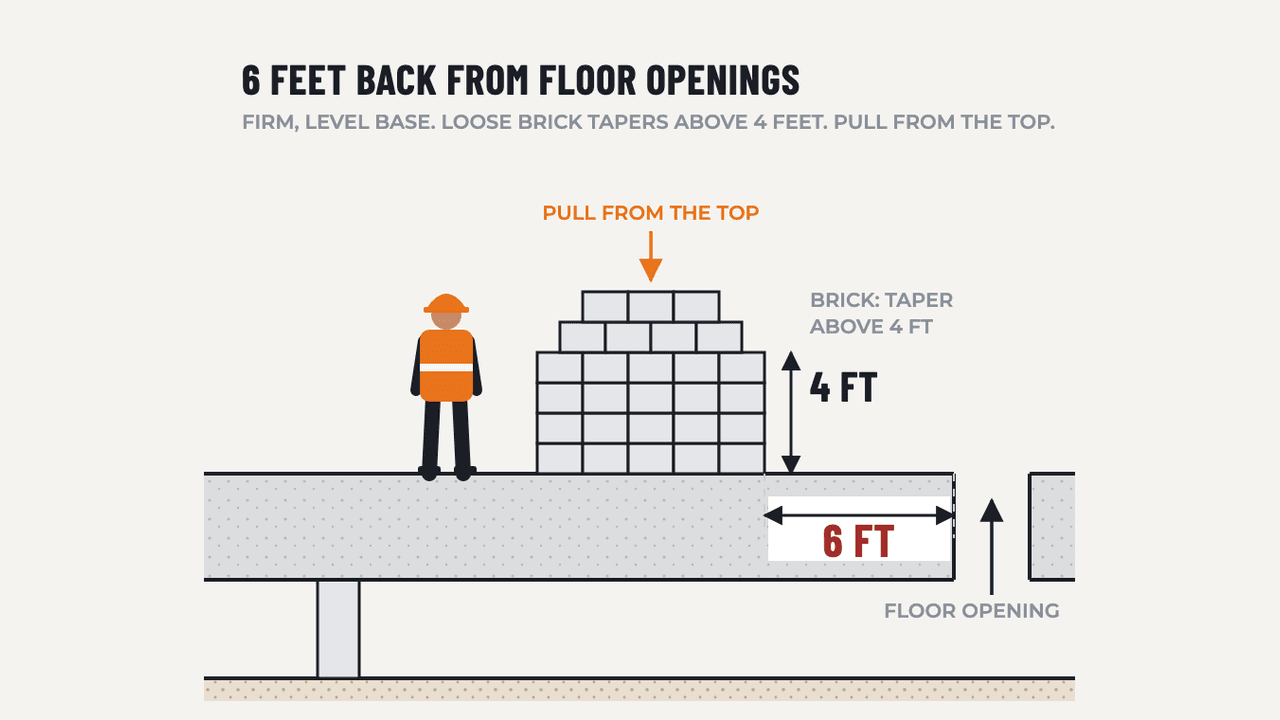
- Height limits exist: block and brick stacks taper back above 4 feet; lumber stacked by hand stays under 16 feet, under 20 by machine; bagged material steps back each layer
- Pipe, rebar, and round stock get racked or chocked — a rolling pile releases without warning
- Pull from the TOP of stacks, never from the middle or the side — undermining a stack is how it lands on you
- Leave working aisles between stacks wide enough for people AND the equipment that serves them
Wind, Edges & Zones
- Sheet goods — plywood, drywall, foam, metal panels — get flat-stacked or strapped THE DAY they land; a monsoon outflow gust arrives faster than a crew can react
- Nothing loose stored on roofs or upper decks without securing — what blows off a deck lands on someone
- Keep storage 6 feet back from slab edges, openings, and excavations; further for tall stacks
- Never block exits, extinguishers, electrical panels, hydrants, or eyewash stations — walk the zone after every delivery
Disposal Is Part of the Job
- Separate the streams: general debris, recyclable metal, concrete/masonry, and hazardous waste (solvents, adhesives, aerosols, oils) — hazardous never goes in the general bin
- Overfilled dumpsters shed on the wind and on the hauler — call the pull before the crown
- Nail-studded lumber goes to the pile with nails pulled or bent — the disposal pile is not exempt from the nail rule
- Chutes for elevated debris, never free-drops; barricade below any loading operation
Key takeaways
- Level base, height limits, taper the stacks
- Round stock racked and chocked, always
- Pull from the top — never undermine a stack
- Sheet goods secured the day they arrive (wind!)
- 6 feet back from edges and openings
- Hazardous waste gets its own container, every time
Questions for your crew
- Stacks fail sideways: stable level base, height limits, tied or stepped back.
- Round stock — pipe, rebar bundles, poles — racked and chocked, always.
- Pull from the top of a stack, never undermine it.
- Arizona wind turns sheet goods into missiles — secure them the day they arrive.
- Nothing stored within 6 feet of an edge, an opening, or a hoist zone.
- Disposal is a workflow, not a pile: sorted, contained, hauled — and hazardous waste gets its own container, every time.
Run this talk with crew sign-offs
This talk is part of the Safirst ONE toolbox talk library, in English and Spanish. Your foreman picks the talk in the app, the crew signs from their own phones by scanning a QR code, and the signed record files itself in your Docs Locker. Talk to Safirst to get it for your crews.