Toolbox Talks
Backing & Spotter Safety Toolbox Talk
Published · 2 min read
A free, ready-to-run toolbox talk for construction crews. Read it aloud at your morning huddle; it takes about ten minutes. Leer en español →
OSHA standard: 29 CFR 1926.601 · 1926.602
At a glance
- Backing equipment is blind — the spotter is its eyes
- One spotter, agreed signals, always visible to the operator
- Spotters spot — no phone, no second task, no standing in the path
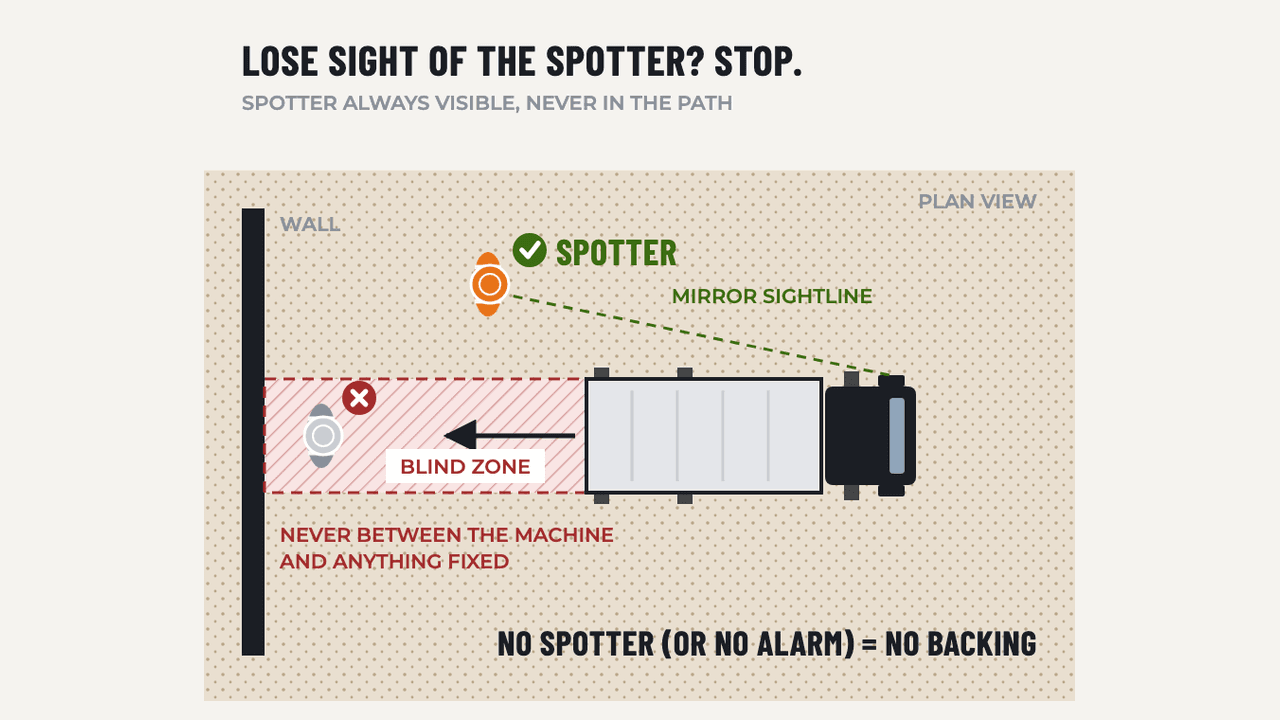
- Lose sight of the spotter? STOP. Immediately.
Introduction
Workers struck by backing equipment die inside a zone the operator physically cannot see — and the fix is old, cheap, and constantly skipped: a dedicated spotter. Most backing fatalities happen with no spotter, a distracted spotter, or a spotter who stepped into the machine's path to be seen better. Today's talk sets the contract between operator and spotter, and the rule everyone else follows around reversing iron.
The Operator's Half
- Walk around the machine before mounting — the blind zone behind a haul truck hides a whole crew, kneeling workers vanish behind pickups
- Backup alarm functional or the machine doesn't back without a spotter, period
- Agree the signals BEFORE moving; windows down where practical
- The instant the spotter leaves the mirror or sightline: full stop, and stay stopped until they reappear and signal
The Spotter's Half
- Spotting is the whole job — no phone, no chatting, no grabbing material on the side
- Stand where the operator can always see you, OUTSIDE the machine's path and its pinch points — never between the machine and anything fixed
- Hi-vis on, standard signals big and unambiguous; at night, lighted wands
- You own the zone: hold traffic and pedestrians out of it until the move is done
Everyone Else
- An alarm beeping is not permission ignored — clear the path, make eye contact, or stay out of the area
- Never walk behind a machine that's running, even "parked" — operators pull away without warning
- Site layout beats vigilance: plan pull-through parking, one-way loops, and marked equipment lanes to erase backing where possible
Key takeaways
- No spotter (or no alarm) = no backing
- Walk the blind zone before you mount
- Spotter always visible, never in the path
- Spotting is a full-time task while it lasts
- Sight lost = machine stops, instantly
- Design out backing with pull-throughs and loops
Run this talk with crew sign-offs
This talk is part of the Safirst ONE toolbox talk library, in English and Spanish. Your foreman picks the talk in the app, the crew signs from their own phones by scanning a QR code, and the signed record files itself in your Docs Locker. Talk to Safirst to get it for your crews.