Toolbox Talks
Abrasive Wheels & Grinders Toolbox Talk
Published · 2 min read
A free, ready-to-run toolbox talk for construction crews. Read it aloud at your morning huddle; it takes about ten minutes. Leer en español →
OSHA standard: 29 CFR 1926.303
At a glance
- A shattering wheel is shrapnel at 9,000 RPM
- Ring-test bench wheels; inspect every wheel before mounting
- Wheel speed rating must meet or beat the grinder's RPM
- Face shield over safety glasses, guard on, no side-of-wheel grinding
Introduction
An abrasive wheel does its work by being hard and fast — and when one lets go, it doesn't crack, it explodes into fragments moving faster than you can flinch. Wheel failures come from mounting damage, the wrong wheel on the wrong tool, dropped wheels put back into service, and grinding on surfaces the wheel wasn't built for. Today's talk covers wheel selection, mounting, and the habits that keep the wheel in one piece.
The Wheel
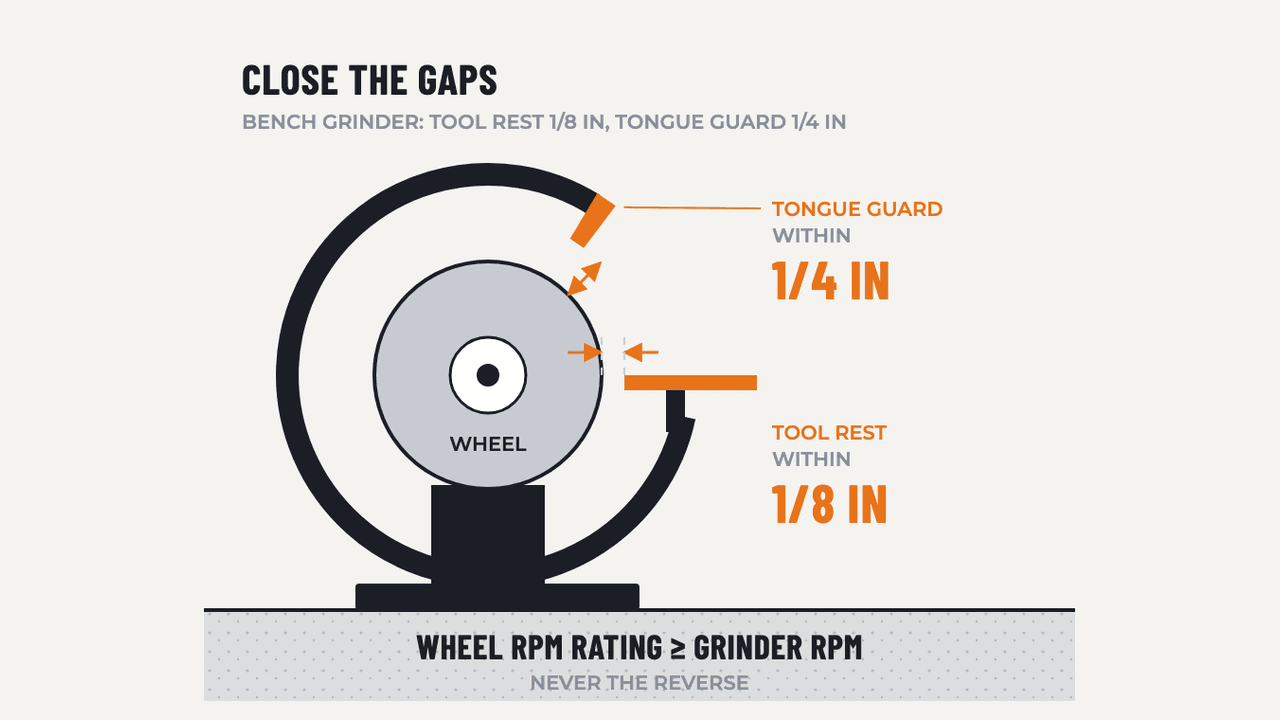
- Match the wheel to the machine AND the material: the wheel's rated RPM must meet or exceed the grinder's maximum — never the reverse
- Inspect before mounting: cracks, chips, moisture damage; ring-test vibratory bench wheels (a healthy wheel rings, a cracked one thuds)
- A dropped wheel is a suspect wheel — retire it, don't remount it
- Cutting wheels cut, grinding wheels grind: side-loading a thin cut-off wheel snaps it
Mounting & Guards
- Use the blotters and flanges the wheel requires, snugged evenly — overtightening cracks wheels too
- Guard covers at least half the wheel and sits between the wheel and your face
- After mounting, stand aside and run at operating speed for a full minute before first contact — new wheels fail in the first minute
- Bench grinders: tool rest within 1/8 inch of the wheel, tongue guard within 1/4 inch
Working
- Face shield OVER safety glasses — grinding throws both sparks and fragments; hearing protection too
- Let the wheel do the work: heavy leaning overheats and cracks wheels and kicks the grinder back
- Keep the spark stream away from people, fuels, and combustibles — a grinder is hot work when combustibles are near (see the fire talk)
- Let the wheel stop before setting the grinder down; no wheel touching anything while coasting
Key takeaways
- Wheel RPM rating ≥ grinder RPM, always
- Inspect and ring-test; dropped wheels retire
- Right wheel for the job — no side-loading cut-off wheels
- Guard on, one-minute stand-aside spin-up
- Face shield over glasses, sparks aimed safe
- Let it stop before it leaves your hands
Run this talk with crew sign-offs
This talk is part of the Safirst ONE toolbox talk library, in English and Spanish. Your foreman picks the talk in the app, the crew signs from their own phones by scanning a QR code, and the signed record files itself in your Docs Locker. Talk to Safirst to get it for your crews.