Toolbox Talks
Anchorage & Anchoring Equipment (PFAS) Toolbox Talk
Published · 3 min read

A free, ready-to-run toolbox talk for construction crews. Read it aloud at your morning huddle; it takes about ten minutes. Leer en español →
OSHA standard: 29 CFR 1926.502(d)(15)
At a glance
- Your harness is only as good as what it's tied to
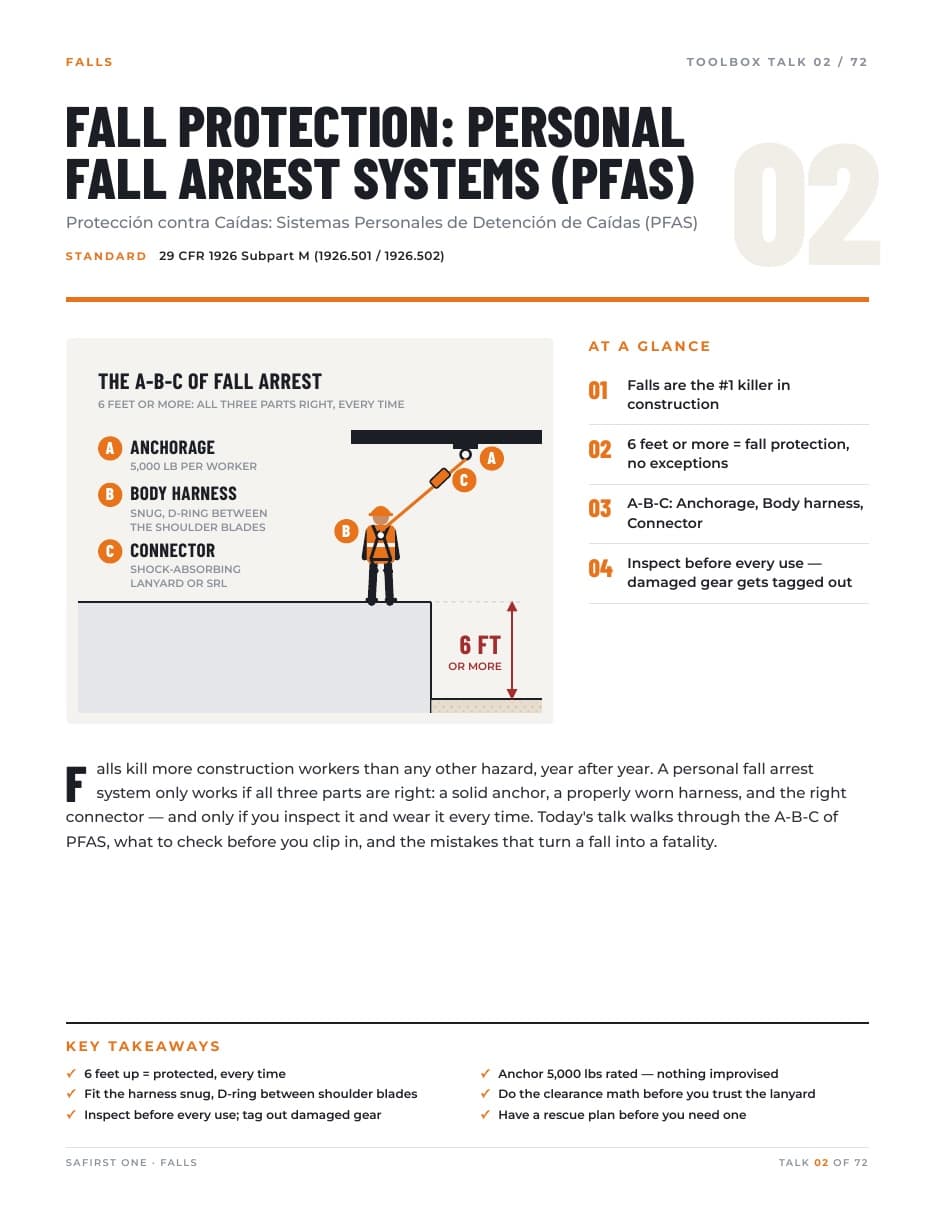
- Anchors hold 5,000 pounds per worker — or are engineered at 2:1 by a qualified person
- Anchor high: at or above the D-ring, to cut free-fall and swing
- Guardrails, conduit, and rebar are NOT anchors
Introduction
The fall protection talk covered the harness and lanyard. This one covers the part of the system most often gotten wrong: the anchor. A perfect harness tied to a bad anchor is a controlled descent to the same impact. Anchors must hold 5,000 pounds per attached worker — the force of a pickup truck hanging from the hook — or be designed by a qualified person with a 2:1 safety factor. Today's talk is what qualifies, what never does, and where to place it.
What Qualifies
- Engineered anchor points: cast-in or bolted anchors, certified roof anchors, beam clamps and trolleys rated for fall arrest
- Structural steel and concrete members identified by a competent or qualified person — not "it looks beefy"
- Manufactured systems used per their instructions: horizontal lifelines are engineered systems, never improvised from wire rope
- When in doubt, ask before you tie off — the question costs nothing
What Never Qualifies
- Guardrails, handrails, conduit, sprinkler pipe, rebar, plumbing, ductwork, light steel bracing
- Scaffold components, unless the scaffold was designed and approved for anchorage
- Another worker's lanyard, a forklift's forks, the back of a truck
- Anything you can flex by hand will not stop a 5,000-pound event
Placement
- Anchor at or above your D-ring — every foot the anchor sits below you adds free-fall distance and impact force
- Mind the swing: tie off far to one side and a fall becomes a pendulum into the column — keep the anchor near vertical over your work
- Do the clearance math: free fall + deceleration + your height + safety margin; a 6-foot lanyard with a shock absorber needs roughly 18 feet of clearance below the anchor
- At heights under that clearance, a self-retracting lifeline anchored overhead is the answer, not hope
Connectors & Care
- Locking snap hooks and carabiners only, compatible with the anchor — side-loading a hook on a beam flange defeats it
- No knots in lanyards, no wrapping the lanyard back on itself unless it's rated for tie-back
- Inspect anchors and connectors before each use; anything deformed, cracked, or corroded is out of service
Key takeaways
- 5,000 pounds per worker, or engineered 2:1
- Anchor at or above the D-ring
- Guardrails and pipe are never anchors
- Do the clearance math before you trust the lanyard
- Watch the swing path, not just the drop
- Not sure it qualifies? Ask before tying off
Questions for your crew
- Your harness is only as good as what it's tied to — anchors hold 5,000 pounds per worker or are engineered at a 2:1 safety factor by a qualified person.
- Guardrails, conduit, rebar, and pipe are never anchors.
- Anchor at or above the D-ring to cut free-fall distance and swing.
- Do the clearance math before trusting a lanyard — a 6-foot shock-absorbing lanyard needs roughly 18 feet of clearance below.
- Watch the swing path, not just the drop — anchoring off to the side turns a fall into a pendulum.
- Not sure the point qualifies? Ask before tying off — guessing is how anchors fail.
Run this talk with crew sign-offs
This talk is part of the Safirst ONE toolbox talk library, in English and Spanish. Your foreman picks the talk in the app, the crew signs from their own phones by scanning a QR code, and the signed record files itself in your Docs Locker. Talk to Safirst to get it for your crews.