A free, ready-to-run toolbox talk for construction crews. Read it aloud at your morning huddle; it takes about ten minutes. Leer en español →
OSHA standard: 29 CFR 1926.602 · 29 CFR 1910.178
At a glance
- Trained and evaluated operators only — per truck type
- Seatbelt on: in a tip-over you ride it down, you don't jump
- Loads low, mast back, and drive in reverse when the load blocks view
- Pedestrians and forklifts don't share paths — eye contact or stay back
Introduction
A rough-terrain forklift is several tons of counterweighted steel working on ground that isn't flat, around people who aren't watching. The two events that kill are tip-overs — usually with the operator trying to jump clear and getting caught by the cage — and pedestrians struck or crushed in blind spots. Today's talk covers stability, visibility, and the walking-around-it rules that everyone on site owns, licensed or not.
Operators
- Trained, evaluated, and authorized for THIS class of truck — variable-reach telehandlers are their own animal
- Daily pre-use inspection: brakes, steering, hydraulics, tires, horn, backup alarm, forks and attachments — deficiencies tag it out
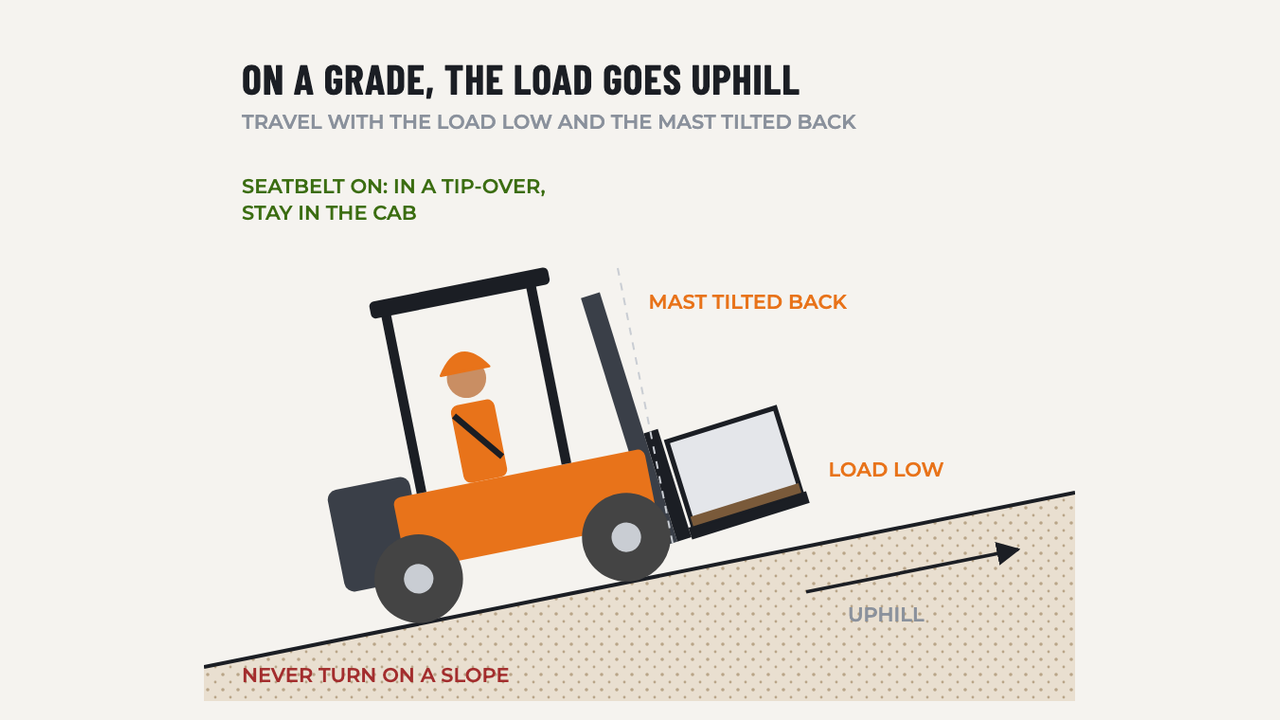
- Seatbelt every trip: in a tip-over, brace and stay IN the cab; jumping puts you under the overhead guard
- No riders, ever, and nobody lifted on forks or a pallet — only an approved work platform, properly secured
Stability & Loads
- Know the capacity AT your load center and attachment — a fork extension or a wide load cuts capacity fast
- Travel with the load low and the mast tilted back; loads uphill on grades
- Rough terrain means walking the route: soft spots, edges, trench crossings, overhead lines
- Turn slowly and never on a slope — an unloaded forklift tips easier than a loaded one
Visibility & Pedestrians
- Load blocks the view? Drive in reverse or use a spotter
- Horn at corners, doorways, and blind stacks; backup alarm working always
- On foot: never walk under raised forks, loaded or empty; never cut behind a truck in motion; make eye contact before crossing its path
- Parked means forks flat on the ground, brake set, key per site rule
Key takeaways
- Certified on THIS truck class, daily inspection done
- Seatbelt on — stay in the cab in a tip-over
- Capacity at YOUR load center, not the plate maximum
- Low load, mast back, uphill on grades, slow turns
- Blocked view = reverse or spotter
- On foot: eye contact, never under forks
Run this talk with crew sign-offs
This talk is part of the Safirst ONE toolbox talk library, in English and Spanish. Your foreman picks the talk in the app, the crew signs from their own phones by scanning a QR code, and the signed record files itself in your Docs Locker. Talk to Safirst to get it for your crews.