Toolbox Talks
Post-Tension Cable Safety Toolbox Talk
Published · 3 min read
A free, ready-to-run toolbox talk for construction crews. Read it aloud at your morning huddle; it takes about ten minutes. Leer en español →
OSHA standard: 29 CFR 1926.701(c) · General Duty Clause
At a glance
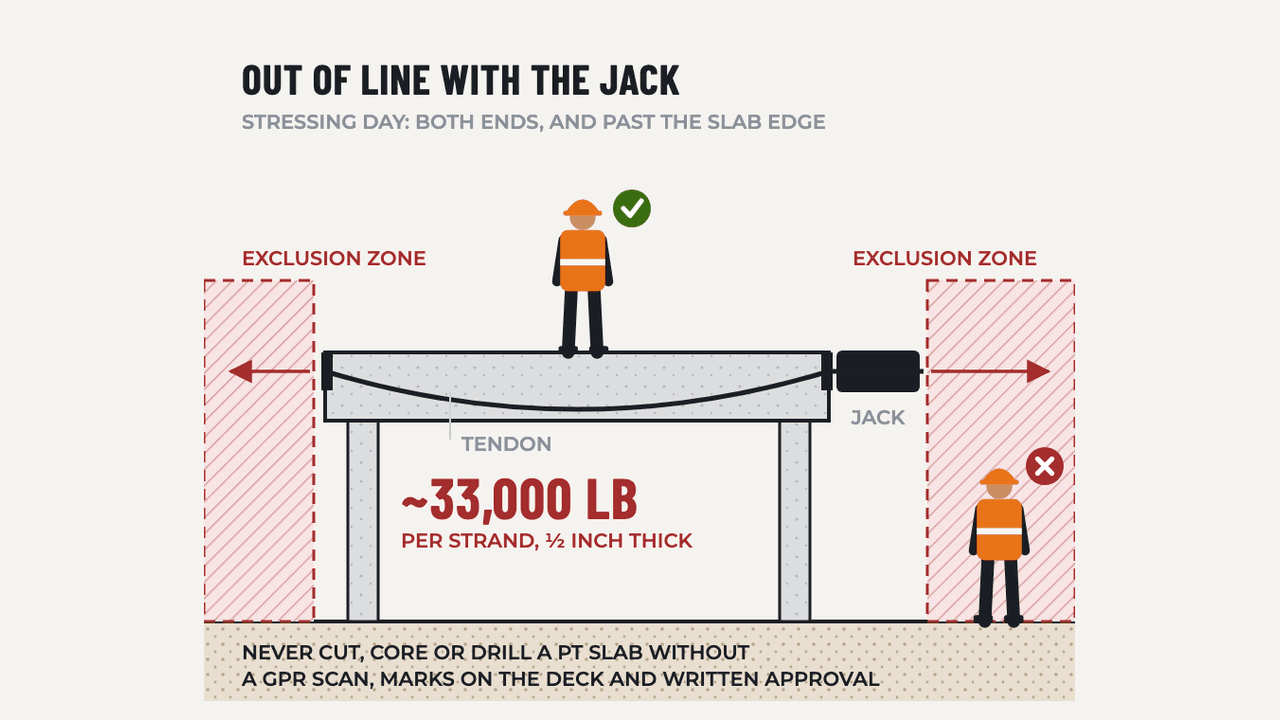
- A stressed PT cable carries ~33,000 pounds of stored energy — treat the slab like it's loaded
- NEVER cut, core, or drill a PT slab without locating cables and written approval
- During stressing: stay out of the line of the jack, both ends, no exceptions
- PT slabs are usually stamped or signed — but absence of a sign proves nothing
Introduction
A post-tensioned slab holds steel cables stressed to around 33,000 pounds of force — the energy of a loaded pickup truck at highway speed, stored in a strand a half-inch thick and buried in the concrete you're about to core. Cut one and the cable can blow out of the slab edge, whip through formwork, or launch the anchor like a cannon shell. Workers have been killed by cables they didn't know were there. Today's talk covers recognizing PT construction, the cutting rule, and stressing-day discipline.
Know You're on PT
- Look for the signs: stamped or painted "POST TENSION" warnings on the slab, tendon tails at slab edges before finishing, grease-filled plastic sheathing in the pours, anchor pockets along edges
- Common in parking structures, elevated decks, and slab-on-grade across the Valley — assume newer slabs COULD be PT until drawings say otherwise
- No stamp doesn't mean no cables: older or poorly marked slabs hide them too — the drawings and a scan are the truth, not the surface
The Cutting Rule
- Never cut, core, drill, or trench a PT slab without: the structural drawings reviewed, cables located by scanning (GPR), marks on the deck, and written approval from supervision
- Cable locations shift during the pour — trust the scan over the drawings when they disagree
- Even shallow anchor drilling counts near tendon depth; "it's just a Tapcon" has found cables
- Hit or nick something you suspect is a tendon? STOP, barricade, report — a damaged strand can fail hours later
Stressing Operations
- Stressing day is exclusion-zone day: NEVER stand behind the jack or in line with the tendon at either end — a failure fires the equipment and cable along that line
- The zone extends past the slab edge — flag it and keep other trades out, including below the edge form
- Only the PT crew handles jacks, wedges, and tails; nobody else touches equipment or cut tails
- Blowouts, slab cracking near anchors, or wedge failures get reported immediately — the engineer decides, not the schedule
Key takeaways
- PT slab = loaded spring; ~33,000 pounds per strand
- No cutting or coring without scan, marks, and written OK
- Trust the scan over the drawings
- Nicked a tendon? Stop, barricade, report
- Stressing: out of line with the jack, both ends
- No stamp is not clearance — verify first
Questions for your crew
- A stressed post-tension strand carries roughly 33,000 pounds of stored energy — treat the slab like a loaded spring.
- NEVER cut, core, or drill a PT slab without a scan, marked cables, and written approval.
- Trust the scan over the drawings — as-builts lie.
- Nicked a tendon? Stop, barricade the area, and report — don't touch it again.
- During stressing, stay out of the line of the jack at both ends, no exceptions.
- PT slabs are usually stamped, but absence of a stamp proves nothing — verify first.
Run this talk with crew sign-offs
This talk is part of the Safirst ONE toolbox talk library, in English and Spanish. Your foreman picks the talk in the app, the crew signs from their own phones by scanning a QR code, and the signed record files itself in your Docs Locker. Talk to Safirst to get it for your crews.