Toolbox Talks
Overhead Power Line Safety Toolbox Talk
Published · 3 min read
A free, ready-to-run toolbox talk for construction crews. Read it aloud at your morning huddle; it takes about ten minutes. Leer en español →
OSHA standard: 29 CFR 1926.1408 · 1926.416(a)
At a glance
- Look up FIRST — before ladders, lifts, cranes, and dump beds go up
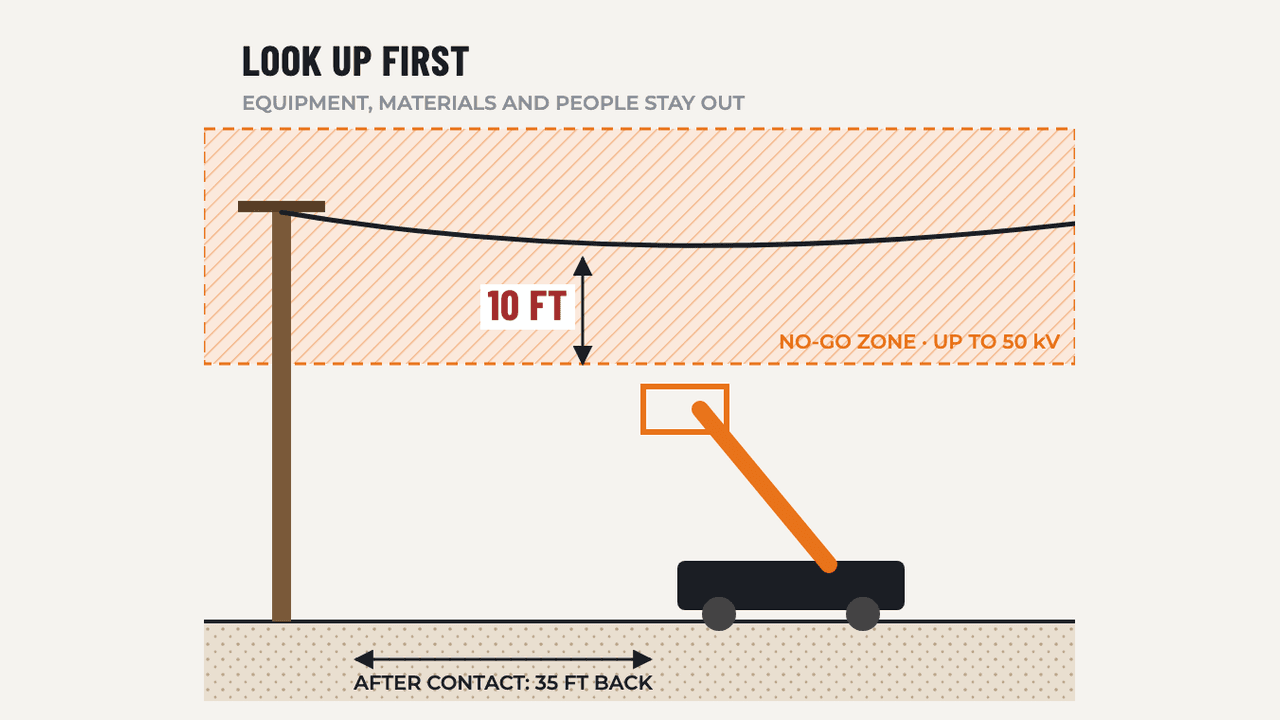
- 10 feet minimum from lines up to 50kV; more above that
- Assume every line is energized — insulation and "it's just cable TV" are traps
- Contact happens? Stay on the machine, warn everyone back
Introduction
Overhead power line contact is one of the most reliably fatal events in construction, and the victim is usually not an electrician — it's the laborer moving an extension ladder, the operator raising a dump bed, the crew setting trusses. The line was there all along; nobody looked up at the right moment. Today's talk covers clearances, the equipment that reaches lines, and what to do in the seconds after a contact.
Look Up, Plan Around
- Walk the site and map every overhead line BEFORE work starts; mark danger zones on the ground where equipment could reach
- 10 feet minimum clearance from lines up to 50kV — for equipment, materials, AND you; higher voltage means more distance
- Treat every line as energized: weathered insulation protects the wire, not you, and "phone" or "cable" lines can be misidentified power
- Need to work closer? That's a call to the utility for de-energizing, insulating blankets, or a spotter plan — arranged in advance, never improvised
The Equipment That Finds Lines
- Extension ladders carried vertical — carry them horizontal, two people if needed
- Dump beds left raised while driving off
- Crane booms, concrete pump masts, drill rigs, and lift platforms swinging or extending into the zone
- Long conductive materials — rebar, pipe, truss chords — carried upright under lines
- A dedicated spotter with no other duties any time equipment works near the 10-foot boundary
If Contact Happens
- On the machine: STAY on it and drive clear if possible; the ground around it is energized in rings
- If fire forces you off: jump clear with feet together — never touch machine and ground at once — and shuffle away, feet never separating
- On the ground: stay back at least 35 feet, keep everyone else back, call 911 and the utility
- Never touch the machine, the load, or the victim connected to either
Key takeaways
- Map the lines before the first ladder goes up
- 10 feet minimum, more above 50kV
- Every line is live until the utility says otherwise
- Ladders horizontal, beds down, booms planned
- Contact: stay on the machine, feet-together jump only if forced
- 35 feet back, and nobody plays rescuer
Run this talk with crew sign-offs
This talk is part of the Safirst ONE toolbox talk library, in English and Spanish. Your foreman picks the talk in the app, the crew signs from their own phones by scanning a QR code, and the signed record files itself in your Docs Locker. Talk to Safirst to get it for your crews.