Toolbox Talks
Foot Protection Toolbox Talk
Published · 3 min read
A free, ready-to-run toolbox talk for construction crews. Read it aloud at your morning huddle; it takes about ten minutes. Leer en español →
OSHA standard: 29 CFR 1926.96 · ASTM F2413
At a glance
- Safety-toe boots rated ASTM F2413 are the site minimum
- Puncture-resistant soles where nails and rebar live — which is framing and demo
- A blown-out boot protects like a sneaker: replace it
- In Arizona heat, your soles cook — check them
Introduction
Twenty-six bones, and one dropped block or one protruding nail can wreck enough of them to end a career. Foot injuries look minor on the stats sheet until it's your foot: crush injuries that never heal right, puncture wounds that infect, sprains that follow you for years. Boots are the one piece of PPE you wear every minute of every shift, which is exactly why nobody thinks about them. Today's talk is what your boots need to be, and when they stop being it.
The Baseline
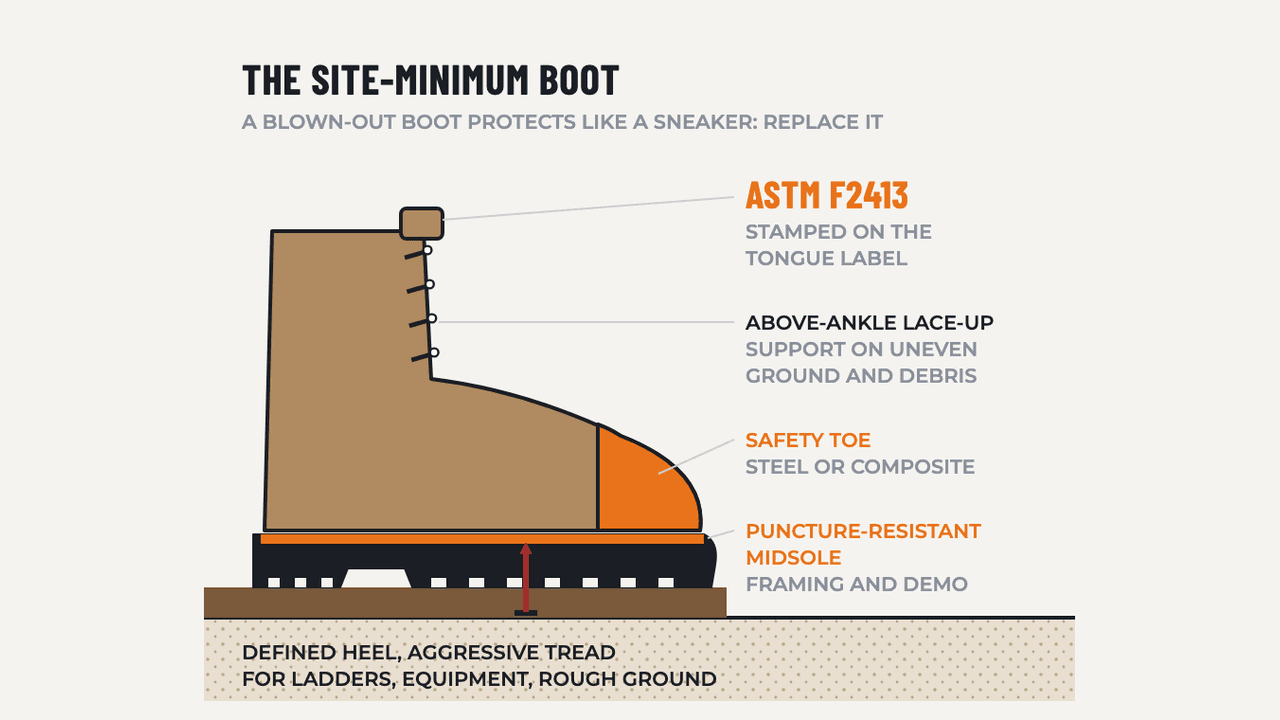
- Safety-toe (steel or composite) rated ASTM F2413 — the rating is stamped on the tongue label
- Defined heel and aggressive tread for ladders, equipment, and rough ground
- Above-ankle lace-up for support on uneven ground and around debris
- No athletic shoes, no sandals, no worn-flat soles — including "just dropping something off"
Match the Work
- Framing, demo, and site work over debris: puncture-resistant midsoles — a nail through a standard sole is a trip to the ER and weeks off
- Concrete work: waterproof boots, pants OVER the boot tops so wet mud can't pour in — cement burns inside a boot are brutal
- Metatarsal guards where crush exposure is constant: heavy material handling, demolition, plate work
- Electrical work: EH-rated soles, kept dry and intact — the rating dies with a worn-through sole
When a Boot Is Done
- Sole separation, worn-smooth tread, exposed steel toe, crushed toe box, dead ankle support
- Arizona bonus: hot slab and asphalt cook sole adhesives — delaminating soles in summer are common; check them
- Boots that got soaked dry out fully before the next shift, or you're breeding foot problems
- A boot that has taken a real crush hit may be compromised even if it looks fine — like a hard hat, replace it
Key takeaways
- ASTM F2413 safety toe — check the tongue stamp
- Puncture-resistant soles for framing and demo
- Pants over boot tops in concrete work
- EH rating only counts with intact, dry soles
- Blown-out boots protect nothing — replace them
- Summer slab heat kills soles — inspect them
Questions for your crew
- Safety-toe boots rated ASTM F2413 are the site minimum — check the stamp on the tongue.
- Puncture-resistant soles where nails and rebar live — framing and demolition especially.
- Pants over boot tops in concrete work — cement inside a boot burns all shift.
- The electrical-hazard rating only counts with intact, dry soles.
- A blown-out boot protects like a sneaker — replace it.
- Arizona slab heat cooks soles — inspect them through the summer.
Run this talk with crew sign-offs
This talk is part of the Safirst ONE toolbox talk library, in English and Spanish. Your foreman picks the talk in the app, the crew signs from their own phones by scanning a QR code, and the signed record files itself in your Docs Locker. Talk to Safirst to get it for your crews.