OSHA & ADOSH
Fall Protection Compliance Starts With the Foreman, Not Gear
Published · 10 min read

Fall protection compliance for a foreman means walking today's edges with the crew and holding the tie-off standard on himself every morning before the first lift. In Safirst inspection data, 2025-2026, fall protection is 825 findings: one total that appears as three separate categories within the top-ten findings. When that standard breaks, the usual cause is a foreman standing alone.
Same hazard. Three labels.
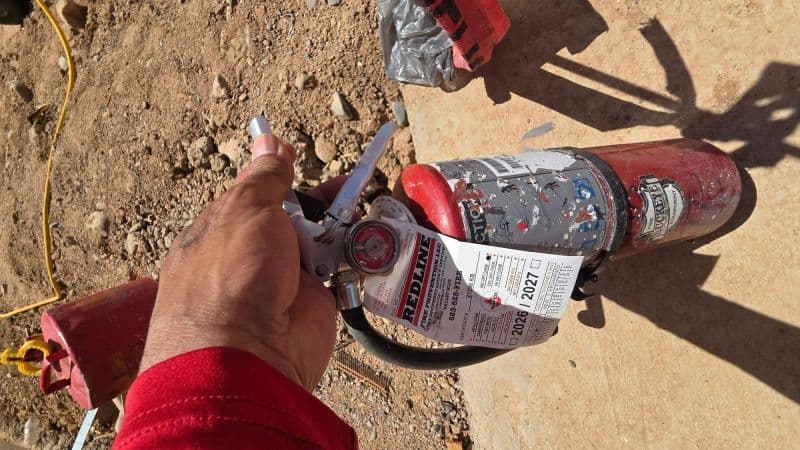
A crew I found during an inspection in Phoenix shows what sits under those labels. They were on the exterior top plate, thirty feet up. None of them were tied off. I stopped work. The real diagnosis on that job was an intimidated foreman, not missing gear.
Most foremen I talk to believe the opposite. Harnesses are on the truck, the crew heard the rule, so the job is covered. If a guy is untied at thirty feet, that's a guy who won't listen.
I disagree.
Why is fall protection the finding that keeps showing up three times in a top ten?
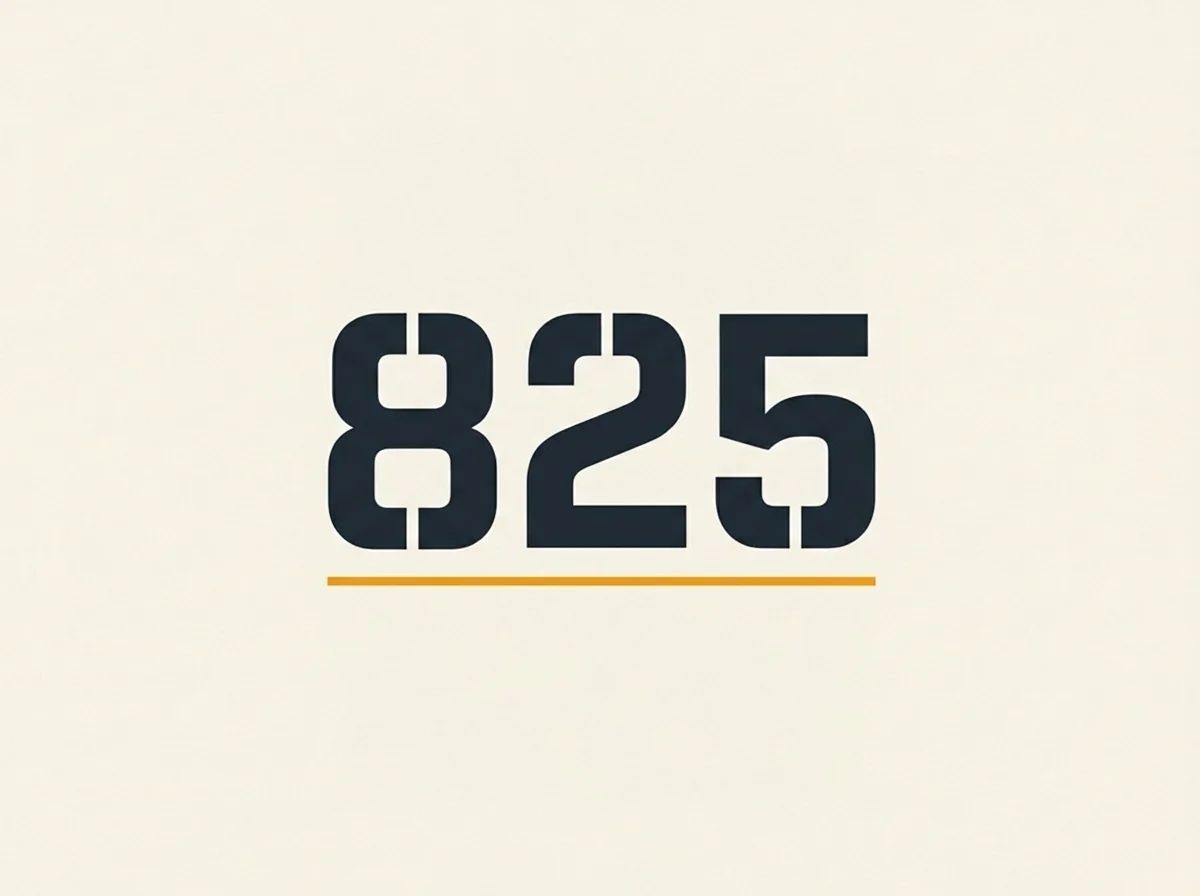
Fall protection keeps showing up three times because the hazard follows the work. Every edge, opening, roof and top plate a crew touches is one more place to miss it. In Safirst inspection data, 2025-2026, the 825 fall-protection findings are one total that appears as three separate categories within the top-ten findings.
Those 825 findings are one fall protection miss, logged under three different labels.
Federal OSHA sees the same pattern nationally. On OSHA's preliminary top 10 list for fiscal year 2026 (Oct. 1, 2025, to Aug. 31, 2026), Fall Protection, general requirements, 29 CFR 1926.501, is the most frequently cited standard.
The rule itself is not complicated. Under 29 CFR 1926.501(b)(1), the trigger is an unprotected side or edge 6 feet or more above a lower level. Each employee working that surface has to be protected by a guardrail system, a safety net system or a personal fall arrest system. For residential work, 29 CFR 1926.501(b)(13) sets the same 6-foot trigger height.
Six feet. No foreman in Arizona is fuzzy on that number.
So here's what the three labels tell me. If the fix were buying more harnesses, one purchase order would close it out. A hazard that keeps landing in three places on the list is a decision getting skipped in three places, every day, by somebody who knows the rule.
In my experience, that somebody is usually the foreman: the man who was supposed to hold the line and didn't feel like he could. I wrote about the gap between a signed training record and a held standard in our piece on safety culture vs compliance, so I won't rerun it here.
What is a foreman actually afraid of when he doesn't enforce tie-off?
In my experience, a foreman who doesn't enforce tie-off fears his own crew's reaction more than he fears ADOSH. An ADOSH inspector is a visitor. His guys are on that deck with him every morning. Stopping work costs a foreman standing with the people he works beside tomorrow, and he pays that cost by himself.
On that Phoenix top plate, the real diagnosis was an intimidated foreman.
As I read it, he was one man holding a standard by himself.
If your crew isn't tied off safely, that's not a crew problem. That's a leadership problem.
Look at what the usual response does to that foreman. The company writes up the crew, the foreman watches it happen, and now he's the guy whose crew got written up. Next time he sees an open edge, he has even more reason to look away.
Crews don't resist safety. They resist feeling blamed. A foreman feels that same pressure from both directions, and fear from above never fixed fear from below.
What does a fall protection plan look like at 6:30 in the morning, before the first lift?
A 6:30 a.m. fall protection plan is a ten-minute walk of today's edges, done by the foreman with the crew, before anybody climbs. It names every exposure over the trigger height, matches each one to a system, counts anchors against men, and ends with the foreman saying the standard out loud, including to himself.
Here's the walk. Run it complete, every morning, on every deck.
| Step | What the foreman checks | The rule behind it |
|---|---|---|
| 1. Name today's edges | Every side, edge, opening and top plate the crew will work 6 feet or more above a lower level | 29 CFR 1926.501(b)(1), or (b)(13) for residential |
| 2. Pick the system for each edge | Guardrail, safety net or personal fall arrest. Say which one, out loud, per edge | 29 CFR 1926.501(b)(1) |
| 3. Check the surface | The deck or plate can carry the guys working it | 29 CFR 1926.501(a)(2) |
| 4. Count anchors against men | Each anchor rated for at least 5,000 pounds per employee attached. More men than anchors means somebody waits | 29 CFR 1926.502(d)(15) |
| 5. Check the rigging | No free fall over 6 feet, and no contact with the level below | 29 CFR 1926.502(d)(16)(iii) |
| 6. Put the competent person on it | The person on site who can identify the fall hazards and has authority to fix them on the spot signs off on the set-up | 29 CFR 1926.32(f) |
| 7. Check anybody new | Trained by a competent person, with a written training record carrying his name, the training date and a signature | 29 CFR 1926.503(a)(2) and (b)(1) |
| 8. Say who can stop work | Every man on the crew, by name, and the foreman included in the rule | Your own program |
Step 8 is the one I'd fight hardest for. On that Phoenix top plate, the crew was thirty feet up with nobody tied off, and the foreman was holding the standard alone. The foreman doesn't just tell the crew the standard. He says out loud that it applies to him first, and that any guy on the deck can call him on it.
Saying the standard out loud flips who holds the line: six guys and a foreman against the edge, instead of one foreman against six guys.
My recommendation: write the walk down, too. A dated walk sheet signed by the foreman and the competent person is the record that shows an inspector the plan happened that morning. For training, 29 CFR 1926.503(b)(2) says "The latest training certification shall be maintained." How long you keep the walk sheets themselves is a program call, so consult your safety professional.
The anchor count in step 4 has a hard limit. If you've got two anchors and five men on a roof, no morning talk solves it. Two anchors for five men is a purchasing and sequencing call for whoever runs the job, and the foreman should send it up the chain that morning instead of negotiating it on the deck.
The 6:30 walk also has a shelf life: it expires the moment the work moves. A new opening gets cut, a guardrail section comes down for a material landing, a crew shifts to the next elevation. Walk it again when the job changes, not when the clock says so.
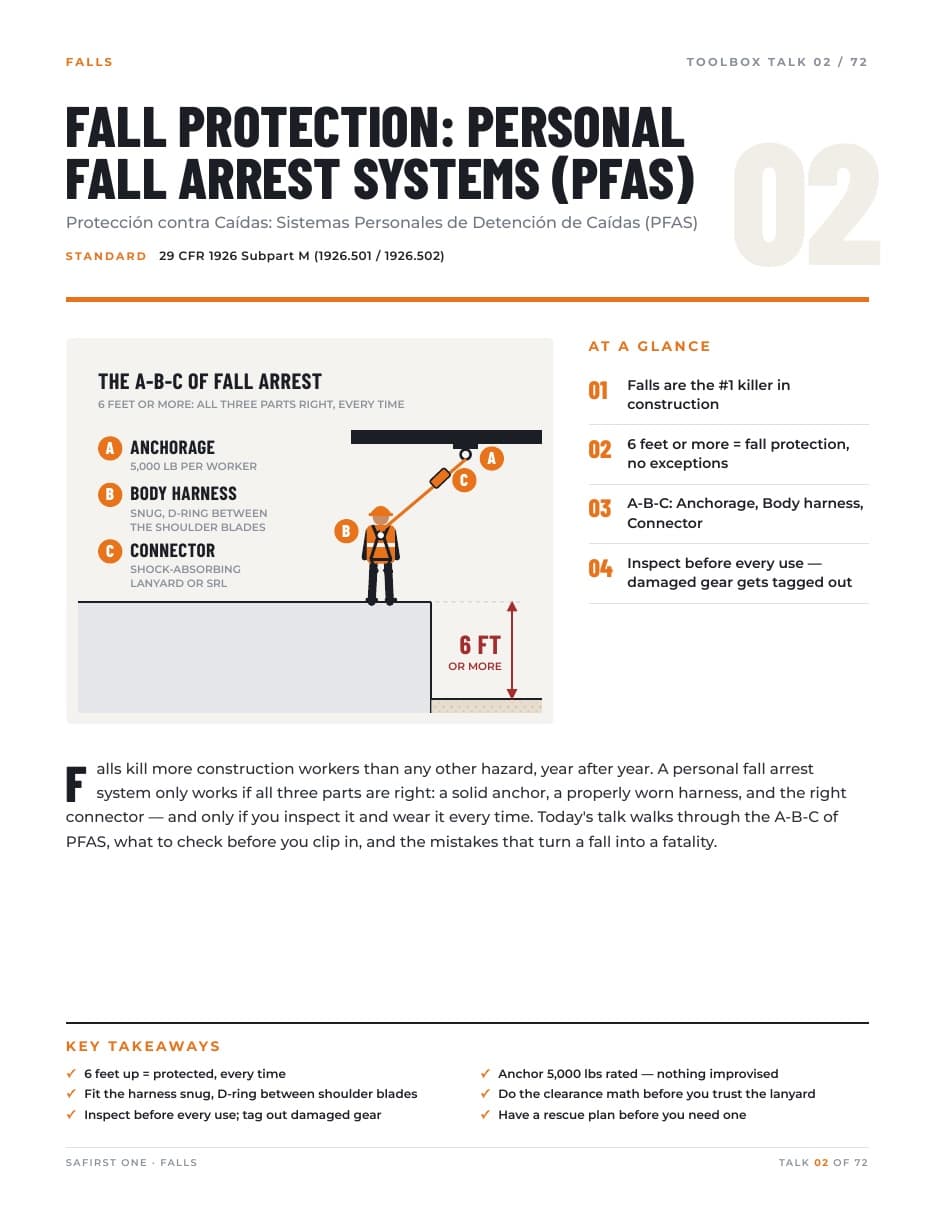
For the gear side of step 5, our personal fall arrest systems toolbox talk is a good one to run right after the walk, in English and Spanish.
What does a serious fall protection citation cost your company in Arizona?
Arizona's penalty ceiling tracks federal OSHA's. Under A.R.S. 23-418, a serious violation carries a civil penalty of not more than the maximum OSHA has adopted for serious violations. OSHA's 2026 maximum for a serious violation is $16,550, per OSHA's penalty page.
The ceiling climbs fast from there. OSHA's 2026 maximum for a willful or repeat violation is $165,514, per the same OSHA penalty schedule. A.R.S. 23-418 ties Arizona's willful and repeated ceiling to OSHA's adopted figure as well.
OSHA's 2026 penalty figures are ceilings, not the amount printed on every citation. ADOSH proposes the actual amount, and how it gets figured for your company is a question for your safety professional.
The three labels matter for your wallet too. A fall protection hazard that keeps showing up on your jobs is the kind of pattern that turns one citation into a bigger conversation. Consult your safety professional on what your own citation history means for your exposure.
The dollar figure, honestly, is the second number I care about. The first one is the guy at thirty feet. One step off that top plate and his family's life changes for good.
Life safety is the ROI. Families intact. Reputation intact. The dollars come after.
How do you hold the standard without blaming the guys?
You hold the standard without blaming the guys by fixing the condition before you correct the man. When somebody's untied, the first question is what made tying off hard right there: no anchor, a bad sequence, a schedule push. Fix that, in front of the crew, and the standard stays the crew's instead of the foreman's.
Three moves make it stick:
- Take the fear out of the stop. When a foreman stops work over an open edge, somebody above him backs him the same shift, out loud. If the GC calls about the delay, you take the call, not him.
- Flip the power structure. The crew holds the standard with him. The guy who says "hold up, the anchor's not set" is doing his job, and the foreman says so.
- Recognize the stand. Credit the stop-work that cost an hour, by name, where the crew hears it. I laid out how that builds a foreman's standing over months in our article on foreman safety leadership.
The rule still doesn't bend. A guy who's been planned for, given the gear and the time, and still won't tie off is a conduct issue, and it gets handled as one.
On the jobs I walk, that guy is the exception. Far more often I find a crew that knows the rule and a foreman who doesn't believe anybody has his back. That's field observation from our client jobsites, not a study, and I'd rather tell you so.
Get every foreman holding the same standard
One foreman running the 6:30 walk is a good morning. Twelve foremen across five jobs running it every day is a team's worth of work. Every walk has to get logged, every new guy's training record has to stay current, and every stop-work call has to reach leadership.
Plenty of contractors try to run that off one safety person and a stack of paper. Safirst ONE is how foremen pre-plan daily operations, crews report hazards without fear, and leaders build safety culture at scale. Your people spend the morning on the edge walk instead of the filing.
If you want a second set of eyes first, ask us out to walk one of your jobs with your foreman. Our upcoming guide to ADOSH violations in Arizona construction will cover the rest of the list.
Put the 6:30 walk on next week's schedule for every crew working an edge over six feet. Then back the first foreman who stops work because of it, the same shift, where his crew can see it. Let's go.
Frequently asked questions
On most Arizona construction jobs, ADOSH does. ADOSH operates under the Industrial Commission of Arizona through an OSHA-approved state plan, and it enforces the federal construction standards Arizona has adopted, 29 CFR 1926. That means the fall protection rules in 29 CFR 1926 Subpart M are the ones an ADOSH inspector cites. For questions about a specific site's jurisdiction, consult your safety professional.