Toolbox Talks
Face Shields Toolbox Talk
Published · 3 min read
A free, ready-to-run toolbox talk for construction crews. Read it aloud at your morning huddle; it takes about ten minutes. Leer en español →
OSHA standard: 29 CFR 1926.102
At a glance
- A face shield goes OVER safety glasses, never instead of them
- Grinding, cutting, chipping, and chemical work are face-shield tasks
- The shield protects the face; the glasses protect the eyes — you need both
- Scratched, clouded, or cracked shields get replaced
Introduction
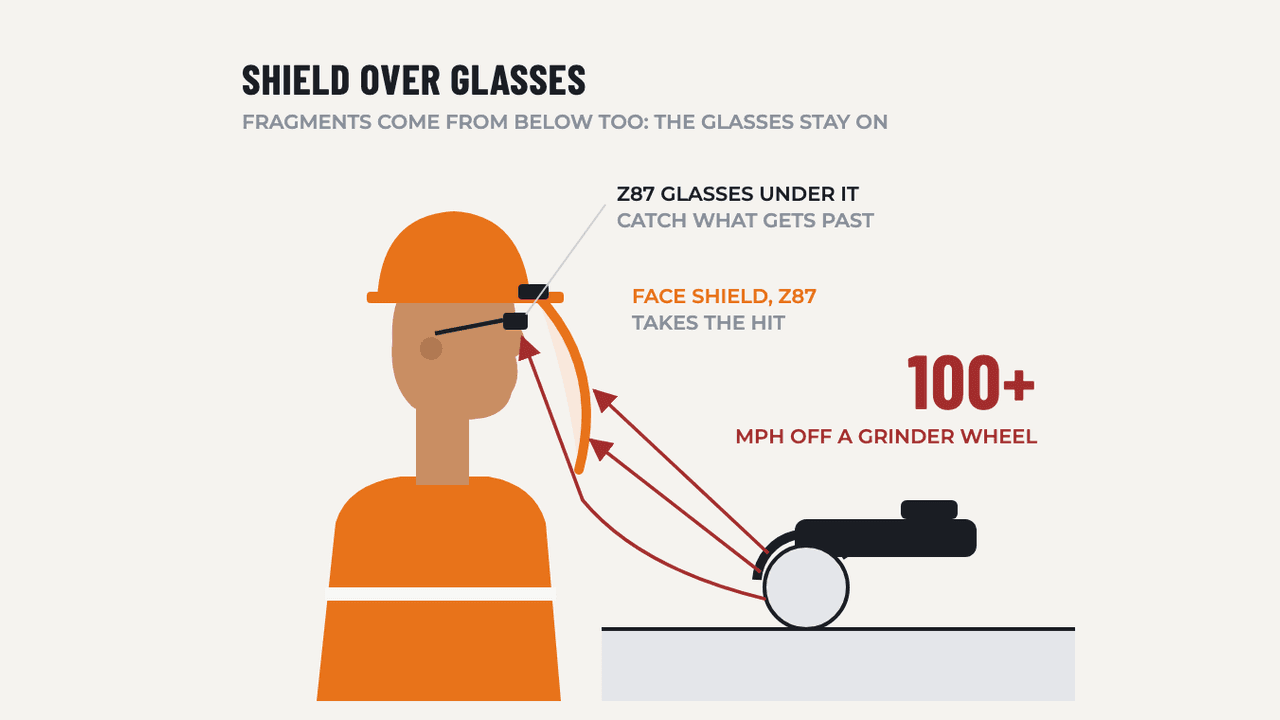
A grinder wheel sheds fragments at over a hundred miles an hour, and it doesn't aim for your safety glasses — it sprays your whole face: cheeks, mouth, jaw, throat. That's what face shields are for. But the shield alone has gaps underneath and around it that fine debris finds easily, which is why the rule is layered protection: Z87 safety glasses underneath, shield over the top. Today's talk covers which tasks demand a shield and how to keep one working.
Shield Tasks
- Grinding, abrasive cutting, wire wheeling — the highest-energy fragment producers on site
- Chipping, scaling, and demolition hammer work — chunks, not dust
- Chemical splash work: pouring solvents, acid cleaning, pressure washing concrete
- Chop saws and masonry saws throwing chips and slurry
- If the tool's own manual says face shield, that ends the discussion
Layered, Always
- Glasses under the shield, every time — fragments ricochet up under a shield from below; fine dust drifts around its edges
- The shield takes the hit so your face doesn't; the glasses catch what gets past
- Welding is its own system: welding hood with the right filter shade, and safety glasses under the hood for grinding between welds
- Chin guards for heavy grinding; a short shield leaves your throat in the spray
Condition & Fit
- Scratched or clouded shields hide the hazard from you — replace the window, they're cheap
- Cracked or brittle shields shatter instead of deflecting; sun exposure ages plastic fast out here
- The shield rated Z87 like the glasses — a hardware-store visor is not protection
- Adjust the headgear so it stays put when you look down; a shield you keep flipping up is a shield that's up at the wrong moment
Key takeaways
- Shield OVER glasses — layered, not either/or
- Grinding, chipping, cutting, chemicals: shield on
- Fragments come from below too — that's why glasses stay on
- Z87-rated shield, not a visor
- Scratched or cracked windows get swapped
- Flipping it up mid-task is how faces get hit
Questions for your crew
- A face shield goes OVER safety glasses, never instead of them — the shield protects the face, the glasses protect the eyes.
- Grinding, cutting, chipping, and chemical splash work are face-shield tasks.
- Fragments come from below and around the shield too — that's why the glasses stay on.
- Use a Z87-rated shield, not a visor.
- Scratched, clouded, or cracked windows get swapped.
- Flipping the shield up mid-task is how faces get hit — it stays down until the tool stops.
Run this talk with crew sign-offs
This talk is part of the Safirst ONE toolbox talk library, in English and Spanish. Your foreman picks the talk in the app, the crew signs from their own phones by scanning a QR code, and the signed record files itself in your Docs Locker. Talk to Safirst to get it for your crews.