Toolbox Talks
Struck-By Hazards Toolbox Talk
Published · 3 min read
A free, ready-to-run toolbox talk for construction crews. Read it aloud at your morning huddle; it takes about ten minutes. Leer en español →
OSHA standard: 29 CFR 1926 Subparts O & W · Focus Four
At a glance
- One of OSHA's Focus Four killers
- Flying, falling, swinging, rolling — know all four
- Hi-vis on, eye contact with operators, never under a load
- Secure everything overhead
Introduction
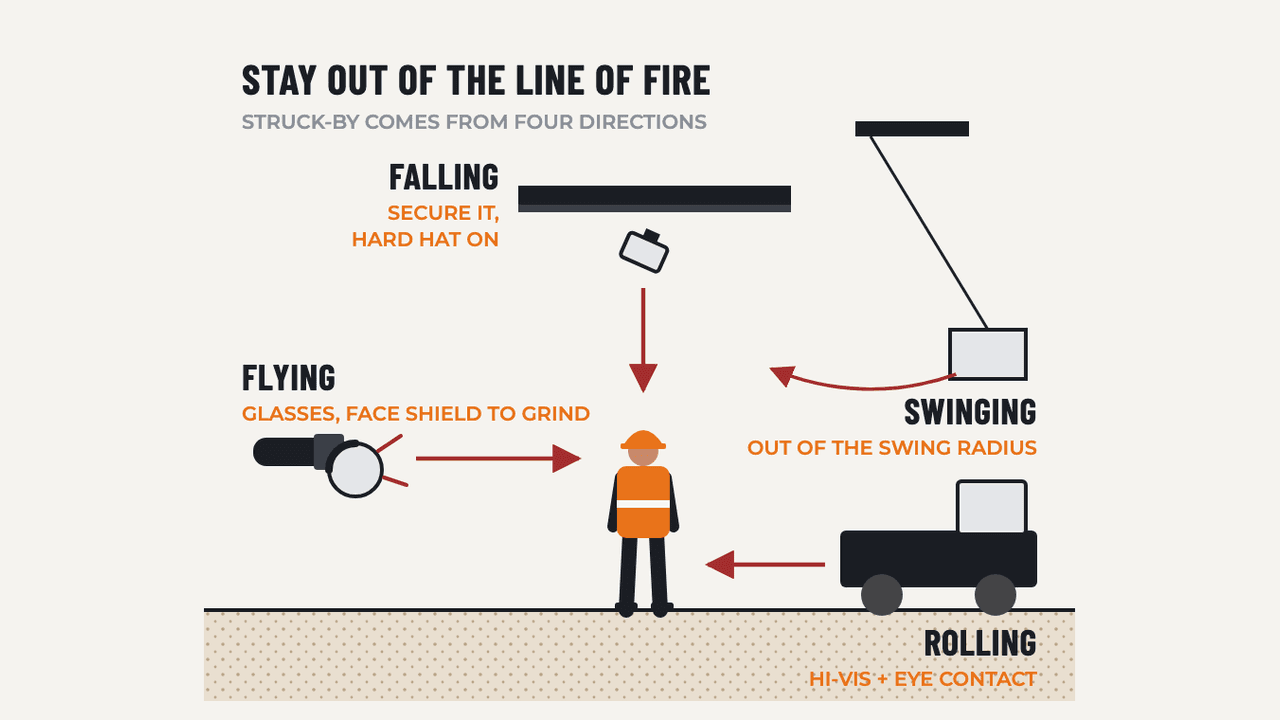
Struck-by incidents are one of construction's Focus Four killers, and they come from four directions: flying objects, falling objects, swinging loads, and rolling vehicles or equipment. Most victims never saw it coming — that's the nature of the hazard. Today's talk covers where each type shows up on our sites and the habits that keep you out of the line of fire.
Flying Objects
- Power tools, grinders, and nail guns throw debris and fasteners
- Safety glasses minimum; face shield over them for grinding and cutting
- Check tool guards before use — a missing guard is a stop-work condition
- Position yourself and others out of the discharge line of nailers and powder-actuated tools
Falling Objects
- Never walk or work under a suspended load — not "quickly," not ever
- Secure tools and materials at height: lanyards, toe boards, netting, containers
- Hard hat on wherever overhead work is happening
- Barricade drop zones below roof, scaffold, and steel work
Swinging Loads
- Stay out of the swing radius of cranes, booms, and excavator counterweights
- Rigging is for qualified riggers; taglines control the load, hands don't
- If you can't see the operator, the operator can't see you
Vehicles & Equipment
- Hi-vis clothing any time you're on foot near equipment or traffic
- Make eye contact with the operator before entering their work zone
- Never position yourself between a vehicle and a fixed object
- Backing equipment needs a spotter — and spotters do nothing else while spotting
- In work zones: stay inside protected areas, watch the traffic side
Key takeaways
- Four directions: flying, falling, swinging, rolling
- Eyes and face protected around tools
- Never under a suspended load
- Secure everything that could drop
- Hi-vis + eye contact around equipment
- Stay out of the line of fire
Questions for your crew
- Struck-by hazards come from four directions: flying, falling, swinging, and rolling objects — know where each shows up on your site.
- Wear safety glasses around tools, and add a face shield over them for grinding and cutting.
- Never walk or work under a suspended load — not quickly, not ever.
- Secure tools and materials at height with lanyards, toe boards, and netting, and barricade drop zones below overhead work.
- Wear hi-vis and make eye contact with the operator before entering any equipment work zone.
- Backing equipment needs a dedicated spotter — and spotters do nothing else while spotting.
Run this talk with crew sign-offs
This talk is part of the Safirst ONE toolbox talk library, in English and Spanish. Your foreman picks the talk in the app, the crew signs from their own phones by scanning a QR code, and the signed record files itself in your Docs Locker. Talk to Safirst to get it for your crews.