Toolbox Talks
Snakes & Rattlesnakes (Arizona) Toolbox Talk
Published · 4 min read
A free, ready-to-run toolbox talk for construction crews. Read it aloud at your morning huddle; it takes about ten minutes. Leer en español →
OSHA standard: General Duty Clause 5(a)(1)
At a glance
- Rattlesnakes live where we work — edges of the site, shade, and stored material
- Look before you reach, step, or sit; use a tool to move debris, never a hand
- Bitten? Stay calm, strip jewelry, hospital NOW — no cutting, sucking, ice, or tourniquets
- Never try to kill or catch one — that's how most bites happen
Introduction
Arizona has more rattlesnake species than any other state, and our jobsites are prime habitat: shade under stored material, cool slab edges on summer mornings, rodents drawn to the trash we generate. Most construction encounters end with everyone leaving — the bites happen when someone reaches blind into a dark space or decides to be the guy who handles it. About 150–250 people are bitten in Arizona every year, and the treatment is measured in vials of antivenom and tens of thousands of dollars. Today's talk covers where they are, how not to meet one, and exactly what to do about a bite.
Where They Are
- Shade and cover: under pallets, plywood stacks, gang boxes, equipment parked overnight, block piles, and trailer skirts
- Temperature drives them: cool mornings they're sunning in the open (including on warm slabs and asphalt); summer heat pushes them into exactly the shade we reach into
- Dawn and dusk in warm months are peak movement — our early summer starts overlap perfectly
- Fresh desert cuts and sites next to washes see the most traffic — the site fence means nothing to them
Don't Meet One
- LOOK before you reach, step over, or sit — the far side of stored material and the shadow side of anything are the blind spots
- Move material with a tool or a kick first: tip the sheet, drag the pallet, THEN pick it up
- Boots above the ankle and long pants — most bites land below the knee or on the hands
- Keep the site unattractive: trash managed (rodents feed snakes), material off the ground where practical, weeds down along fences
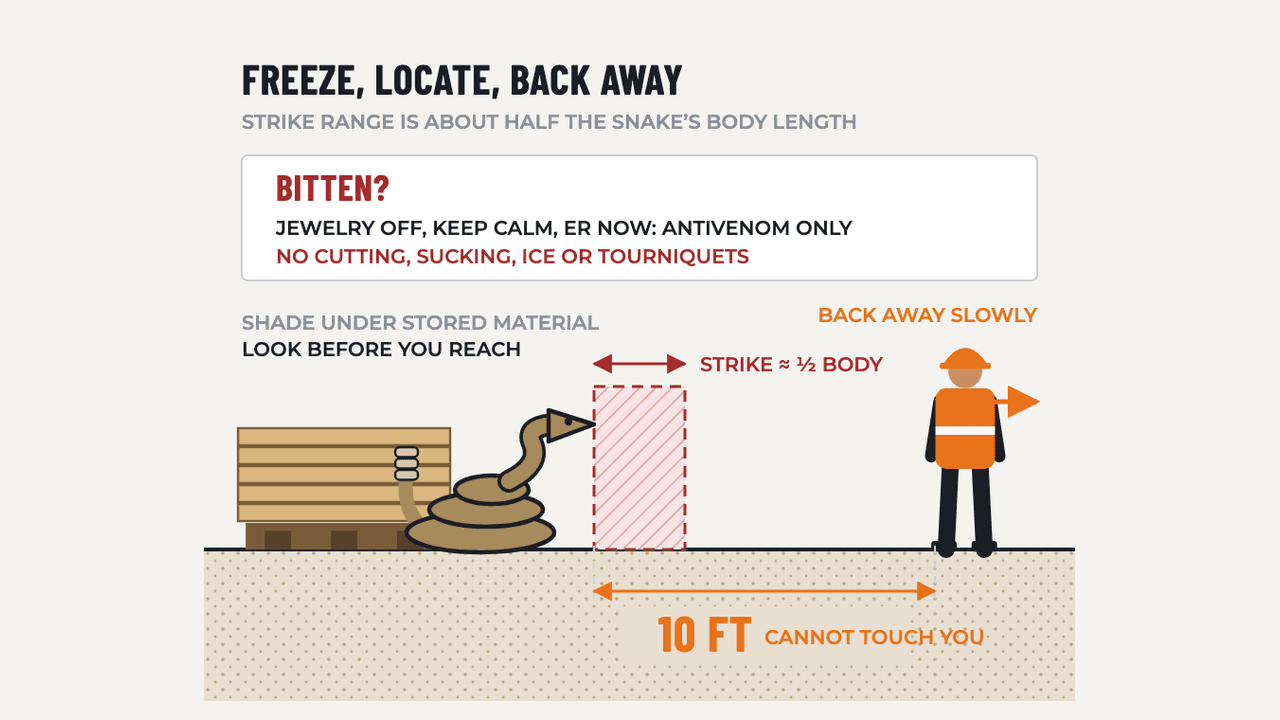
- Hear the buzz or see one? FREEZE, locate it, back away slowly — strike range is about half their body length; ten feet away it cannot touch you
- Flag it, tell the crew, and let it leave or call someone qualified to relocate it — NEVER attempt to kill or catch it; dead ones still envenomate on reflex
If Someone Is Bitten
- Get them and everyone else away from the snake — no revenge hunt, though a phone photo from distance helps the ER
- Call 911 / get moving to the nearest ER immediately — antivenom is the ONLY treatment, and time is tissue
- Remove rings, watches, and tight clothing from the limb NOW, before swelling; keep the limb roughly at heart level, keep them calm and still as transport allows
- DO NOT: cut the wound, suck venom, apply ice, apply a tourniquet, or give alcohol — every one of those makes it worse
- "Dry bites" exist but nobody diagnoses one in the field — every bite goes to the hospital, full speed
Key takeaways
- They're under what we store and beside what we build
- Look, then reach; tool first, hand second
- Freeze, locate, back away — ten feet is safety
- Never kill or catch — that's how bites happen
- Bite = jewelry off, calm, ER now, antivenom only
- No cutting, sucking, ice, or tourniquets — ever
Questions for your crew
- Rattlesnakes live where we work: site edges, shade, and under stored material.
- Look before you reach, step, or sit — and move debris with a tool, never a hand.
- Hear or see one? Freeze, locate it, back away — ten feet is safety.
- Never try to kill or catch a snake — that's how most bites happen.
- Bitten: stay calm, strip rings and watches before the swelling, and get to a hospital NOW — antivenom is the only treatment.
- No cutting, no sucking, no ice, no tourniquets — ever.
Run this talk with crew sign-offs
This talk is part of the Safirst ONE toolbox talk library, in English and Spanish. Your foreman picks the talk in the app, the crew signs from their own phones by scanning a QR code, and the signed record files itself in your Docs Locker. Talk to Safirst to get it for your crews.