Toolbox Talks
Snakes, Bees & Other Insects Toolbox Talk
Published · 4 min read
A free, ready-to-run toolbox talk for construction crews. Read it aloud at your morning huddle; it takes about ten minutes. Leer en español →
OSHA standard: General Duty Clause 5(a)(1)
At a glance
- Arizona's bees are Africanized — they defend in swarms and chase for a quarter mile
- Attacked? RUN in a straight line to a vehicle or building — never jump in water
- Scorpions and black widows live in the same dark gaps as snakes: look, shake, glove up
- Known sting allergy = crew knows, and the epinephrine is on site, not in a car
Introduction
The snake talk covered the famous one; this talk covers everything else out here that stings and bites: Africanized bees that attack in the hundreds when a colony feels a generator's vibration, bark scorpions in the gang box, black widows under the porta-john skirt. Most of these encounters are painful nuisances — until they're a swarm attack or an allergic reaction, both of which are genuine emergencies. Today's talk covers the habits that avoid them and the two responses everyone must know cold: the bee run, and the anaphylaxis signs.
Bees — the Serious One
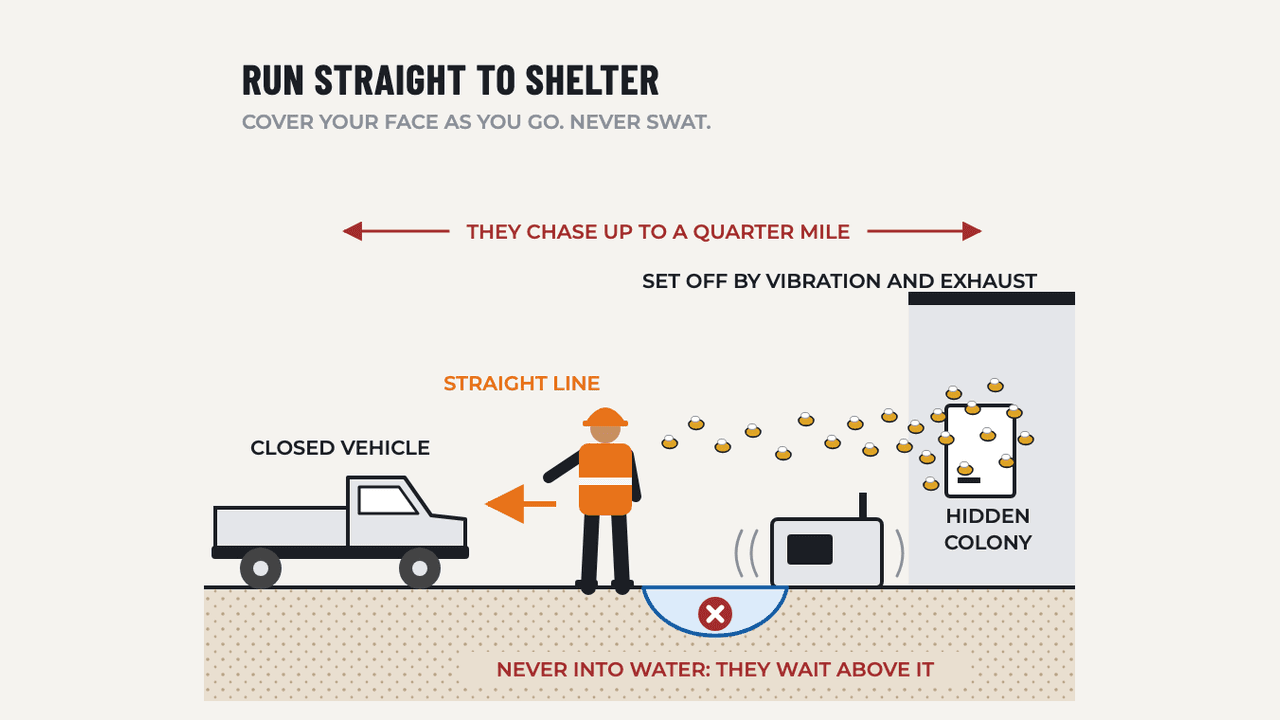
- Assume every wild colony in Arizona is Africanized: they defend a huge radius, attack in numbers, and pursue up to a quarter mile
- They nest in exactly our stuff: wall voids, meter boxes, irrigation valve boxes, junked equipment, block cores, attics under demo
- Triggers: vibration and exhaust — mowers, generators, saws, and equipment idling near a hidden colony start most attacks
- See steady bee traffic in and out of one spot? Mark it, keep the crew and equipment away, and call a professional removal — never spray or plug the hole
- ATTACKED: RUN, straight line, to a closed vehicle or building — cover your face as you go; do NOT swat (crushing releases attack pheromone), do NOT jump in water (they wait above it)
- Once safe: scrape stingers out sideways with a card or knife edge (pinching squeezes more venom in); a person with dozens of stings goes to the ER regardless of how they feel
Scorpions & Spiders
- Bark scorpions — the one that matters medically — climb, cling to the UNDERSIDE of things, and love block, bark, and gang boxes
- Shake out boots, gloves, and clothes left on site; look under anything you flip; leather gloves for blind material handling
- Black widows: messy webs in dark corners — meter boxes, stacked material, under equipment; brown spiders hide in undisturbed storage
- Serious scorpion sting (numbness spreading, muscle twitching, trouble swallowing — especially in smaller adults) or any suspected widow/recluse bite: medical attention, not toughness
Stings & Anaphylaxis
- Normal sting: wash, cold pack, done — but WATCH the person for 30 minutes
- Anaphylaxis: hives beyond the sting site, face or throat swelling, wheezing, dizziness, nausea — this kills in minutes; 911 NOW
- Anyone with a known allergy: the crew knows, the epinephrine auto-injector is ON SITE and reachable, and someone besides them knows how to use it
- Used the epi-pen? They still go to the ER — the reaction can rebound after the shot wears off
Key takeaways
- Steady bee traffic = mark, avoid, call removal — never spray or plug
- Swarm attack: run straight to shelter; never swat, never water
- Scrape stingers sideways; dozens of stings = ER
- Shake out boots and gloves; look under before lifting
- Hives, swelling, wheezing after a sting = 911 immediately
- Known allergies: crew briefed, epi on site, backup trained
Questions for your crew
- Arizona's bees are Africanized — they defend in swarms and chase for a quarter mile.
- Steady bee traffic in or out of a wall, meter box, or valve box: mark it, avoid it, call removal — never spray or plug the hole.
- Swarm attack: RUN in a straight line to a vehicle or building — never swat, and never jump in water.
- Scrape stingers out sideways with a card; dozens of stings means the emergency room.
- Scorpions and black widows live in the same dark gaps — shake out boots and gloves, and look under before lifting.
- Hives, swelling, or wheezing after a sting is 911 immediately — known allergies mean the crew is briefed and epinephrine is on site, not in a car.
Run this talk with crew sign-offs
This talk is part of the Safirst ONE toolbox talk library, in English and Spanish. Your foreman picks the talk in the app, the crew signs from their own phones by scanning a QR code, and the signed record files itself in your Docs Locker. Talk to Safirst to get it for your crews.