Toolbox Talks
Scaffolding Safety Toolbox Talk
Published · 3 min read
A free, ready-to-run toolbox talk for construction crews. Read it aloud at your morning huddle; it takes about ten minutes. Leer en español →
OSHA standard: 29 CFR 1926 Subpart L (1926.451)
At a glance
- Scaffold violations sit in OSHA's most-cited list every year
- Competent person inspects before every shift — check the tag
- Full planking, guardrails, and proper access on every working level
- Never alter a scaffold unless you're authorized to build it
Introduction
Scaffolds put whole crews at height on a temporary structure, which is why scaffolding sits near the top of OSHA's most-cited standards year after year. A scaffold is only as safe as its last inspection and its last unauthorized modification. Today's talk covers what to check before you climb, how to work on one, and the handful of things you never do to a scaffold.
Before You Climb
- A competent person inspects the scaffold before each shift and after weather, impact, or changes — know today's status before you step on
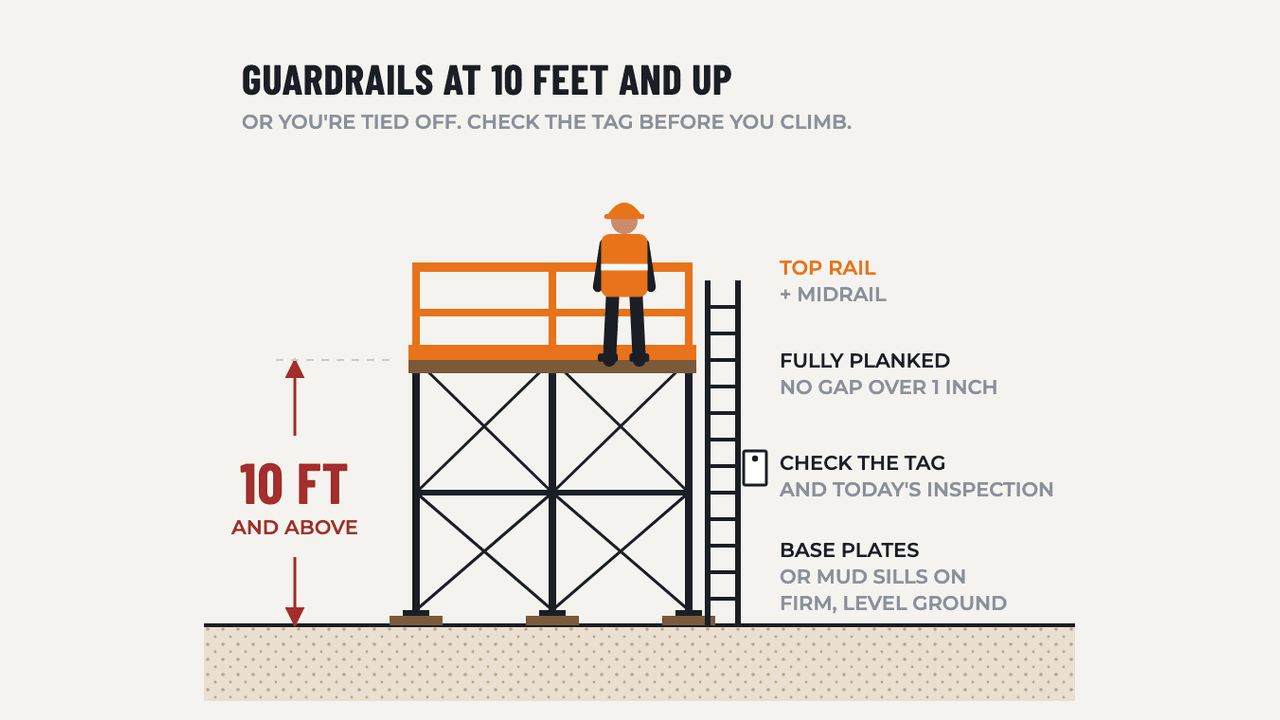
- Base plates or mud sills on firm, level ground; plumb and square; no blocks or bricks under legs
- Platforms fully planked, no gaps over 1 inch at uprights, planks secured against movement
- Guardrails (top rail + midrail) on open sides at 10 feet and above — or you're tied off
- Red tag or incomplete scaffold = stay off, no exceptions
On the Scaffold
- Use the ladder or stair access — never climb cross-braces or frames not designed for climbing
- Never stack boxes, buckets, or ladders on a platform to gain height
- Keep platforms clear: debris, ice, and stored material near edges cause the falls guardrails can't stop
- Know the load rating — workers plus materials plus tools count together
- Falling-object protection below: toe boards, netting, or a barricaded zone
Never
- Never remove braces, planks, ties, or rails — only the scaffold crew modifies a scaffold, and they re-tag it after
- Never work on scaffolds in high wind, storms, or lightning
- Never ride a rolling scaffold; lock all casters before climbing, everyone off before it moves
- Never let a scaffold get within 10 feet of energized power lines
Key takeaways
- Check the tag and today's inspection before climbing
- Full planking, guardrails, proper access — every level
- Climb the access, not the frame
- Nothing on the platform to boost height
- Only the scaffold crew alters a scaffold
- 10 feet from power lines, always
Questions for your crew
- Check the scaffold tag and the competent person's inspection before every climb — red tag or incomplete scaffold means stay off.
- Work only on fully planked platforms, with guardrails or tie-off at 10 feet and above.
- Use the ladder or stair access — never climb frames or cross-braces.
- Never stack boxes or ladders on a platform to gain height, and keep platforms clear of debris.
- Only the scaffold crew alters a scaffold — never remove planks, braces, ties, or rails.
- Keep scaffolds at least 10 feet from power lines, and stay off in high wind and storms.
Run this talk with crew sign-offs
This talk is part of the Safirst ONE toolbox talk library, in English and Spanish. Your foreman picks the talk in the app, the crew signs from their own phones by scanning a QR code, and the signed record files itself in your Docs Locker. Talk to Safirst to get it for your crews.