Pre-Work Planning
Construction Pre-Work Planning Checklist: Plan What Changed
Published · 10 min read

A pre-work planning checklist for construction should be short. Cut every line copied forward from yesterday and keep only what changed since then: the task, the height, the gear, the people, the conditions. The crew answers each changed line out loud before the first task. A list that never changes will never catch nine-foot walls and a four-foot ladder.
That ladder is one of the stories I tell most. Nobody on that crew was careless. The ladder simply couldn't reach the work, so the top step became the plan.
One question at the truck would have caught it before anybody climbed: does the gear we have match the height of the work we're doing today?
Here's what I hear from good foremen. "My guys know the job. We've got the checklist. I run it at the truck every morning and they sign. If somebody still cuts a corner, that's on them."
I disagree.
A signature at the truck proves the sheet went around. It doesn't prove anybody planned the day.
Why does a checklist that's the same every morning plan nothing?
A checklist that's the same every morning plans nothing because nobody has to make a decision to get through it. The crew has seen those exact lines for weeks. Signing becomes muscle memory. A plan is a set of decisions about today's work, and a copied-forward list asks for none.
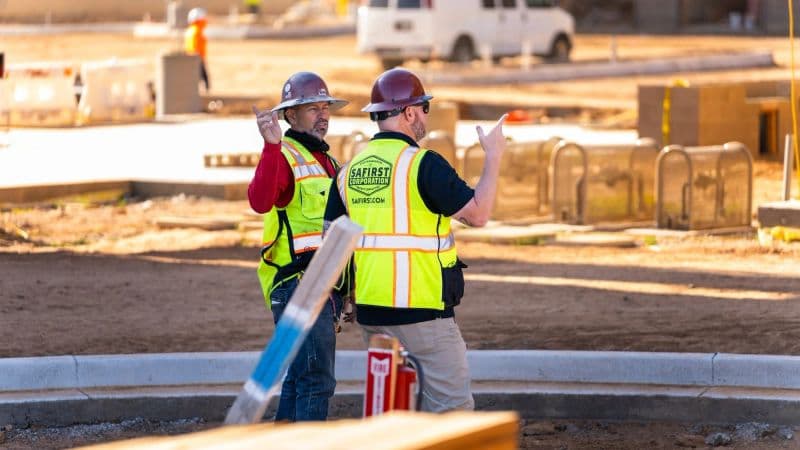
Think about what the guys actually do at the tailgate. The foreman reads, or doesn't. They initial. Coffee. Truck doors. Done in four minutes, and nobody said a word about the work.
That sheet is a good compliance document and a bad plan. I wrote about why those are two different scores in our piece on safety culture vs compliance, and the morning checklist is where the gap shows up first.
Here's a number from our own field work. Ladders alone show up as 389 violations in Safirst inspection data, 2025-2026, logged across 95 Arizona contractor clients between August 2025 and August 2026.
I can't tell you how many of those jobs had a ladder line on the morning sheet. What I can tell you is the line I usually see reads something like "ladders inspected, good condition." A ladder can pass that line and still be the wrong ladder.
Which lines on a pre-work checklist change every morning, and which can you cut?
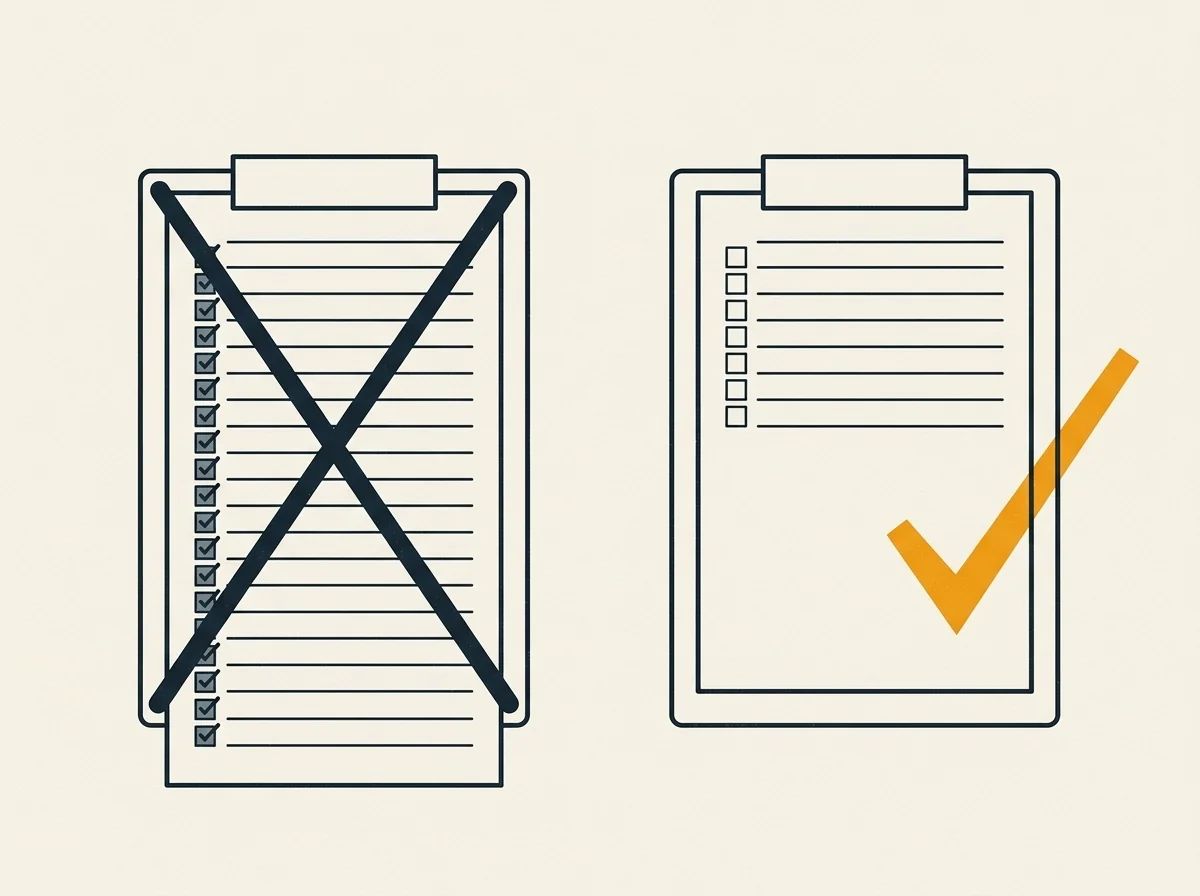
The lines that change every morning are the ones tied to today's work: the task, the height, the gear on hand, who's on the crew, the conditions, and who else is working near you. The lines you can cut from the morning run are standing conditions that were true yesterday and will be true tomorrow. Those belong somewhere else in your program.
Cutting a line from the morning run is not cutting it from your program. It's moving it to where it gets real attention.
| Copied-forward line | Where it lives instead |
|---|---|
| "Hard hats, vests, glasses on" | Site orientation and the standing rule. The foreman corrects it on sight, all day. |
| "First aid kit on site" | Your weekly site inspection |
| "Fire extinguishers in place" | Your periodic extinguisher inspection |
| "SDS binder available" | Job-start setup, checked again when a new product shows up |
| "Housekeeping OK" | The walk. You see it or you don't. |
| "Ladders in good condition" | The competent person's ladder inspection, plus the height line on today's list |
That last row matters. Under 29 CFR 1926.1053(b)(15), ladders have to be inspected by a competent person for visible defects on a periodic basis and after anything that could affect their safe use. A competent person is the person on site who can spot the hazards and has the authority to fix them. That inspection still happens. It just stops pretending to be a plan.
The broader duty sits in 29 CFR 1926.20(b)(2): your safety program has to provide for frequent and regular inspections of the job sites, materials and equipment by competent persons the employer designates. What your own program has to carry, and on what schedule, is a question to put to your safety professional before you cut anything.
Here's the trade-off, stated plainly. A shorter morning list puts more weight on those other inspections. If your weekly walk is already getting skipped, moving lines there just hides them somewhere new. Fix the weekly walk first.
And one case where there's nothing to cut: day one. On a new job or with a new crew, nothing is "same as yesterday." The whole start-up list is changed-today material, so run all of it.
Would a four-foot ladder on nine-foot walls ever show up on a copied-forward checklist?
No. A four-foot ladder on nine-foot walls would sail through a copied-forward checklist, because every standard line checks the ladder by itself. Is it damaged? Is it the right type? Is it set up right? The hazard wasn't in the ladder. It was in the match between the ladder and the work.
That's why the top step became the plan on that job. The guys still had to reach the top of a nine-foot wall. The only way to do it with a four-foot ladder was to stand where you're not supposed to stand.
The rules here aren't fuzzy. 29 CFR 1926.1053(b)(13) says the top or top step of a stepladder shall not be used as a step. And 29 CFR 1926.1053(b)(4) says ladders shall be used only for the purpose they were designed for.
Every guy on that crew probably could have told you not to stand on the top step. Knowing the rule wasn't the gap.
The fix was a six-foot ladder. It cost $200.
We didn't write anybody up. The new ladder came with a plain message: this is an investment in you and the work you're doing. The crew used it right away, with no enforcement. Nobody had to police it, because the right tool removed the reason for the shortcut.
That's the whole argument of this post in one ladder — the hazard lived between the task and the equipment, and only a line asking "what changed today, and does our gear match it?" would have flagged it.
For the gear side, our ladder safety toolbox talk covers picking the right ladder and setting it up, in English and Spanish. It's a good one to run the morning a height changes.
What happens at the first 'we'll just do it this once' on a day the plan didn't cover?
At the first "we'll just do it this once," the shortcut becomes the plan, because nobody made another one. The work gets done, nobody gets hurt, nobody says anything. Next time it comes up, the answer is already decided. Our upcoming piece on why crews take shortcuts lays out that drift step by step, so I won't rerun it here.
What I want you to see is where the changed-today list fits. It doesn't stop at 6:30. When the work changes at 10 a.m., the list runs again.
The re-run is two minutes, standing where the work is:
- Stop the task that changed.
- Ask the one line that moved. New height? New material? Somebody left?
- Decide what the crew does instead, out loud, before anybody goes back up.
A foreman who re-runs one line at 10 a.m. is holding his guys to a plan they already agreed to. A foreman who invents a rule in the middle of a delay is picking a fight by himself. The list gives him something to point at.
Here's the limit. If the gear you need isn't on site at all, no huddle fixes it. That's a purchasing call for whoever runs the job, and the foreman sends it up the chain that morning. The ladder story worked because somebody above the foreman spent the $200.
What does a one-page changed-today list look like, and who writes it?
A changed-today list is one page, seven questions, and three signature lines. The foreman drafts it the afternoon before from tomorrow's task list, so he walks up to the truck with the changes already named. The crew answers each line out loud in the morning. The competent person signs that the gear matches the work.
Here's the full list. Copy it, print it, use it tomorrow.
Changed-today list
Date: ______ Job: ______ Foreman: ______ Competent person: ______
- Task. What are we doing today that we didn't do yesterday? What's the first step?
- Height. What height is the work today, and what are we standing on to reach it? Does it reach without the top step? Extension ladders used to reach an upper landing extend at least 3 feet above it, per 29 CFR 1926.1053(b)(1).
- Gear. What arrived, left or broke since yesterday? Does what we have match the work in lines 1 and 2?
- People. Who's new on the crew, or new to this task? Who's partnered with them?
- Conditions. What's different about heat, wind, ground, light or access?
- Neighbors. Who else is working above, below or beside us today, and what are they doing?
- Stop. If one of these changes mid-shift, who calls the stop, and where do we re-huddle?
Foreman signature: ______ Competent person signature: ______ Crew initials: ______
Two rules make the list work.
"Same as yesterday" is a valid answer only after somebody walked it this morning. Say who.
Somebody on the crew answers each line, not the foreman. If the foreman reads the questions and also answers them, you're back to a checklist.
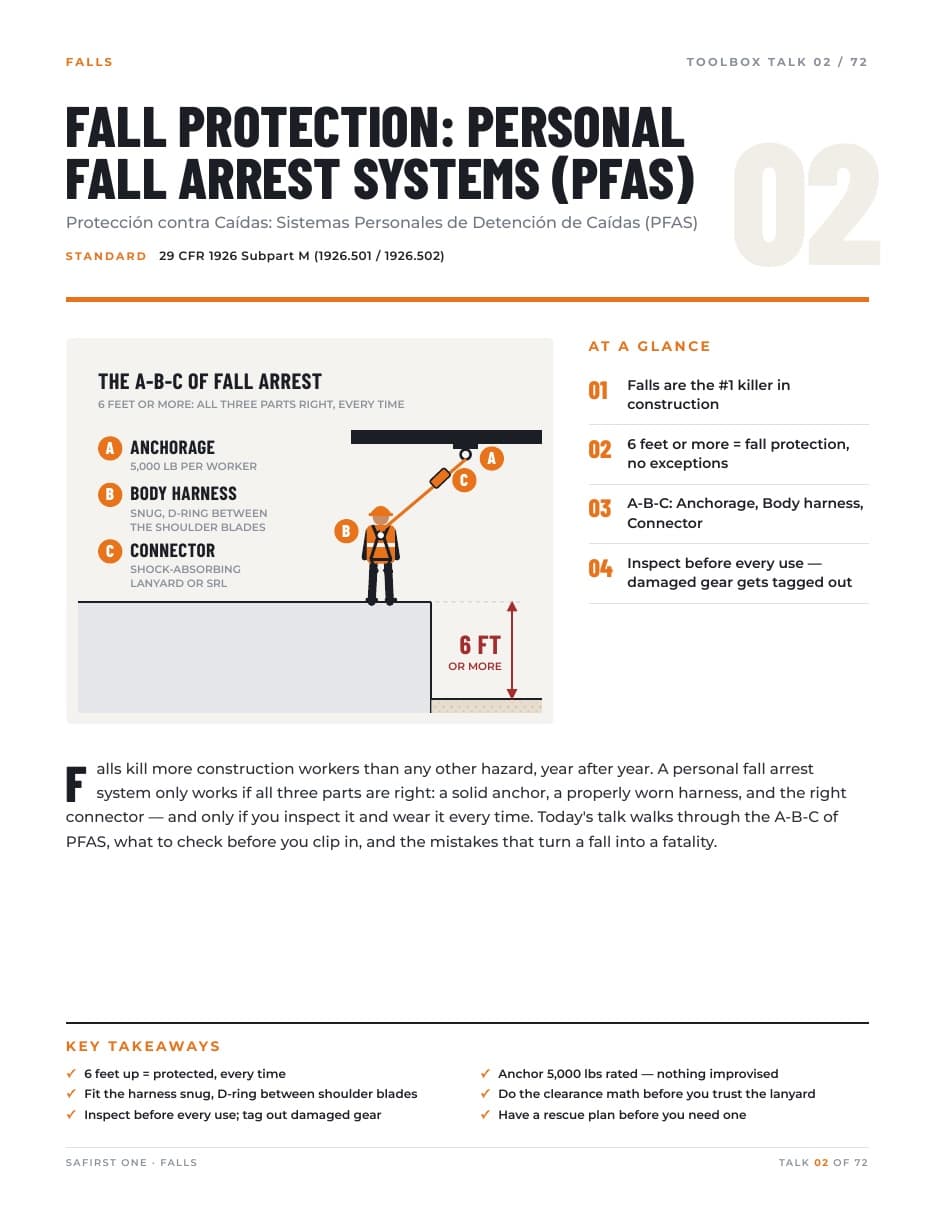
If the work is at an open edge, line 2 is also where fall protection gets decided. Our personal fall arrest systems toolbox talk is the one I'd run next to it.
Run the changed-today list on every crew
One foreman running seven questions with one crew is easy. Twelve crews on five jobs is a different job. Somebody has to make sure every list got written, every changed line got a real answer, and every signed sheet lands where an inspector can find it.
Most contractors try to carry that on one safety person and a truck full of paper. Safirst ONE is how foremen pre-plan daily operations, crews report hazards without fear, and leaders build safety culture at scale. Your foreman spends the morning on the questions, not the filing.
If you'd rather start with a second set of eyes, ask us out to walk one of your jobs with your foreman.
This week, pull five days of your morning sheets and highlight every line that read the same Monday through Friday. That's your cut list. Whatever's left is where your crew has actually been planning.
Frequently asked questions
In my view, a changed-today list runs in about ten to fifteen minutes at the truck, and less on a quiet day when fewer lines moved. If it's taking thirty, the foreman is answering questions he should have drafted the afternoon before. If it's taking three, nobody on the crew is talking. The clock is a check on whether the crew is actually answering, so watch who speaks, not the minutes.
Keep it. A dated sheet with the foreman's, the competent person's and the crew's marks is the record that a plan happened that morning, and it's the first thing you'll want if something goes wrong on that job. Store it with the job file, not in the truck. How long your company holds those sheets is a program decision, so consult your safety professional and write the answer into your program.