Toolbox Talks
Powder-Actuated Tools Toolbox Talk
Published · 3 min read
A free, ready-to-run toolbox talk for construction crews. Read it aloud at your morning huddle; it takes about ten minutes. Leer en español →
OSHA standard: 29 CFR 1926.302(e)
At a glance
- Certified, carded operators only — this is a licensed tool
- It fires a fastener with a gunpowder charge: all firearm rules apply
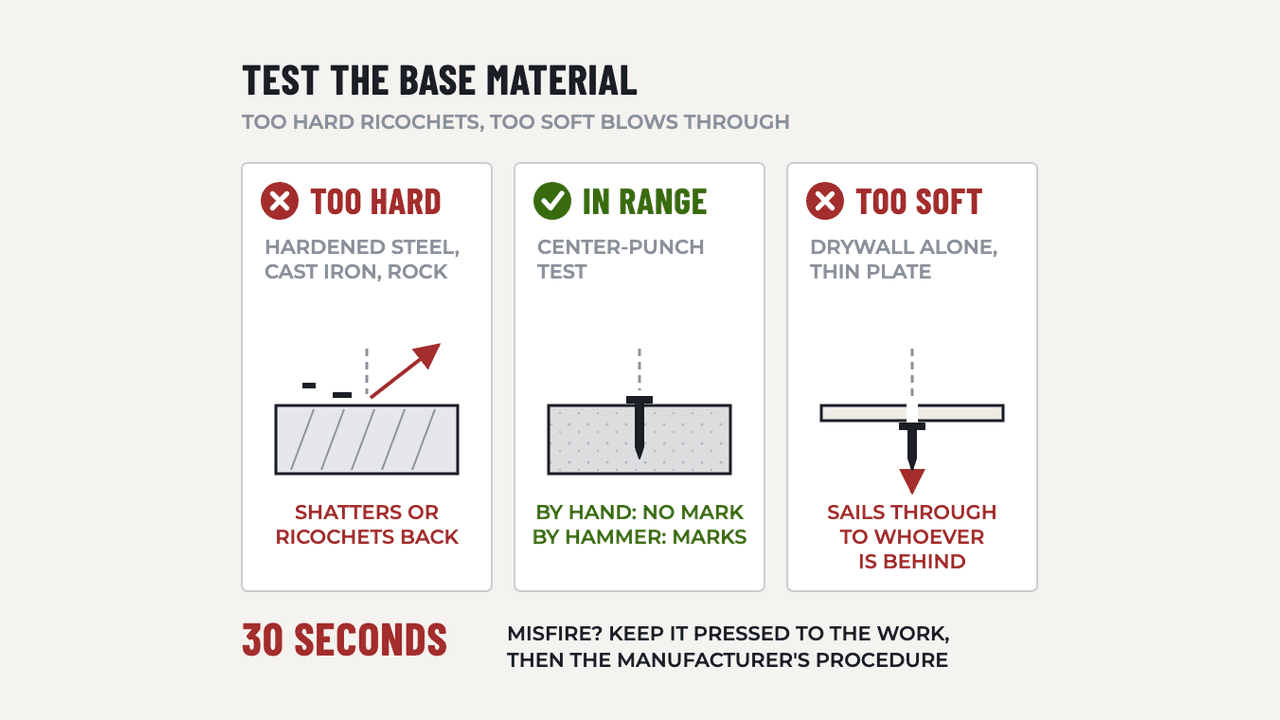
- Know your base material — too hard ricochets, too soft blows through
- Misfire? Hold 30 seconds against the work, then follow the manufacturer's drill
Introduction
A powder-actuated tool drives fasteners into concrete and steel using an actual gunpowder charge — which is why OSHA requires operators to be trained and certified on the specific tool, carrying the card to prove it. These tools hurt people two ways: fasteners that go through or bounce off the base material, and casual handling of what is functionally a single-shot firearm. Today's talk covers who may shoot, what to shoot into, and the misfire routine.
Who and What
- Certified operators only, carrying the certification card for THAT class of tool — no card, no shooting, no exceptions
- Inspect the tool daily per the manufacturer: barrel clear, moving parts free, safety functional
- Use the fastener, charge level, and shield the chart calls for — more powder is not better fastening
- Store tools and charges locked up, unloaded, and never leave a loaded tool unattended — charges stay in their marked containers
The Base Material Test
- Too hard (hardened steel, cast iron, glazed tile, rock): the fastener shatters or ricochets back
- Too soft or thin (drywall alone, thin plate): the fastener sails through to whatever — whoever — is behind
- Center-punch test: if a fastener pressed by hand won't mark the surface but a hammer blow does, you're in range
- Keep required edge distances and spacing — close to an edge, concrete spalls and the fastener escapes sideways
Firing Discipline
- Load at the work, fire promptly — never walk around with a loaded tool, never point it at anyone, loaded or not
- Tool perpendicular and pressed firmly against the work; never hand-hold the workpiece
- Nobody on the other side of the wall or deck in the fastener's line
- Hearing and eye protection — it is literally a gunshot
Misfires
- Keep the tool pressed against the work for 30 seconds — hang-fires are real
- Then follow the manufacturer's unloading procedure exactly; never pry a live charge out with a knife
- Misfired charges go in a marked container, not the trash and not your pocket
- A tool that misfires repeatedly comes out of service
Key takeaways
- Card in pocket or tool stays in the box
- Right charge, right fastener, right shield — per chart
- Test the base material before the first shot
- Load at the work; muzzle discipline always
- Misfire: 30 seconds pressed, then the book
- Locked storage for tools and charges
Run this talk with crew sign-offs
This talk is part of the Safirst ONE toolbox talk library, in English and Spanish. Your foreman picks the talk in the app, the crew signs from their own phones by scanning a QR code, and the signed record files itself in your Docs Locker. Talk to Safirst to get it for your crews.