

Across 95 Arizona contractor clients we inspected between August 2025 and August 2026, fall protection came back 825 times. Ladders and rebar combined came back 715. Your ADOSH exposure is not spread evenly across dozens of rules. It piles onto one habit your crews already know.
So here is the claim, and you can check it against your own paperwork by Friday. You do not have a code-knowledge problem. You have one habit failing a few hundred times a year and several others barely failing at all.
A checklist that weights every rule the same spends your foreman’s attention on the parts already going fine.
What Does ADOSH Actually Cite Most on Arizona Jobsites?
I can’t hand you ADOSH’s docket. I can hand you ours. Across 95 Arizona contractor clients, August 2025 through August 2026, fall protection was flagged 825 times, ladders 389, rebar 326. Fall protection by itself outweighs the other two put together by 110 findings.
| What we checked | Violations found, Aug 2025 to Aug 2026 |
|---|---|
| Fall protection | 825 |
| Ladders | 389 |
| Rebar impalement guarding | 326 |
That dataset just closed its first full year, so it’s the freshest count I have of what actually turns up out here.
Read it for what it is. Those are our inspection findings, not ADOSH citations. A state inspector’s docket and a consultant’s field log are two different records, and I’m not going to pretend otherwise.
We are walking Arizona jobsites against the same book ADOSH works from, though.
ADOSH is "the division of occupational safety and health within the commission," and the commission is the Industrial Commission of Arizona (A.R.S. 23-401). Arizona builds its standards out of the federal ones. A.R.S. 23-410 directs the division to "propose adoption of national consensus standards or federal standards or draft such rules as it considers necessary."
Federal law lets a state run its own program only where its standards "are or will be at least as effective in providing safe and healthful employment and places of employment" as the federal ones (29 U.S.C. 667(c)(2)).
The duty sitting on you is state law. A.R.S. 23-403(A) requires each employer to furnish employment and a place of employment "free from recognized hazards that are causing or are likely to cause death or serious physical harm."
Heat ran the other direction in the same window: 2,471 compliant observations. Arizona contractors are doing something right there, and heat illness prevention in Arizona is getting its own article.
Why Does Fall Protection Outnumber Rebar and Ladder Violations Combined?
Because tying off is a decision a man remakes every time he moves, and guarding rebar is a decision somebody makes once. Fall protection is the only item on that list that has to be re-chosen all day, by every guy, with nobody watching. That is how a number gets to 825.
Look at the shape of that number instead of the size. 825 findings across 95 contractors over twelve months is not one catastrophic jobsite. It is a small failure repeating on ordinary days, on ordinary crews, at ordinary heights.
The trigger height is not obscure. 29 CFR 1926.501(b)(1) says an employee on a walking/working surface with an unprotected side or edge "which is 6 feet (1.8 m) or more above a lower level shall be protected" by guardrail systems, safety net systems, or personal fall arrest systems.
Six feet. Nobody skips a tie-off because the number is hard to remember.
That was never the hard part.
Doing an inspection in the middle of Phoenix, I saw a crew working the exterior top plate thirty feet in the air. None of them were tied off.
I pulled the foreman aside afterward. He admitted he was intimidated, too intimidated to enforce the rule, because he knew how his guys would respond.
That is what 825 looks like from the inside. Not defiance. One man holding a line with nobody standing behind him.
Your checklist has a box for fall protection and no box for that. So does mine. The gap between a clean audit and a safe crew is where the count comes from.
Here’s where I part with how most programs answer a number like this. They write another rule. A rule already existed at every single one of those 825 findings. What didn’t exist was somebody with the standing to hold it at 6:45 in the morning.
Ask a different question on your next walk. Not "is this crew tied off." Ask how many separate times today each man has to decide to be. On a deck with one anchor forty feet away, the answer is a dozen, and every one of them is a chance for your number to move.
The categories bleed together too, which is another reason a flat checklist misleads you. 1926.501(b)(5) files rebar under fall protection: "Each employee on the face of formwork or reinforcing steel shall be protected from falling 6 feet (1.8 m) or more to lower levels."
A rebar mat is a fall hazard and an impalement hazard at the same time. Your checklist counts it once.
How a foreman actually holds that line in front of his guys is its own article, on fall protection compliance for foremen. It isn’t published yet. The piece that comes before it is the ten-minute tailgate huddle, where today’s anchor points get named out loud before anybody climbs.
Why Did Ladders Turn Up 389 Times on Jobs That Looked Fine?
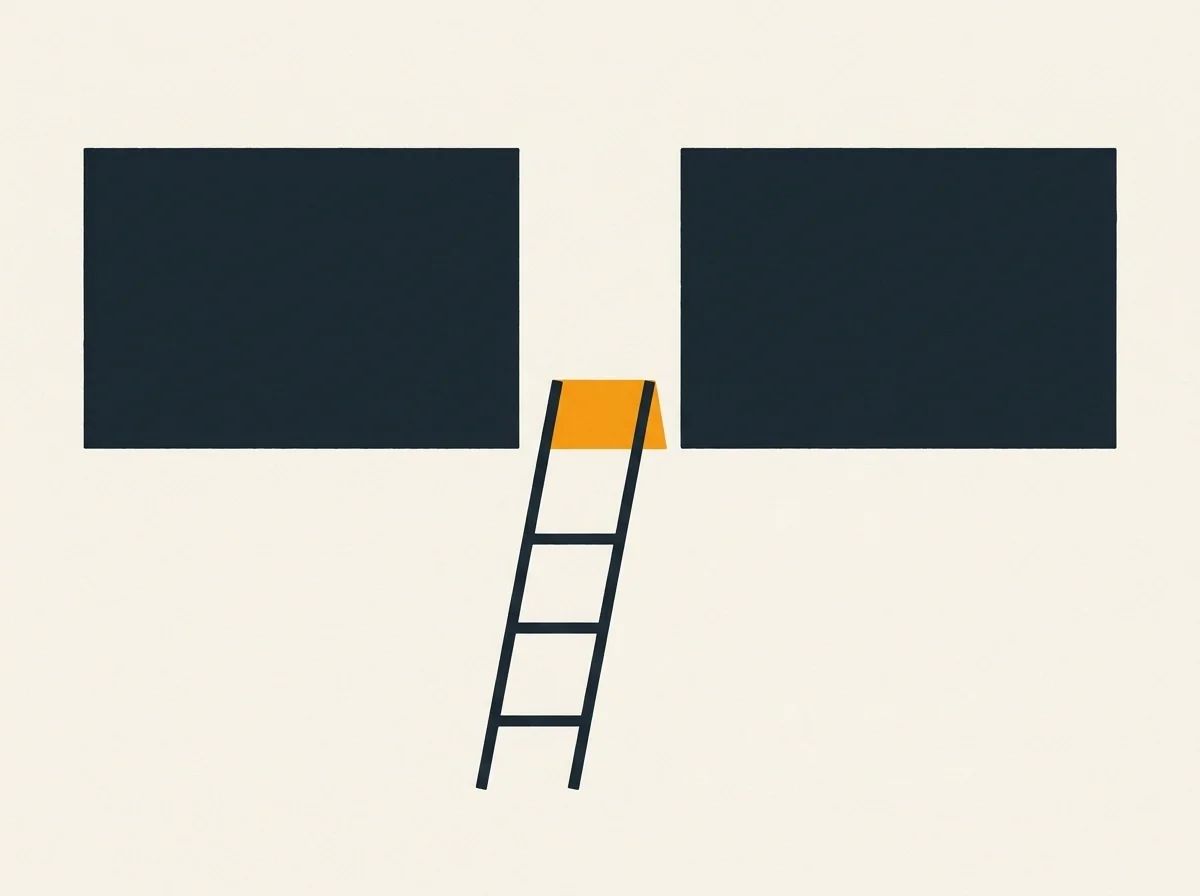
Because the ladder on the truck was the wrong length and the work happened anyway. Look behind a ladder finding and you generally find a purchasing decision, not a discipline problem. The guy is up on the top step because the equipment you bought him cannot reach the work.
I walked a job with 4-foot ladders going against 9-foot walls.
Do that arithmetic before you write anybody up. 29 CFR 1926.1053(b)(1) requires that when portable ladders are used for access to an upper landing surface, "the ladder side rails shall extend at least 3 feet (.9 m) above the upper landing" surface. The same section adds that "Ladders shall be used only for the purpose for which they were designed."
A 4-foot ladder at a 9-foot wall fails both of those before a boot touches it.
There’s a second reason ladders show up on jobs that otherwise look clean. A ladder is the one piece of fall equipment nobody is assigned. Harnesses get issued to a name. Guardrails get installed and inspected. Ladders just appear on the truck, get borrowed between crews, and nobody owns the decision about which one goes where.
That job’s fix cost $200. A 6-foot ladder, handed over as an investment in the guys instead of a correction of them. Adoption was immediate and nobody had to enforce anything.
Cheapest culture win on this whole list.
The top-two-steps rule and what it actually says is getting a dedicated article, not published yet. Until then: measure the wall, then buy the ladder.
What Are the 1,416 Compliant Rebar Sites Doing Differently?
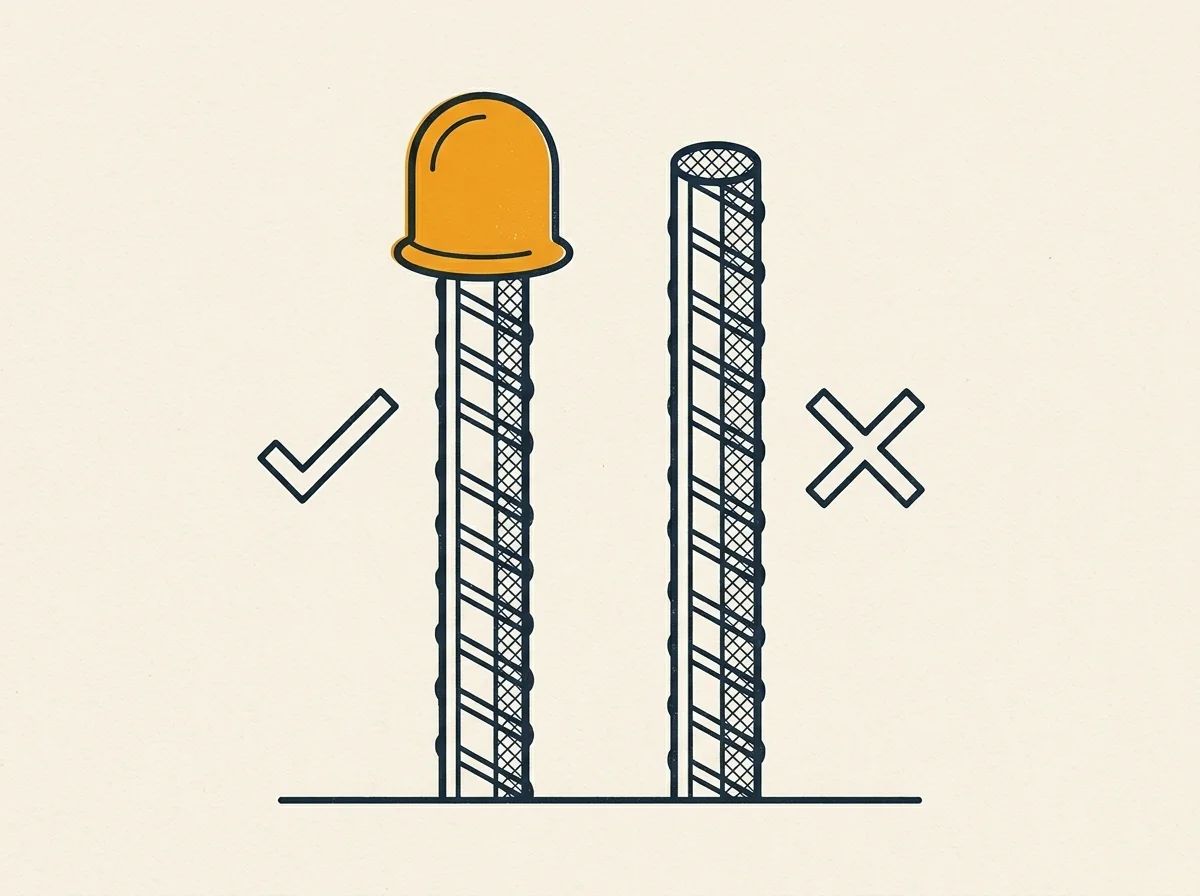
Rebar is the one category where compliance wins outright. 1,416 compliant sites against 326 violation sites, a 4.3x cut. The difference is not crew discipline. Guarding rebar is a purchase somebody makes once, and everyone on the job can see whether it happened.
29 CFR 1926.701(b) is one sentence long: "All protruding reinforcing steel, onto and into which employees could fall, shall be guarded to eliminate the hazard of impalement."
Sit with that 4.3x for a second. Same crews, same foremen, same companies as the 825. One hazard gets guarded far more often than it gets missed. The other gets missed 825 times in the same twelve months. The difference isn’t the people.
The 326 are where it gets interesting. I walked a site with hundreds of sticks of exposed rebar. The crews knew. Nobody had reported it.
Not one guy wanted to be the snitch — and that, not the rebar, is the actual failure.
Guarding it would have run somewhere between $2,000 and $5,000. On the other side of that decision is $165,514, OSHA’s 2026 maximum for a willful violation.
The math is easy. The reporting was the hard part.
So we handed the crews a sentence they could use. You can ALWAYS call safety or tell your foreman. What you can’t do is ignore it.
No judgment. No retaliation. No choice between loyalty and safety.
That sentence is what separates a 1,416 site from a 326 site, and it costs nothing to say.
Cap types and exactly when guarding is required are getting their own piece on rebar guarding standards. Also not published yet.
Where Does Your Crew Fall in the 95-Contractor Snapshot?
Pull your last twenty inspection reports and sort every finding into four buckets: fall protection, ladders, rebar, everything else. If fall protection is more than half, you match the snapshot, and you have one problem to work instead of thirty.
Four moves, in order:
- Count. Twenty reports, four buckets, one afternoon. Write the number down so you can compare it in ninety days.
- Put the task next to every fall protection finding. Top plate, deck edge, rebar mat, ladder access. Tasks repeat. That repetition is your real exposure, not the total.
- Take the ladder count to whoever buys ladders. Not to the crew. Bring the wall heights with you.
- Say the permission line out loud at one huddle this week. In English and Spanish if that’s your crew. Then watch what gets reported over the next two weeks.
Concentrating on one habit is not permission to stop looking at the rest, and this is where the argument gets abused.
Our numbers have a hole in them and you should know where it is. We counted what our inspectors were on site to see, on the days we were there. A category nobody is checking will never top a list like this. And 2,471 compliant heat observations describe one Arizona year, not a promise about the next one.
None of this is legal advice about your program. Consult your safety professional on what you have to abate, how fast, and what you hold on file afterward.
One person can sort twenty reports on a Thursday. Sorting them every month, across every crew you run, chasing the signatures and filing the records behind them, is a job somebody has to be paid to do. Safirst ONE is the system that does that team’s work, so your foremen get the conversation and not the filing.
If you’d rather start with one job and a second set of eyes, we’ll come walk it with you.
Sort the reports this week. Then take the biggest number to the foreman it belongs to and ask him what he needs, not what he missed.